




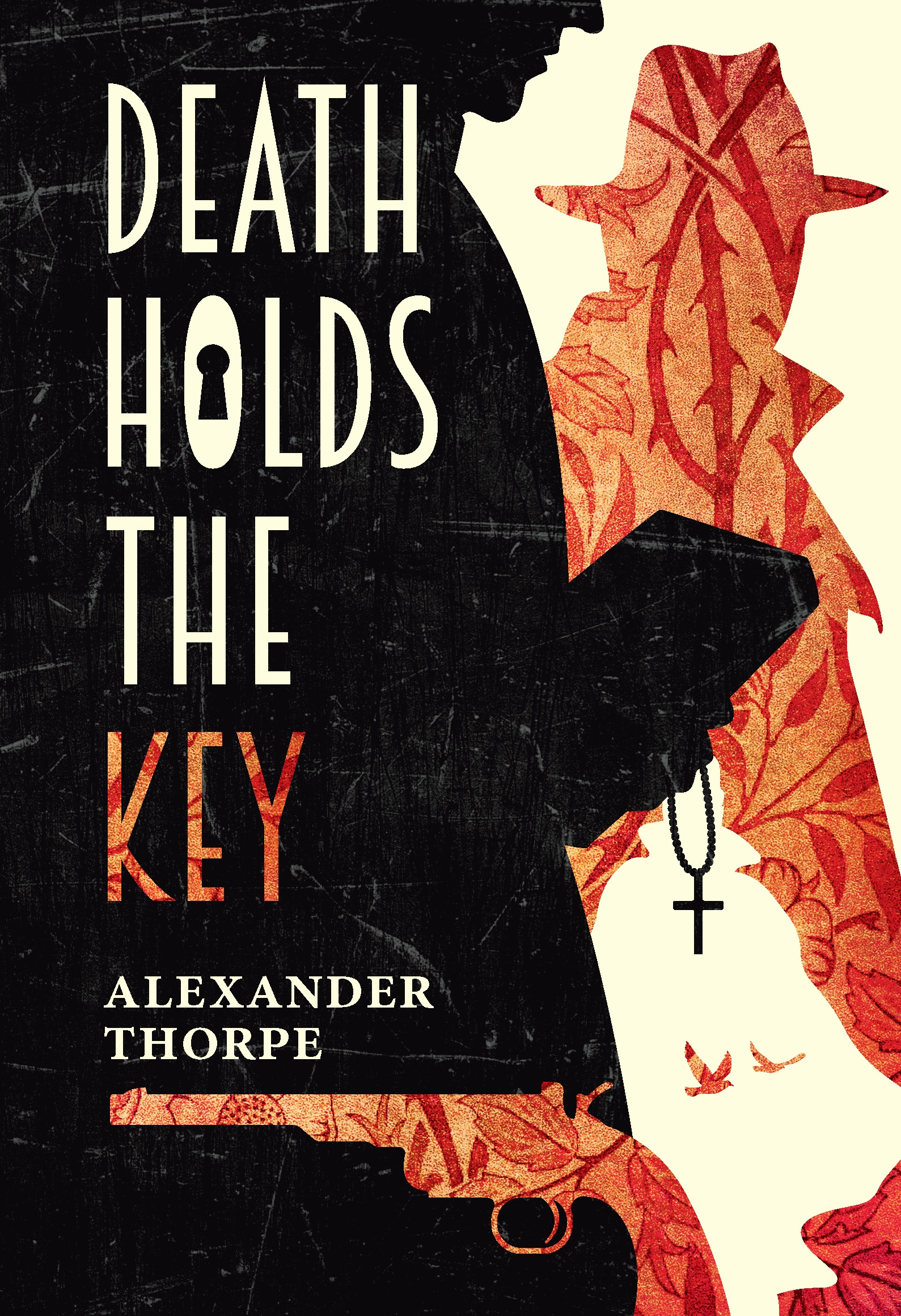
Set in a small Australian town in the 1920s, lose yourself in Alexander Thorpe’s latest cosy crime mystery. In the true tradition of parlour-room reveals, it’s a thrilling ride right to the shocking and satisfying conclusion.
When loathed landholder Fred O’Donnell is found dead in a locked room with a bullet in his chest, rookie Detective Hartley must seek help from a mysterious wanderer to solve the case. And it’s one where everyone, including his family, has a motive and a secret to keep.
Featuring the mendicant monk from Thorpe’s previous novel, Death Leaves the Station, readers will be drawn into the world of small-town Western Australia in the late 1920s, delighting in the characters as they navigate the strained sensibilities and dark secrets of the past.
Full of twists and turns, this seemingly impossible murder mystery is cosy crime writing at its finest.



(5/5)
A boyish detective out of his comfort zone, a family with secrets, a murder in a locked room and a mysterious mendicant. These are some of the delicious ingredients of a cosy, playfully written murder mystery.
Detective Constable Jamie Hartley is seemingly out of his depth and sinking fast when he meets the mendicant friar. Hartley has heard of the friar by reputation as he had successfully helped police solve other crimes and is relieved when the friar agrees to assist him.
The author combines a rich storyline with concise descriptions to keep the dynamics moving along crisply. Each member of the family is painted large and there would appear to be no shortage of potential murderers. New characters are introduced seamlessly and added to the melting pot of mystery and confusion.
This period whodunit also explores societal pressures such as children born out of wedlock and being gay. I did wonder whether the characters reactions to these was of the period as they seem more in keeping with today’s responses. This was a great read with a very satisfactory ending.
(5/5)
Growing up, I developed a great love and appreciation of whodunits. Mysterious deaths, a motley cast of characters with secrets and obvious motives, key clues buried in very ordinary conversations with suspects etc etc. This new work by Alexander Thorpe delivers these key things in spades. I thoroughly enjoyed reading this, and it was a breath of fresh air after I’d been stumbling around for some time reading a bunch of unsatisfying random selections from my local library. This had my close attention and I finished it quite quickly. The pairing of the two investigators works well, the central 1920s setting in rural WA seems very authentic and the narrative moves along at a tidy pace. Realistically, I can see a Marple-style movie coming from this novel. I’ll keep my eye out for further efforts from this author.
(5/5)
I read this page-turner over the course of a weekend. Once started, it was hard to put down and it certainly keeps the reader guessing until the very end. I’ve not read any novels by Thorpe before but enjoyed the ease of language and the constant addition of clues and intrigue. I definitely recommend this for lovers of period crime!
(5/5)
Well what a lovely surprise. A whimsical witty tale a cross between Agatha Christie and Kerry Greenwood with modern morality thrown in. The glimpse of a bygone Western Australia for an ex Pom like me was enlightening and I couldn’t put it down. I found myself determined to solve it before either our bumbling detective or mendicant friar. The use of the Poirot denouement was well done and convincing. The characters themselves were plausible even though the odd one was slightly irritating.
As a passionate reader of the genre yes I did solve it before the end, but even so it was a great entertaining read. I loved the stylised language and the classical references from our educated friar. Three cheers to Alexander Thorpe.
(4/5)
Death holds The Key is a crime thriller that pulls no punches when getting to the nitty gritty. A classic Who Done it ?
It is Detective Jamie Hartley has been sent to the remote area of Kojonup to investigate the death of respected local farmer Fred O’Donnell found in his study with the classic bullet hole to his chest. He is determined to make a good impression as he is on his first case which will have him questioning whether Fred O’Donnell was really the beloved character he has been made out to be.
Fred had plenty of enemies that would love to see the old man six feet under, however it seems that there is also an unwanted stranger that has appeared clothed in black. It seems that in Kojonup there are so many suspects Detective Hartley will need to keep his wits about him in case he is the next target with a bullet lined up to take him out.
Gripping yarn in the best possible way. Just the book to spend afternoons huddled down and trying to work out what is happening and who has the means and motive.
(4/5)
I enjoyed this book by Alexander Thorpe. I found the characters engaging and I felt I understood their motives. Pace of this book was great – enough to keep me interested and wanting to read ‘just one more page’ before putting it down.
Although at times I found the vocabulary was a little wordy, I admit to having to google what a mendicant monk was! I found it a great read and I would happily recommend.
(4/5)
Alexander Thorpe’s most recent book is indeed the cosy murder mystery. A seemingly impossible scenario of a dead man in a locked room serves as the central foundation. Layered over the mystery are the living characters and their individual stories which provide so much of the charm and intrigue for this novel. With each page turn the author has nicely paced the incremental reveal of the characters, tantalising the reader with enough of the who and suggesting a potential of when, yet retaining most of the how and why to maintain intrigue until the final chapters of the novel. An unexpected bonus was the careful use of humour, with certain characters, and there were moments that elicited a laugh aloud providing a nice surprise for the reader. The characters were believable, interesting, flawed, yet ultimately good people living life as best they could.
It was refreshing to read a modern take on the cosy murder mystery. This book should be close by when on a weekend getaway, a holiday, or by the bed in a busy week as it is an easy to read, nicely paced intriguing story laced with some good old-fashioned escapism.
(4/5)
Death Holds the Key by Alexander Thorpe is the second in the series featuring a mendicant monk. I’d originally assumed the detective (Detective Hartley) to be the main character but given he quickly tells us of his lack of experience and potential ineptitude, I was glad someone else was on hand.
I found the narrative here a bit wordy in parts though the verbose prose may be in keeping with the more formal language of the time, particularly that of the learned friar.
I liked the cast of characters Thorpe offers, mainly comprising our suspect pool – those living with Fred. He manages to give each of them their own nuance, offering insight into their character.
The early part of the investigation was glossed over which frustrated me. The detective is there at the time of the murder but then we move forward three days, during which time he’s made no progress and haven’t been privy to any of his evidence-gathering.
It’s not until Hartley invites the monk to join the investigation that readers are present as suspects are questioned. Fred was universally disliked so they are plentiful but we end up dipping into Fred’s past and are given glimpses of how he became the man he was. And on that journey we learn a bit more about the friar and how he separated from his past profession.
(4/5)
Death Holds the Key is a very good read, it keeps you guessing right up until the end. Whilst reading, you are often left wondering how everything will tie into the eventual conclusion, and very cleverly all the pieces fit neatly into the ending.
Alexander Thorpe does a wonderful job of depicting the scenes without over explaining allowing the reader to picture the scenes without getting lost in the details. A very compelling read, that will have you engrossed until the very last page.
(4/5)
The death of unpopular family member, Fred O’Donnell, in a locked room sets the scene for the next mystery for the mendicant monk who aids rookie Detective Hartley. While the murderer first appears to be a ghost, Hartley grapples with his first case, desperate to unravel the mystery. However, the observant monk seems to add to Hartley’s confusion with his unusual questions, to which the detective slowly becomes accustomed, and recognises their value to rethink what is being revealed.
Solving the mystery develops at a steady pace, with subtle clues and several amusing scenes (the one in which Hartley attempts to make an arrest at night nearly made me laugh aloud while on the train). The narrative strikes a balance though, delving into the victim’s background, societal norms of the era, and the treatment and status of Indigenous people.
I had not read the previous novel in this series, but certainly intend to now. Thanks to Good Reading magazine for this copy – I genuinely enjoyed reading this.
(4/5)
Death Holds the Key is the second of a proposed series of four books written by Alexander Thorpe. It features a nameless, mendicant monk, helping in this case a rather clumsy, sometimes troubled, sensitive young police detective named James (call me Jamie) Hartley. His task is to solve the murder of a man found shot in a room locked from the inside, in his family home. Set in 1920s rural Western Australia, as in all classic mysteries it is filled with a cast of characters who may turn out to be more than they present or appear to be. The history, personality, and intentions of the people on the farm are revealed. The focus is on how the patriarch met his death, and who was involved. The author cleverly weaves the story of this inter-generational farm with matters that still echo nearly a hundred years later – family inheritance, the treatment of women, mental health, Aboriginal people, immigration, and isolation. Throw in some red herrings, plus the aftermath of war, epidemics, and the ultimate value of family loyalties, this author’s love for, and mastery of the English language shines through. I look forward to number three in this series.
(4/5)
What do you get when you combine murder in a rural 1920s, Western Australian small-town with a quirky, nomadic monk, a vengeful ghost, and a rookie cop on his first case? A cosy, historical murder mystery set in a gossip-filled Australian farming community following in the footsteps of Christie’s Poirot and C K Chesterton’s Father Brown.
Newly minted police officer, Detective Hartley, is on his first assignment to investigate a mysterious prowler at a family home. But when the town’s most hated landowner, Fred O’Donnell, is found shot dead in a locked room, puzzled detective Hartley joins forces with the nameless peripatetic monk to help solve the crime. However, with such a despised victim, narrowing the pool of suspects is no easy feat and every character has a motive.
The British, crime-drama inspired unlikely team of priest and cop are led in many directions through the town’s dark secrets, albeit with many humorous, light touches. Death Holds the Key is the second in book in a series of four, featuring the monk from Alexander Thorpe’s first novel Death Leaves the Station. Full of unexpected twists and turns, this page-turner to keep you guessing until the end.
(4/5)
It is the late 1920s and a newly inducted detective is sent from Perth to a remote outback station to investigate some unexplained sightings. He is met in a nearby town by a family member to be taken to the property, but on arrival shots are heard and it has been discovered that a murder has taken place while they were there. The door to where the murder took place was locked from the inside, but there are plenty of suspects as a family member the victim was far from popular. The detective along with a monk do the investigating and there are many twists and turns.
(4/5)
I tend to read books according to my mood and Death Holds the Key is the genre that I like to read between books that are unsettling and also when life gets a bit hectic around me and I want to escape and dip in and out of the pages easily. This book was perfect in that the characters were likeable and the pace and humour of the book gently drew you along with its surprising reveals.
Detective Hartley befriends a “mendicant friar” after mistaking him for the mysterious figure seen arguing with the deceased shortly before his death and the two band together to investigate the death of Fred O’Donnell. The banter between these two characters provides much of the humour in the book.
This is the second book in the series and I was surprised that it was the friar who was featured in the first book rather that our Detective as we get to know Hartley quite well but it is not until the end that I felt a connection to our observant Friar. Nevertheless, I would still be keen to read the first book Death Leaves the Station.
(4/5)
Death Holds The Key is a clever, cosy murder mystery. It’s the second in a series that loosely follows a nameless, potentially aimless, apostate monk. Though I haven’t read the previous book, it was easy to follow along.
The novel is set in 1920s rural Western Australia. I appreciated the imagery of a thriving agricultural setting (a time before the salinity issues reared their ugly head!) and the snippets of historical detail throughout. The descriptions of rural life rang true – the detective isn’t the only one to wonder why no one ever uses the front door of a farmhouse.
I found myself grinning throughout at the quips – one favourite was, “…hit him with a devastating quote from the Bard. Compare him to a summer’s day but make it one of the really awful ones. The muggy ones that have you sweating through your collar.”
Overall, it’s just not my usual style and I didn’t fully engage with the story, putting it aside for a week before finishing. However, I think it’s an excellent example of the genre, and I recommend Death Holds The Key to anyone who enjoys a good cosy mystery or a gentle historical read.
P.S. Full marks for the cover design – very neatly presented book, tying nicely to the 1920s setting.
(3/5)
For fans of a murder mystery, but one not set in a quaint English village rather in Western Australia.
(3/5)
This story weaves together a tale with an unlikely duo – a detective and a mendicant friar. I enjoyed the use of descriptive language and the iconic Australian setting created by Thorpe, painting an interesting landscape for the unveiling of this mystery. Being a fan of crime fiction, I was looking forward to this mystery. I also enjoyed the vintage 1920’s setting – being a fan of other Australian vintage detective novels, such as those by Kerry Greenwood including her Phryne Fisher and Corinna Chapman novels. In this story, there was quite a build up to who the mystery man was and whether in fact he was responsible for the murder of Fred- the family’s patriarch. Fred was unliked by the community and even unliked by some of his own family.
Being a fan of the twist and turns of the crime genre, I was looking forward to the unveiling and peak of this story. However, at the conclusion of this novel, I found myself disappointed in the unfolding of events and the reveal of the murderer. Don’t worry, no spoilers here. I still recommend this book and always enjoy reading Australian novels, especially by authors I haven’t encountered before.
(3/5)
A real ‘who dunnit’ in the style of Agatha Christie that kept me guessing for the whole book. I have not read the first book in the series but didn’t feel at a loss as the main character (the mendicant monk) was slowly drawn out. I felt there were many characters to keep an eye on at the beginning of the book and I had to flip back a few times to remind me who was who. This made it drag a little as did the early investigations that seemed a little repetitive. But it was cleverly put together towards the last third of the book with a lot of twists, intrigue and finally answers that brought it to a nice tidy end, that wasn’t too perfect.
(3/5)
This book, the author’s second, is set mainly in country WA in 1928. A protagonist – the itinerant religious unnamed man – is common to both. Otherwise the cast is entirely new. The religious man serendipitously appears in chapter two and Detective Constable Hartley is glad to accept his help. Hartley is feeling out of his depth after finding the dead body of Fred O’Donnell, station owner, in chapter one.
The death of Fred by gunshot has taken place in a locked room with no entrances or exits. A typical device. Fred seems to have been disliked by family and friends alike and Hartley must determine his killer. The religious man is exceedingly well versed in literature, science and psychology and is thus able to inform Hartley in these areas when required.
In addition to the mystery death, the author manages to include topics such as unwed mothers, the requirement for Indigenous people to have work permits, lesbians, homosexuals, lunatic asylums, TB and devious insurance salesmen.
Crime writing is the genre I like most. While this book fulfilled the category I did not find it compelling reading. I fairly early on guessed the culprit but had to wait to near the finish to learn the ‘how’. I would have liked more information on the Aboriginal work permits and early lunatic asylums. This book was an easy, enjoyable read.
Full of the promised twists and turns, this seemingly impossible murder mystery, was cleverly solved by rookie Detective Hartley teaming up with a mysterious monk.
I did not guess the perpetrator. And what a big surprise it was, to discover who fired the fatal shot. The book was well written and the characters were carefully developed, especially the self depreciating Detective Hartley.
Unfortunately, my interest was not maintained throughout the story, because in part, it became overly descriptive of straightforward situations. I was impatient to get on with the story and turn the pages. I felt there were too many twists and turns and the plot ending laboured, and to me, not fitting in with the character of the shooter of the fatal gunshot. Also, the language used by the monk at times, seemed too obscure.