




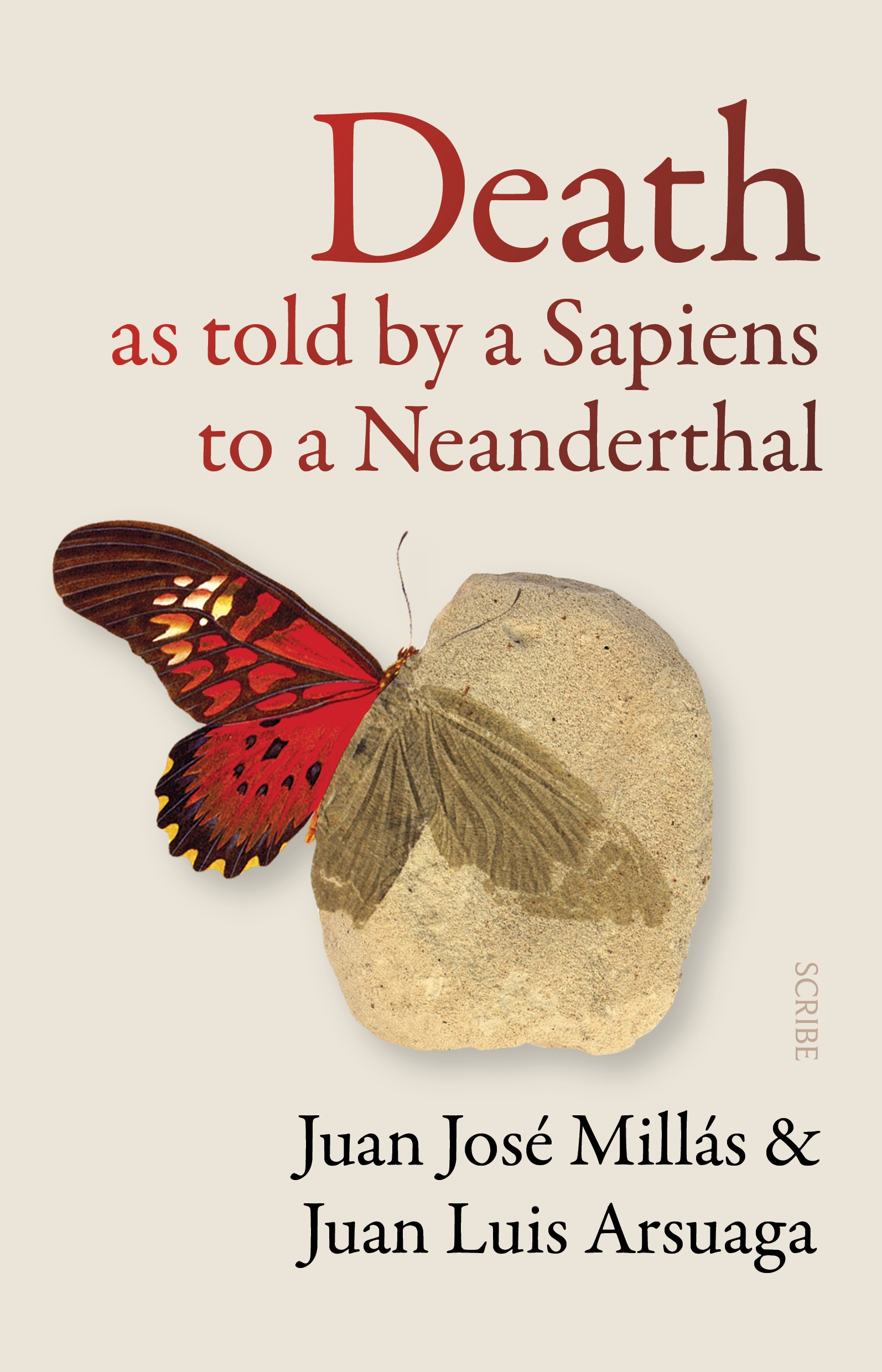
As humans, we’re likely to live longer if we exercise daily, eliminate stress, eat well and don’t stuff ourselves throughout the day, get a good night’s sleep and don’t smoke. Be sure to avoid accidents or hungry lions looking for their next meal. Death As Told by a Sapiens to a Neanderthal is a follow up to a previous book (‘Life …’). The co-authors are a bestselling novelist and a palaeontologist.
Death is an enjoyable dialogue between the two men as they travel around various Spanish locations – restaurants, wildlife parks, ancient forests, caves, and museums – chatting casually (and reflctively) about life, death, disease, chronic ailments, genetics, life expectancy, and ageing. Arsuaga’s engaging oral storytelling, as heard and captured by Millás, is insightful and enlightening.
It takes a light-hearted and human approach to a conventionally abstract and serious topic. One hilarious moment involves a vacationing Millás trying to catch his pet cat while talking on the phone with Arsuaga discussing metabolism, biological clocks, cell division, and the possibility of eternal life.
The description of an ancient Spanish forest and giant Yew – a tree straight from a fairy tale – is magical, delightful, informative, and profound. The style is personable with many of the scientific insights ironically and unexpectedly reassuring (‘… illnesses people suffer in old age, comes about at a time when we ought to be dead’).
The authors merge academic rigour with popular voice to tell an engaging story about living longer. Now, back to the hamster wheel.
Reviewed by Mark Parry
ABOUT THE AUTHORS
Juan José Millás is a bestselling and multi award–winning Spanish novelist and short-story writer, and an award-winning regular contributor to major Spanish newspapers. His narrative works have been translated into more than 20 languages, and include the novels From the Shadows and None Shall Sleep.
Juan Luis Arsuaga is a professor of paleontology at the Complutense University of Madrid and the director of the Human Evolution and Behaviour Institute. He is a member of the American National Academy of Sciences and of the Musée de l’Homme of Paris, a visiting professor at University College London, and a co-director of excavations at the Sierra de Atapuerca World Heritage site.
He is a regular contributor to Nature, Science, and the American Journal of Physical Anthropology, is the editor of the Journal of Human Evolution, and is a regular lecturer at the universities of London, Cambridge, Berkeley, New York, Tel Aviv, and Zurich, among others. The recipient of many national and international awards, he is the author of more than a dozen works.



0 Comments