



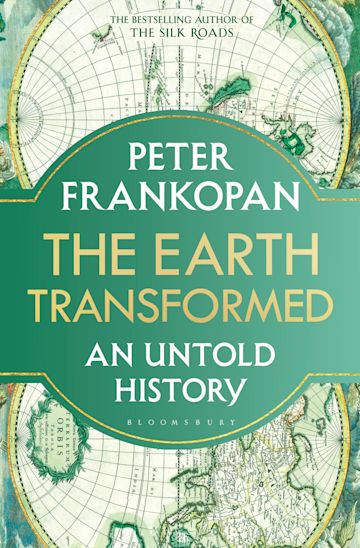
Environmental history is actually not all that untold – Jared Diamond published Collapse in 2005 and before him, the father and son team of the McNeils had pioneered the genre a generation earlier – see Plagues and Peoples (H R McNeill, 1974) and Something New Under the Sun (J R McNeill, 2000).
Whatever its provenance however, no sane individual would dispute its importance. The oubliettes of the web are still inhabited by last ditchers whose largely unpaid efforts on behalf of the fossil fuel industries have now had to acknowledge that something is going on, but it’s not due to what we burn. As ever, history comes in particularly handy in debunking false narratives about the past.
The Earth Transformed is a work of synthesis and. at times, Frankopan is clearly not comfortable with his material; the sections on neolithic agriculture for example do not seem to take into account recent scholarship which emphasises the fluidity of the transition from hunter-gatherer to agriculturalist. But he is covering four billion years or so and some simplification is unavoidable.
After a relatively brief treatment of how the Earth acquired an oxygen-rich atmosphere, Frankopan takes us to the Great Dying, the volcanically induced episode some 252 million years ago, when average temperatures increased by 14 to 18 degrees Celsius and – three quarters of land animals and 96 per cent of marine life went extinct. The 12 km in diameter meteor that killed the dinosaurs 66 million years ago of course gets a mention. The nuclear winter that ensued led to a 10 to 16 degree drop in average temperature.
Most of the book, however, focuses on the last 10000 years. The author takes us through the last Ice Age and gives a somewhat contentious account of the development of agriculture. See The Dawn of Everything by Graeber & Wengrow for a different account. There follows a whistlestop tour of major civilisations and their impacts on the environment. Roman manufacturing shows up in Greenland ice cores. The Mediaeval Warm Period saw wine in England, whereas The Little Ice Age (1550 to 1800) turned the English into beer drinkers. Cold weather facilitates epidemics. Volcanic eruptions reliably cause crop failures and famines. Francopan also gives due attention to non-Western civilisations.
All very interesting, if not particularly persuasive, as to the primacy of environmental factors during what was, in fact, a period of relative climate stability over the last 2000 or so years. What the reader really wants to see is the author’s take on the last century. Finally, at page 619 we get it: ‘For 98 per cent of the planet, the 20th century was the warmest period of the last two millennia. This is not only unprecedented; it is not a coincidence.’ There follows a comprehensive analysis of the trouble we are in and the word ‘ominous’ gets a good work out.
Historians of course don’t get to make policy, more’s the pity. But the history of the Earth’s environment does tell us that human action has transformed it – and if we chose to, could yet mitigate the worst outcomes.
Reviewed by Grant Hansen
ABOUT THE AUTHOR
 Peter Frankopan is Professor of Global History at Oxford University, where he is Director of the Oxford Centre for Byzantine Research and Senior Research Fellow at Worcester College, Oxford. He is also Professor of Silk Roads Studies and a Bye-Fellow at King’s College, Cambridge.
He works on the history and politics of the Mediterranean, Russia, the Middle East, Persia/Iran, Central Asia, China and beyond – as well as on the histories of climate, natural resources and connectivities.
Peter often writes for the international press, including The Sunday Times, New York Times, Financial Times, Guardian, and the Evening Standard.
He has been called ‘the first great historian of the 21st century’ by Brazil’s DCM magazine; ‘the history rock star du jour by The New Statesman, and simply ‘a rock-star historian’ (VLT – Sweden; Helsingin Sanomat – Finland). The Times has called him ‘a literary star.’
Silk Roads was named The Daily Telegraph‘s History Book of the Year 2015. it went to Number One in the Sunday Times Non-Fiction charts, remaining in the Top 10 for nine months in a row, as well as being #1 in China, India and many other countries around the world, selling more than 2m copies. It is one of ‘ten books that change how you see the world’ (The Times). It was named one of the ‘Books of the Decade’ 2010-20 by the Sunday Times.
His follow-up, The New Silk Roads, is a ‘masterly-mapping out of anew world order’, according to the Evening Standard, and ‘a brilliant guide to terra incognita’ (Sunday Times) that is reminiscent of Tolstoy (Daily Telegraph). It won the Human Sciences prize of the Carical Foundation in 2019
In his latest book, The Earth Transformed: An Untold History, Peter looks at environmental history, at climate and the ways it has shaped the human and natural past. ‘This is an endlessly fascinating book’, says Gerard DeGroot in The Times, ‘an easy read on an important subject. It has the intellectual weight and dramatic force of a tsunami.’ According to Walter Scheidel in The Financial Times: ‘Humanity has transformed the Earth: Frankopan transforms our understanding of history.’
In December 2018, The Silk Roads was named one of the 25 most influential books translated into Chinese in the last 40 years, alongside One Hundred Years of Solitude, Pride and Prejudice, Catcher in the Rye and The Great Gatsby. In 2019, he won the prestigious Calliope Prize of the German Emigration Center, one of the richest prizes for the Humanities in Germany.
In 2016-18, Peter’s Songlines audio channel in which he chose his favourite pieces of world music was part of British Airways’ In-Flight Entertainment system. In 2018, The Silk Roads was chosen as part of the Government of Pakistan’s Read to Lead program to encourage literacy in the country. It was the inspiration for a new character in The Vikings mini-series.

0 Comments