




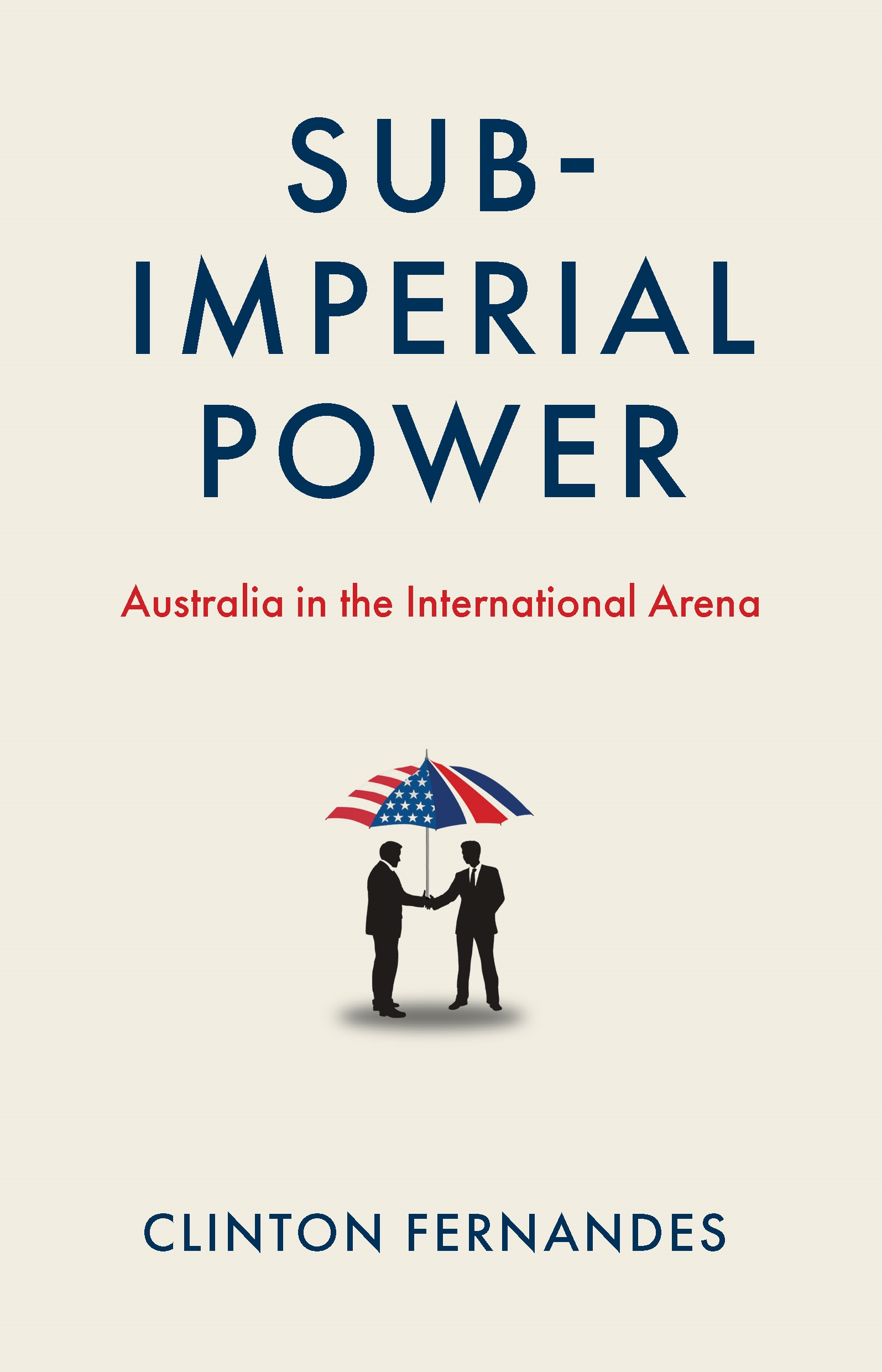
We hear a lot about the International Rules Based Order these days, mainly because of the war in the Ukraine. Usually, it is presented as an unalloyed good thing and its preservation is essential to our security. Critics of the United States, such as former Supreme Court Judge Pembroke in his Play by the Rules, or Brophy in China Panic, don’t suggest that the rules-based international order is a bad thing – just that the US has shamelessly gamed it since World War II.
In Sub-Imperial Power, however, Fernandes takes this argument a step further – you may have thought the point of a Rules-Based System is to protect smaller countries from being bashed by bigger countries. If so, you’d be wrong – Fernandes sees it as a vehicle for US imperialism. I’d best quote him, ‘This book examines the claim that Australia is a middle power trying to uphold a rules-based international order. Rejecting these euphemisms, it shows that Australia is a sub-imperial power upholding a US-led imperial order.’
So this is foreign policy analysis for those who like their steak very red. The thought that we might actually be the bad guys is pretty confronting, and Fernandes marshals his arguments well. It came as a surprise to this reviewer that the US has been involved in 72 attempts to change the government of a sovereign nation since World War II.
In an attempt to show that post-World War II order is just European imperialism by another name, Fernandes embarks on an analysis of the political economy of the British Empire. Much of history on which his thesis is based however, is highly contentious.
To take just one example, to say the British East India Company ‘caused’ 10 million deaths in 1770 (a reference to the great Bengal famine of that year) ignores the fact that the British shared control of Bengal at that time with the Mughals.
While one can criticise interpretation in detail, Fernandes’ basic thesis that the classical economics’ doctrine of comparative advantage enforced by European military might have kept much of the world poor, is interesting. It may well explain the case of Egypt, which really was a rich country in the early 19th century. It certainly explains India’s lack of economic development prior to independence.
One does not have to accept Fernandes’ thesis lock, stock and two smoking barrels but we can, however, acknowledge that his arguments on AUKUS (it goes beyond our needs)and China (that, apart from Taiwan, its plans are not expansionist) have force.
His analysis of the post-war international order is, while a good read, a bit problematic. The trampling of that order by the Russian invasion of Ukraine reminds us of what old fashioned imperialism really looks like. That is something we haven’t seen for the last 70 years.
Reviewed by Grant Hansen
ABOUT THE AUTHOR

Clinton Fernandes captured on campus in Clinton’s office.
Clinton Fernandes is Professor of International and Political Studies at the University of New South Wales. He has published on the relationship between science, diplomacy and international law, intelligence operations in foreign policy, the political and regulatory implications of new technology and Australia’s external relations more generally. His research in the Future Operations Research Group at UNSW analyses the operational environment, and the threats, risks and opportunities that military forces will face, in the 2030-50 timeframe.



0 Comments