


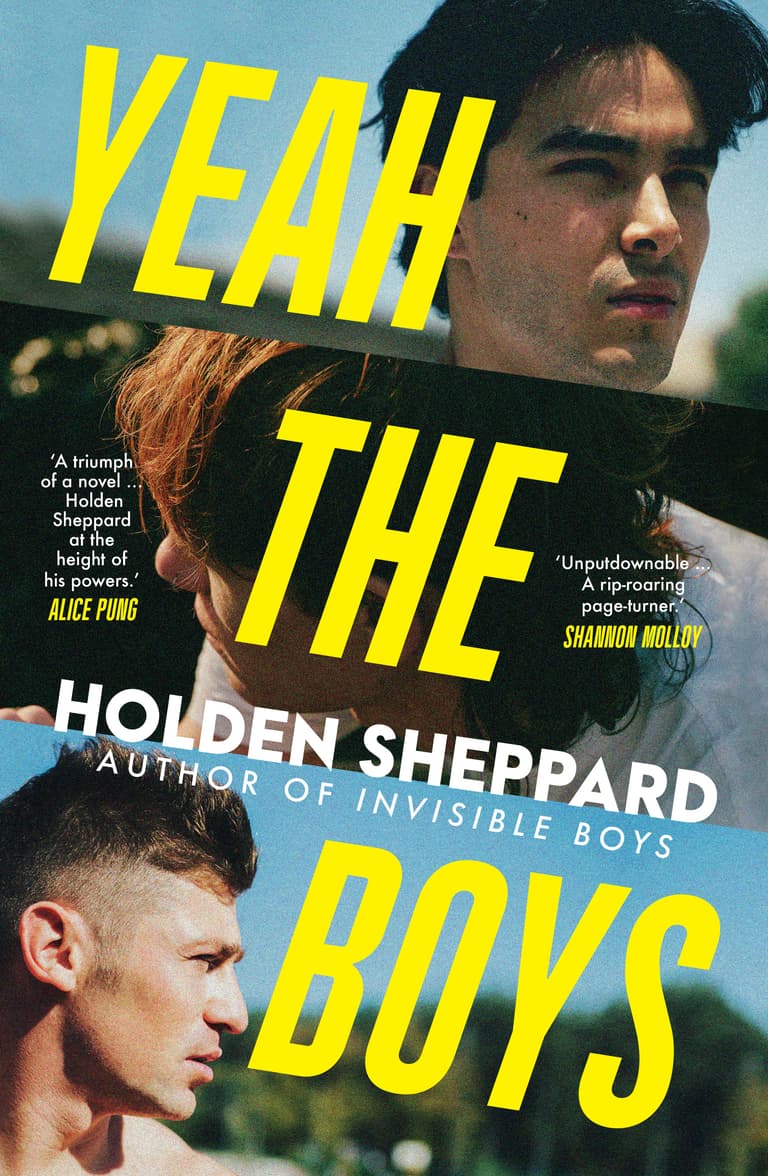
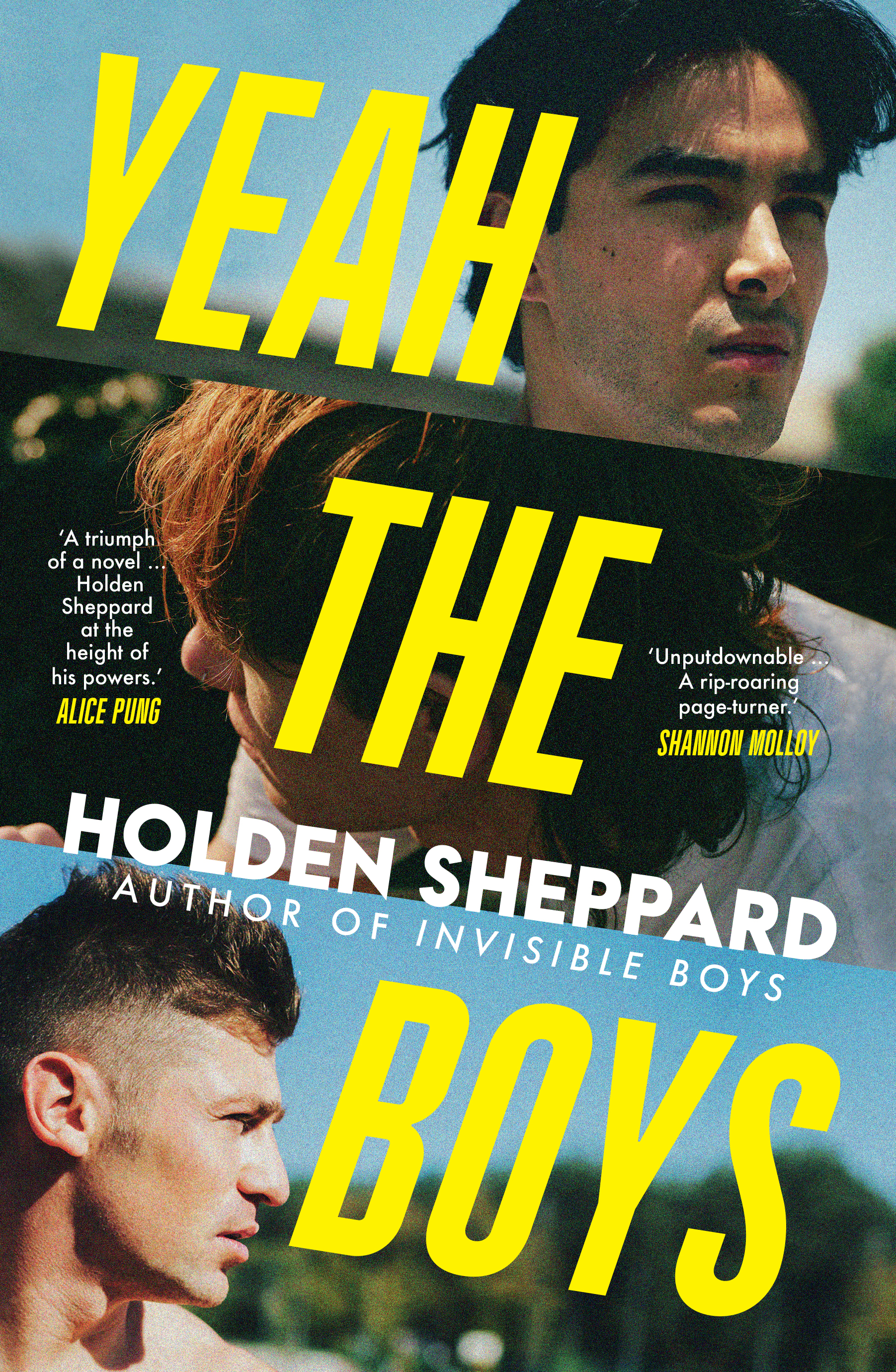
Invisible Boys by HOLDEN SHEPPARD was his explosive debut YA novel that explored queer identity in rural Geraldton, and was adapted into an award-winning TV series. Now SHEPPARD is back with the new adult sequel.
Yeah the Boys picks up seven years later, and follows Charlie, Zeke and Hammer in a bold and touching story of male friendship, masculinity, and love. Read the prologue here.
ABOUT THE BOOK
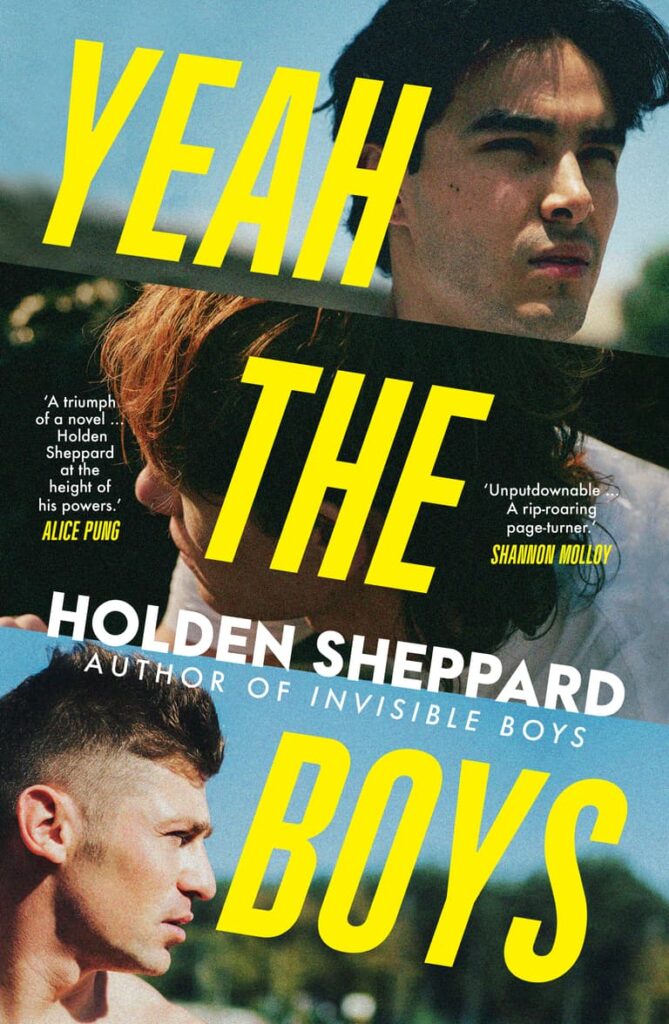 Seven years after escaping their rural hometown, the boys – Charlie, Zeke and Hammer – are back, though not as we left them.
Charlie’s fighting spirit has faded as he’s struggled to make it as a punk musician in Perth. The opening of a new gay bar by Curtis and Ahmed, an older gay couple who have become Charlie’s mentors, offers him a different way to make his mark – but the bar’s opponents have other ideas.
Zeke is lost. He knows what he stands against – the closeted life and conventional success his strict Italian parents demanded of him – but doesn’t know what he stands for. He surprises himself by joining a gay footy is it the mistake his friends think it is, or will playing footy finally give him what he’s always wanted?
Hammer has it all – fame and fortune as a star football player – or so he thinks. He’s still closeted, and can’t stand the AFL stuffing diversity initiatives like Pride Round down everyone’s throats, especially his. But when he opens his mouth, he ignites a furore that throws all the boys’ lives into chaos.
Unapologetic and unforgettable, this is the story of three boys finding their way back to each other, and finding their own ways to become men.
**********
EXTRACT
ZEKE
It is a universal truth, acknowledged by no one, that gay men are meant to be so grateful for the straight people who don’t actively want to murder us that we ought to sit down, shut up and be the kind of faggot they want us to be.
I should know. I tried to please everyone, walking a tightrope for the world’s approval, and that’s how I ended up here: in a literal toilet, barefoot, bruised, bleeding and, most unbearably of all, alone.
Here’s the thing: some straighties are super chill, but on any given day you stumble fucklong into someone with a fixed idea about what gay men should be.
We’re meant to be married and mortgaged, with two adopted kids and a fluffy Cocker Spaniel, for the moderate conservatives who tolerate us as long as we’re clean and (w)holesome – living proof even deviants obsessed with buggery can be redeemed by a collared Tarocash shirt and Sunday mass in a broad-minded parish.
We’re meant to be wounded victim poster-boys for outrage addicts masquerading as allies, who like to use us as human battering rams for advancing their activism campaign du jour. We are brilliant little clockwork toys: pull the string on our backs to hear one of six nauseating pre-recorded phrases like ‘it gets better’ and ‘love is love’!
We’re meant to be camp, witty ‘yasss, queen’ bunny rabbits for a certain subset of toxic straight women who see homos as about as useful, interchangeable and capable of self-actualisation as a Gucci clutch purse.
And we’re meant to be as beige as possible for the straight guys who will deign to talk to us about shared interests as long as we don’t make it too obvious we’re not proper, fully functional males with a red-blooded thirst for tits.
Nobody talks about how it is humanly impossible to be all these at once, but we’re expected to try, to prevent whoever is in front of us from turning their back on us (gay kryptonite, fatal). It’s not even their fault. If we didn’t have to contend with those who sometimes do want to literally murder us, we could ignore them. But we need the nice ones, so we become hypervigilant approval monsters. When we’re given the choice between death or disapproval, never underestimate our willingness to choose death.
Why? Because nobody, and this is the real issue, wants to accept us for who we really are:
Horny.
Dirty.
Male-fucking.
MEN.
Men we are, and men we were, and men we always will be.
From the first homosexual caveman, Ug, who shoved his club up the clacker of his buddy Grug, to the gay pirates, to Brokeback Mountain. From me and Charlie and Hammer to some future poofter named Zoltan zipping around New Sydney on his hoverboard in the year 3000, dodging killer AI robots in his quest to trawl for some hot tradie man-arse at the cyber-mall. It will never change. We are who we are. We are who the world is disgusted by and who the world does not want us to be. We pretend not to be ourselves even among those who claim to love us. We contort ourselves into publicly pre-approved, psychologically unsound pretzel shapes to be spared total social opprobrium from the rest of the tribe.
Or we die.
Which is how this was always going to end, when the three of us collided with the world. It was foretold. Inexorable. A maverick can’t break out of the box and expect to survive. It was always going to end exactly like this.
With one of our hearts no longer beating.
**********
When I was sixteen, Charlie Roth was more than my friend: he was my hero.
He saved my life.
We both grew up four hours north of Perth, in a hot windy coastal town called Geraldton, where you feel like the only homo in the village even when you know you’re not. My Catholic parents found out I was gay at my brother’s wedding. My dad hit me. My mother was mortified. They both wanted to disown me. I was expected to go back into the closet to make them happy even though it would’ve killed me. Being a mild-mannered Clark Kent nerd, I was going to do it.
But then, a miracle. Charlie Roth, outed troublemaker, announced he was bailing, upping sticks to the big smoke. I felt abandoned – my lifeline was being ripped away – until I did something totally unhinged.
I decided, on the spur of the moment, to go with him.
We hopped on a bus to Perth: two starry-eyed country boys dreaming of big-city liberation. That snap decision defined my life – for better and for worse.
At first, it was everything we dreamed of. We stayed in a grungy, dirt-cheap hostel in Northbridge called Francis Street Backpackers, living off a couple of grand Charlie would much rather not have inherited. It was like we were overseas on a backpacking holiday. We slept in a six-bed dorm: me on the bottom bunk and Charlie on the top. The carpets were sticky and the whole building reeked of morning-after puke and mi goreng noodles. Charlie and I befriended people from all over the world: Brazilians, Germans, South Koreans, Americans. They’d buy us grog from the bottle-o on Lake Street and we’d hang out in the hostel beer garden getting wasted on Foster’s (they thought it was an Aussie beer) and kicking hacky sacks and throwing frisbees. We smoked cigarettes and weed. We hooked up with other backpackers, and strangers, and did everything we’d ever craved to do now we had the horny freedom of the city.
The Francis Street era was golden: the best fun I’ve ever had.
The real Zeke emerged from his cocoon. I’d always played Good Catholic Boy, but in that hostel, I was unapologetically myself: a red-blooded man who wanted nothing but pleasure. I felt like the Beat poets of the 1960s. I was Jack Kerouac waking up every day in a hedonistic haze I was too young for, but never overwhelmed by: my best mate was right beside me.
It lasted three months.
My parents had been trying to get me back home: the outrage I did to their authority by running away was thermonuclear. My mother even reported me as a missing person. The Gero cops called me, and I had to convince them I was safe and escaping my homophobic parents which, weirdly, the grizzled Gero sergeant seemed to understand. The old me would have been worried about not graduating, but in that hostel, the old me was a dead me. I dismembered myself to come to Perth – a mouse ripping off its own feet to escape a trap.
But burnout life was only fun until the money ran out, and the reality of living as emancipated minors hit us like a frisbee to the face. A fog lifted. Hostel life was expensive, long term: we’d need jobs, a share house. The dream lost its lustre: trawling Seek for entry-level jobs was depressing, especially with our nearly blank resumes. I don’t think Jack Kerouac had to lower himself to that level.
And then, the kicker: my dad got cancer.
That was it. No matter how much I hated my dad, I didn’t want him to die. I told Charlie I had to go home to see him. The Gays in the Big Smoke Dream was dead.
Charlie and I had the worst fight of our lives. A screaming match. A total shitfight. We both went for the jugular. Charlie called me a traitor. I called him hypocritical for not realising how important it was for me to see my dad since he’d lost his own dad, years earlier, and his boyfriend, only months back.
I told Charlie I’d come back once I saw my dad but he called me a liar and said I was abandoning him. He said if I went back to my family I wouldn’t come back to him.
The worst part was he was right.
Read our interview with Holden Sheppard on Invisible Boys and the TV adaptation.
Read our review of The Brink by Holden Sheppard.
ABOUT THE AUTHOR
 Holden Sheppard is a West Australian author whose debut novel Invisible Boys won multiple awards, including the 2019 WA Premier’s Prize for an Emerging Writer. Invisible Boys has now been adapted as a ten-episode television series with Stan Australia which premiered in 2025. Holden’s second book The Brink won several accolades, including the 2024 Ena Noël Award. His new 2025 release King of Dirt is his third novel, and his first book for adults.
Holden’s writing has been widely published in books, journals and the media. A country boy from Geraldton, Holden now lives in Perth’s far north with his husband and his V8 ute.
Visit Holden Sheppard’s website here
Follow Holden Sheppard on Instagram here
Read more about Yeah, the Boys on the publisher’s website
0 Comments