




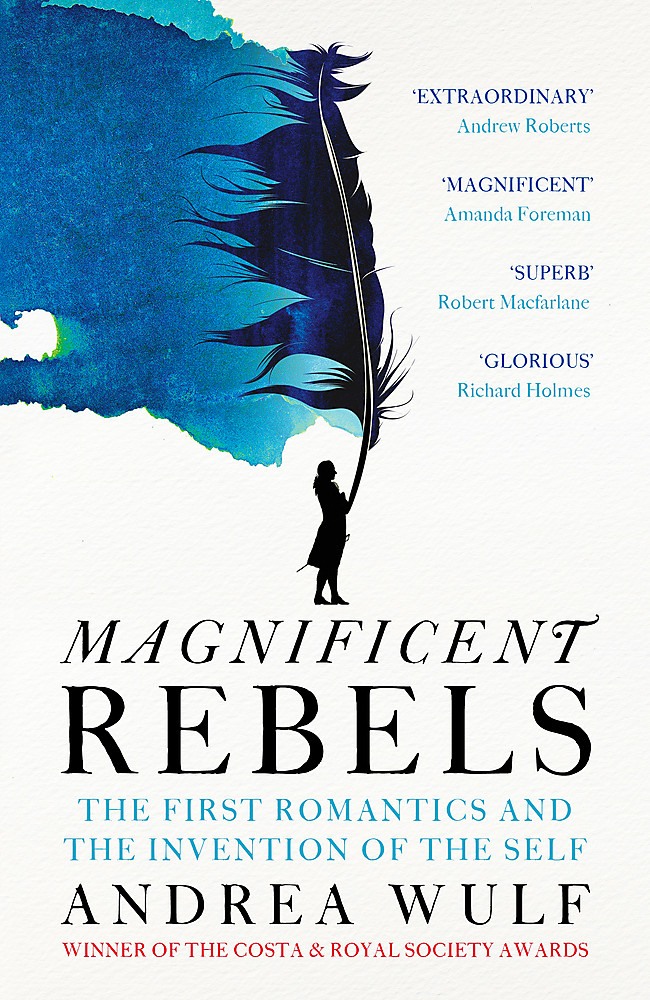
In Magnificent Rebels Andrea Wulf makes the claim that ‘a group of novelists, poets, literary critics, philosophers, essayists, editors, translators and playwrights’ located in the small German town of Jena in the late 18th century were critical in the ‘shaping of the modern mind … we may not know it, but their way of understanding the world still frames our lives and being.’
Now the moment someone uses a phrase like the ‘modern mind’ ones ears should prick up. Because if the modern mind was shaped, there must once have been an unmodern mind. And that ‘mind’ must be more than an individual physiological phenomenon – it must be something that can be shared and transmitted. So, what was the mind before? And what did it become? And how?
Wulf’s thesis is that the modern mind is individualistic, selfish, and craves autonomy.
This mentality can be traced to a relatively small group of German intellectuals residing in the fairly obscure university town of Jena in the 1790s.
The strength of the book lies in its detailed account of these individuals and their times. Some of them, such as Goethe and Schiller or Hegel, are rightfully considered important artists and thinkers. Others, such as Johan Fichte or Caroline Schlegel, are fascinating but profoundly obscure.
The weakness of the book is that it begs almost every question it raises. No attempt is made to justify the concept of the ‘modern mind’. It is a given, apparently derived from a fairly uninteresting account of the author’s personal circumstances in the preface. Certainly, no thought is given to what preceded it, or how it has become, as the author claims, the frame of our lives – as opposed to the influence of say, the thinkers of the Scottish Enlightenment or the French Revolution or John Stuart Mill or Karl Marx or Karl Popper or Frederick Hayek.
An unkind person would be tempted to remark that German phenomenology – the body of epistemological thought derived from Immanuel Kant (that tree in the forest stuff) – which is really what we are talking about here – is, and always was, an intellectual dead end. I don’t go that far. But to argue, as Wulf does, that this motley crew of provincial German thinkers had a profound effect on the modern world view would require a rigorous analysis. First of what is that world view, and secondly, how her subjects influenced say, Hayek, or if one is feeling more optimistic, Keans. I don’t say this couldn’t be done, just that it isn’t done in Magnificent Rebels.
Back in the day, the big debate in historical studies was whether intellectual history mattered at all. Back then, in the ’70s and ’80s of the last century, many historians were Marxists and most of the rest could be described as structuralists. The history of ideas was considered somewhat quaint – what mattered was economics, class, technology and geography. Intellectual history made a comeback after the fall of the Soviet Union derailed the Marxist project and Magnificent Rebels does focus on some amazing characters in an amazing period of history. For that it is worth a look. It’s thesis however, remains untested.
Reviewed by Grant Hansen
ABOUT THE AUTHOR
 Andrea Wulf is an award–winning author of seven acclaimed books.
She has lectured across the world – from the Royal Geographical Society and Royal Society in London to Monticello and the New York Public Library in the US, as well as literary festivals across the world. She is a Miller Scholar at the Santa Fe Institute, a three-time fellow of the International Center for Jefferson Studies at Monticello and the Eccles British Library Writer in Residence 2013. She’s a member of PEN American Center and a Fellow of the Royal Society of Literature.
Andrea is a regular on radio and TV in the US, the UK and in Germany. The ZDF / Smithsonian Humboldt documentary won the Discovery Award 2019 / Science Film Festival. In 2019, she was part of the delegation that accompanied Germany’s President Frank-Walter Steinmeier on his trip to Ecuador and Colombian … following Humboldt’s footsteps.



0 Comments