



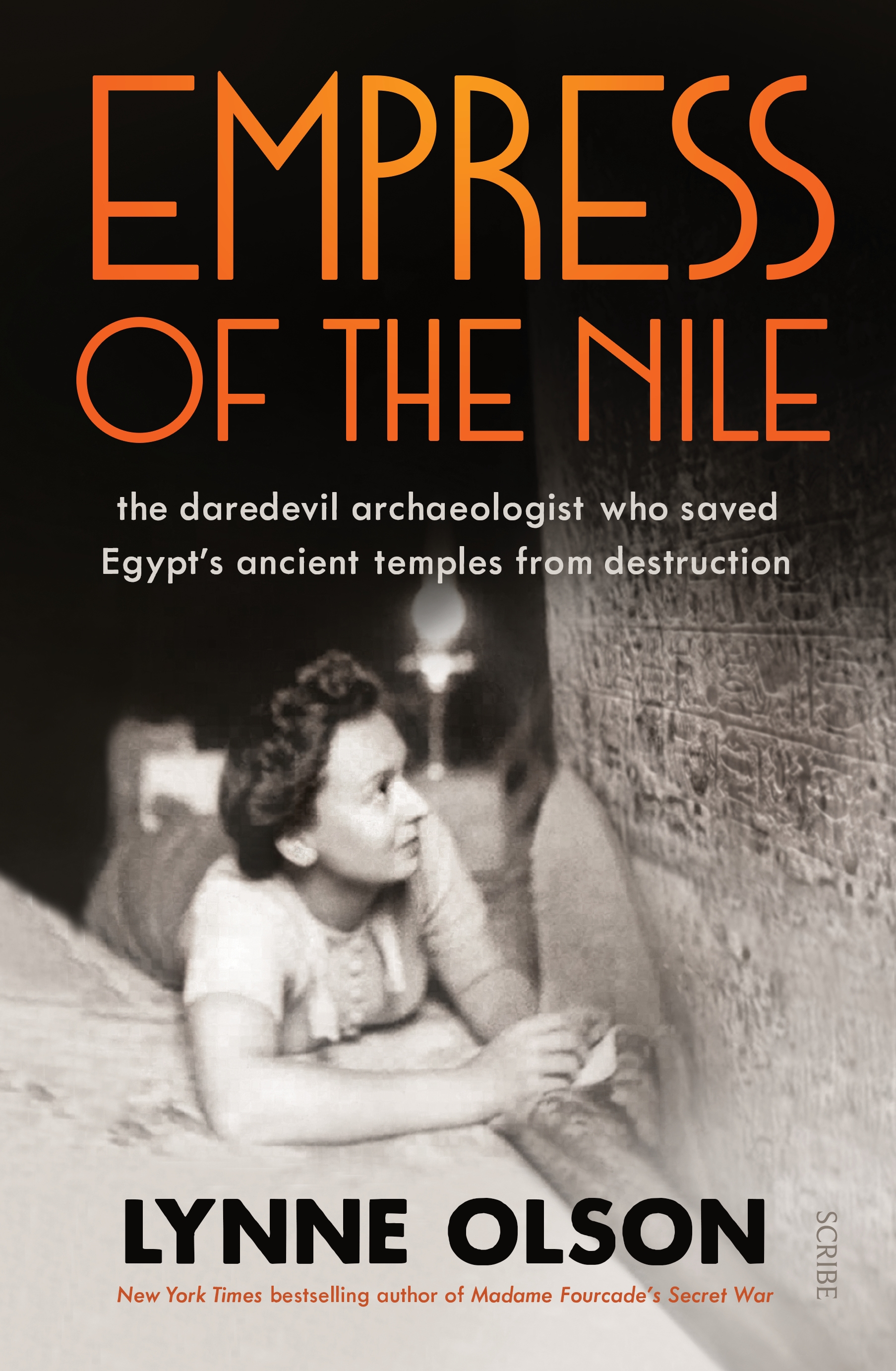
There is just one jarring note in this utterly absorbing account of a diminutive French female archaeologist who saved 20 ancient Egyptian temples from destruction in the 1960s.
And that odd note is in the title. During Christiane Desroches-Noblecourt’s long life, she had nicknames such as the ‘high priestess of Egyptology’ and ‘Lady of the Nile,’ but the one she preferred was that conferred on her by Egyptian colleagues. It was ‘Umm Simbel’, Arabic for ‘Mother of Simbel’, for it was the temples of Abu Simbel that she had saved. So why the use of ‘Empress’? Putting that quibble aside, I can see that Olson, a US writer, historian and journalist, has finally given that French archaeologist the general acclaim that seemed lacking during her lifetime.
Olson, who has written several previous books dealing with World War II, came to Egyptology almost by accident. She was researching the first resistance group in Occupied France during World War II, and became fascinated by the story of one of its women members – a feisty young archaeologist named Christiane Desroches-Noblecourt, who was the acting chief curator of Egyptian antiquities at the Louvre.
After the war that archaeologist led a seemingly hopeless campaign in the 1960s to save several ancient temples in Egypt from being destroyed. That crusade, as it turned out, led to the greatest instance of international cultural cooperation the world has ever known, with 50 countries taking part in a colossal effort to move the ancient temples.
That Frenchwoman is the subject of Olson’s latest work, which itself provides an enlightening political history of Egypt, including the ancient pharaohs, as well as that of France and even the United States. Christiane Desroches-Noblecourt not only stood up to the Egyptian president, Gamal Abdel Nasser, but also her own French president, Charles de Gaulle, in insisting that the 20 temples at Abu Simbel, in Nubia, well south of Cairo, should be saved from flooding after the Aswan High Dam was built on the Nile.
With the help of UNESCO, many nations, and particularly the stone-cutting expertise of Italian workers, marmisti, from the Carrara marble quarries, over four years the temples were moved, either cut and reassembled, or moved as entities. Financial contributions came from around the world, even from Britain, still smarting over Egypt’s nationalisation of the Suez Canal.
Olson was fascinated to find that the USA’s participation had been spearheaded by Jacqueline Kennedy, the wife of the-then president, who researched and wrote a report for him, recommending the importance of the project. While Jacqueline Kennedy never claimed any role for herself in that US participation, she told her daughter Caroline that the project was as satisfying for her as her restoration of the White House.
It was fitting that in 2009, shortly before Christiane Desroches-Noblecourt died at 97, she was honoured by UNESCO at a screening of a documentary about her life. She wore a tiny pin on her jacket that night, showing that she had been awarded the highest level of France’s most prestigious order of merit, the Grand Cross of the Legion of Honour, one of only six women to receive it in the order’s 220-year history.
Olson has carried out painstaking research into this woman, who overcame strong misogyny from male archaeologists at the start of her stellar career, but who was never afraid to stand up for what she believed. The result is a riveting account of her years spent in Egypt and her role in the world’s greatest international cultural cooperation.
Reviewed by Jennifer Somerville


0 Comments