




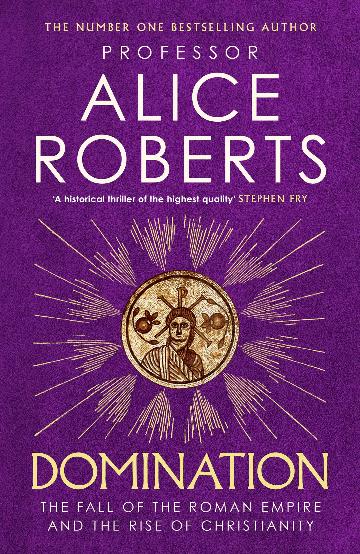
Alice Roberts’ Domination is a fascinating exploration of how Christianity gradually supplanted Paganism, as the dominant religion in the late Roman Empire. By focusing on what the material and documentary evidence actually tells us about the origins of the Christian church, Roberts leads readers on a journey likely to challenge much of their received knowledge. For example, when did the Emperor Constantine become a committed Christian, if he ever did? Is the Chi-Rho necessarily a Christian symbol? Were most early Christians found among the lower classes?
Descriptions of early monasteries in Wales and Brittany give way to interesting analysis of the writings of early Christian leaders and the administrative structures they inherited from the Romans and maintained, even as the empire shrank. The transition from marginal cult with Jewish origins to dominant cultural force was more ‘evolution’ than ‘revolution’, Roberts argues.
Consider the distribution of charity. The early Christians eventually took over this role from wealthy families in many cities who, instead, were encouraged to donate to the church. Education and health care followed. Roberts helps readers to understand how Christianity succeeded, even as the earliest theologians struggled to agree on fundamentals such as the very nature of Jesus, Son of God.
Readers familiar with Alice Roberts made-for-tv documentaries will likely hear the author’s voice as they read Domination. I certainly did. The wholly secular viewpoint of this insightful book will not please everyone. But, as Roberts writes, ‘history shouldn’t just be about repeating the claims of the hagiographers’.
ΗΗΗΗ Simon & Schuster $36.99
Reviewed by Peter Hodge
 ABOUT THE AUTHOR
 ABOUT THE AUTHOR
My journey began in medicine, but I transitioned from surgery to academia to teach clinical anatomy and research human origins and ancient diseases. I believe in sharing the incredible knowledge generated at universities, and since 2012, I’ve served as the Professor of Public Engagement with Science at the University of Birmingham. I’ve been honoured with eight honorary doctorates and have been president of prestigious organizations like the Association of Science Education and the British Science Association. In recognition of my work, I received the Royal Society’s David Attenborough Award for Public Engagement in 2020.
I’ve had the pleasure of presenting over a hundred TV documentaries on human biology, history, and archaeology. My television debut was as a human bone specialist on Channel 4’s Time Team in 2001. Since then, I’ve hosted BBC Two’s Coast, and written and presented landmark series such as The Incredible Human Journey, Origins of Us, and Ice Age Giants. I’ve also presented history and archaeology series like Britain’s Most Historic Towns, Fortress Britain, Ancient Egypt by Train, Curse of the Ancients, and Royal Autopsy. My longest-running series, BBC Two’s Digging for Britain.
Beyond my academic and media endeavours, I’m an enthusiastic artist, blending science with art. I’m proud to be an associate of the Medical Artists’ Association of Great Britain and an honorary academician of the Royal West of England Academy.



0 Comments