




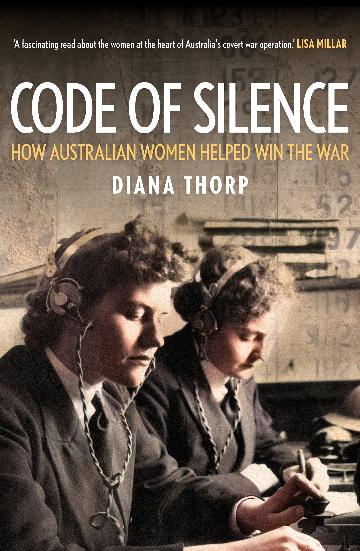
It is appropriate that this book was published in 2025, 80 years since World War II ended, revealing secret work in that war by many Australian women.
Thorp spent five years tracking women across the country who had engaged in this secret work. Many of those still alive were in their 90s or more than 100, and some had left oral or written records. They had worked in signals intelligence, intercepting enemy communications and exploiting that information. Sworn to secrecy, they kept those secrets for decades.
Some had been learning Morse even before the war began, in lessons given by Australia’s first female electrical engineer, Mrs Mac (Florence McKenzie), who had correctly predicted that war was on its way and set up classes in a former woolstore in Sydney’s CBD.
She trained thousands of men and women before the war ended and, in 1941, when the Women’s Royal Australian Naval Service (WRANS) was formed, some of her ‘girls’ went to a naval depot outside Canberra.
The newly formed Women’s Auxiliary Australian Air Force (WAAAF) and the Australian Women’s Army Service (AWAS) also absorbed women telegraphists, releasing servicemen for duty overseas.
The Code of Silence just deals with the women who worked in signals intelligence, but ultimately 66 000 women enlisted in the three services. Using the women’s own words, Thorp paints a word picture of young women, some still teenagers, who worked in secret units such as a garage behind a 19th century Brisbane house; a camouflaged farmhouse in North Queensland; a block of apartments in Melbourne; and even a hole in the ground at a Perth school.
She also reveals that there was an Australian working at Bletchley Park in the UK; and that another Australian was the only female coastwatcher, based on an island in the Solomons.
Book review by Jennifer Somerville
 ABOUT THE AUTHOR
 ABOUT THE AUTHOR
Diana Thorp has scaled a pyramid, excavated a Bronze Age palace and been threatened by a deadly war spy. She also wrote a thesis on forgotten women that almost included a sealed section, all in pursuit of a good story. A journalist, historian and teacher, Diana has worked for The Australian, including its weekend magazine, and The Times in London. She has studied Australian history, with a focus on gender, at Macquarie University, and ancient Egyptian literature at Monash University. After lecturing in journalism for many years, her passion for history inspired her to become a teacher, and she works at a Melbourne girls’ school. Her work appears widely in Australia and beyond, and her feature article on Australian World War II spy Nancy Wake, whose wartime story was then little known, inspired her interest in this covert field.
Follow Diana Thorp on Instagram



0 Comments