




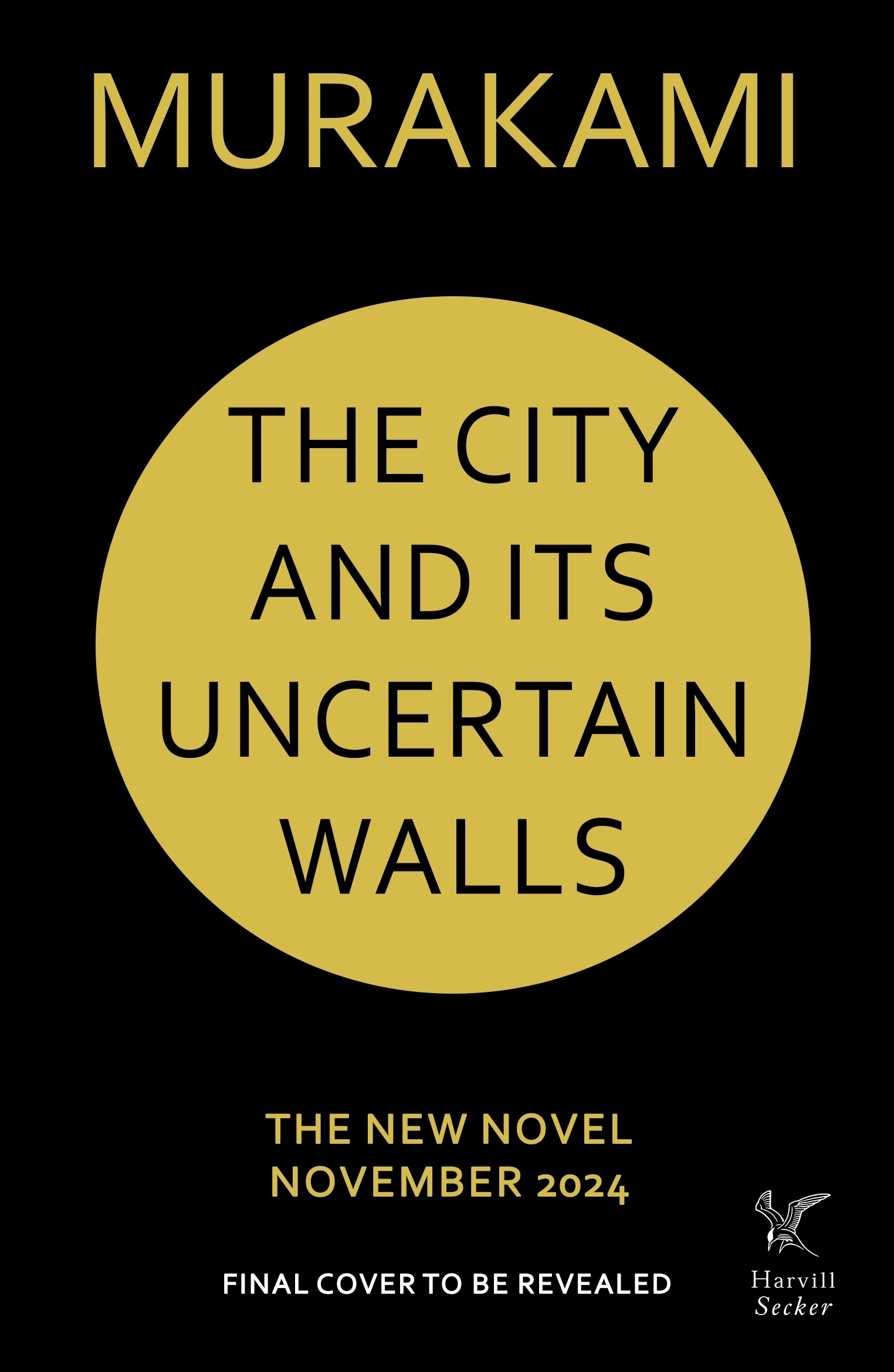
Nearly half a century ago, Haruki Murakami published a novella in the Japanese literary magazine Bungakukai (meaning ‘literary circles’) called The City and Its Uncertain Walls. By Murakami’s own admission, he called his novella a failed story, one that was 150 handwritten pages. He always had the intention to return to complete the manuscript as a full novel, but his career took off and his many other wonderful ideas seemed to top his ‘to-do’ list. Well, nearly 45 years later, this full-length novel has arrived on Australian shores and while it would never be considered a ‘failed story’, it won’t be remembered among his best work.
In The City and Its Uncertain Walls, an unnamed narrator has been mysteriously drawn back to a city he once fled, a place that is entirely enclosed by walls. There, among the shadowy figures and creatures, he encounters a young woman who is somehow linked to his past, as well as a ghostly and enigmatic librarian who helps him navigate the peculiar setting. As he explores the city, and creeps closer to its centre, the unnamed protagonist faces philosophical and existential questions about his identity, memory and connection. It is his journey of self-discovery that drives him forward to seek answers within the city’s unreliable walls.
In Murakami’s true style and tone, this surrealist novel explores the space between reality and fantasy, the material and imaginary, the tangible and illusionary. It takes time to allow yourself to become one with his world, and you have to be open to this transition. The novel explores isolation, psychological barriers, and connection, which might be further enhanced due to the fact that the novel was largely written during the pandemic.
Murakami later wrote that The City and Its Uncertain Walls had felt like a small fishbone caught in his throat over many years, and that it was a great relief to have finished it. Unfortunately, on some level as a reader, that feeling was shared. While The City and Its Uncertain Walls is not a failure, it certainly doesn’t live up to the standard he has set from his classic works. He builds atmosphere like no-one else alive, and he doesn’t miss a beat in this domain. His heart remains strong, his imagination unwavering, and the human element ever green, but the playfulness, comedy, and mischievousness that readers fell in love with has been left wanting.
If you are a fan of Murakami, then there is no doubting you will enjoy this novel on some level. If you haven’t read him before, then you must, but you must start elsewhere in his back catalogue.
Reviewed by Samuel Bernard
ABOUT THE AUTHOR
 Haruki Murakami was born in Kyoto, Japan, in 1949. He grew up in Kobe and then moved to Tokyo, where he attended Waseda University. After college, Murakami opened a small jazz bar, which he and his wife ran for seven years.
His first novel, Hear the Wind Sing, won the Gunzou Literature Prize for budding writers in 1979. He followed this success with two sequels, Pinball, 1973 and A Wild Sheep Chase, which all together form “The Trilogy of the Rat.”
Murakami is also the author of the novels Hard-Boiled Wonderland and the End of the World; Norwegian Wood; Dance Dance Dance; South of the Border, West of the Sun; The Wind-Up Bird Chronicle; Sputnik Sweetheart; Kafka on the Shore; After Dark; 1Q84; Colorless Tsukuru Tazaki and His Years of Pilgrimage; and Killing Commendatore. He has written five short story collections: The Elephant Vanishes; After the Quake; Blind Willow, Sleeping Woman; Men Without Women; and First Person Singular; and an illustrated novella, The Strange Library.
Additionally, Murakami has written several works of nonfiction. After the Hanshin earthquake and the Tokyo subway sarin gas attack in 1995, he interviewed surviving victims, as well as members of the religious cult responsible. From these interviews, he published two nonfiction books in Japan, which were selectively combined to form Underground. He also wrote a series of personal essays on running, entitled What I Talk About When I Talk About Running, a conversation with friend and former Boston Symphony Orchestra conductor Seiji Ozawa entitled Absolutely on Music, a reflection on his personal t-shirt collection entitled Murakami T, and a unique look at the craft of writing entitled Novelist as a Vocation.
The most recent of his many international literary honors is the Jerusalem Prize, whose previous recipients include J. M. Coetzee, Milan Kundera, and V. S. Naipaul. Murakami’s work has been translated into more than 50 languages.



0 Comments