


Discussion points and questions
- Catherine Chidgey, rather audaciously, provided an alternative ending to the Second World War. How did this affect your reading of the novel?
- The author says she likes to challenge herself with each new novel. The Book of Guilt, her ninth novel, is her first foray into dystopian fiction. Could it also be classified as fantasy, historical, a thriller or realist fiction? How did you feel about the journey back to the late 1970s?
- In this late 1970s England, some lives are valued less than others. The author uses children to emphasise this aspect of her narrative. Do you think she chose this time and place for a particular reason? Could the novel be set anywhere, anytime, now?
- Did Dr Roche’s research have any medical value?
- The triplets had different relationships with each other and held each other in different esteem. Is this sibling bias explained by their circumstances?
- What was the role of the Minister for Loneliness in the novel?
- Were you shocked by the behaviour of Nancy’s parents? How they treated her and the triplets? Can you imagine grief overwhelming all other potential behaviours?
- Catherine Chidgey implicates the reader through her use of the Copies and the townspeople. We are all bystanders. How did this make you feel?
- There is rising unease for the duration of The Book of Guilt, interspersed with moments of humour, warmth and connection, shock and pathos. How were you feeling by the end of the novel?
- How many of the twists across the novel did you see coming?
**********
OUR BOOK REVIEW
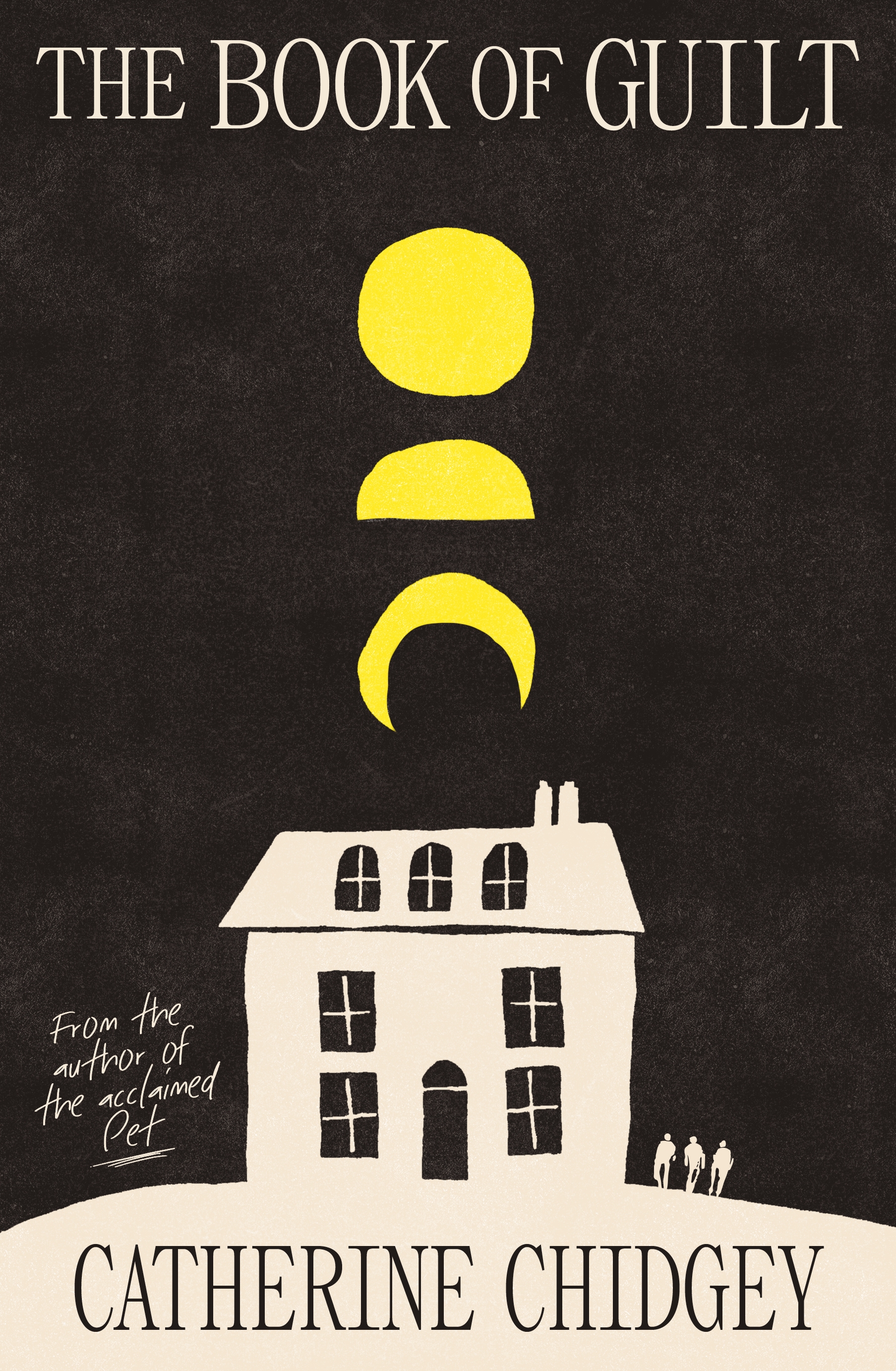
The first clue we get about the strange nature of The Book of Guilt is the narrator referring to his mother as Mother Afternoon. In fact, Vincent, a 13-year-old when we meet him, also has a Mother Morning and a Mother Night. He and his two identical brothers, Lawrence and William, are the only remaining residents rattling around in a huge old house in the heart of the New Forest called The Captain Scott Home for Boys. The house is one of a chain of such places set up by the Sycamore Scheme introduced by the UK Government in 1944 to accommodate what Vincent calls ‘children like us’.
This enigmatic description lures us into a story, at first deceptively artless, but intensifying, by means of the scattering of strategic clues, into the macabre. It’s been compared to Kazuo Ishiguro’s Never Let Me Go. The author’s ability to hint that all is not as it seems while concealing a very dark truth is compellingly evocative of Ishiguro and quite as masterful.
For a start there are the anonymous mothers whose duties include recording the boys’ nightmares in The Book of Dreams, instructing them in the lessons of The Book of Knowledge and, most importantly, recording their misdemeanours in The Book of Guilt. Then there is the benevolent Dr Roach who visits regularly to examine them for signs of the ‘Bug’, a viral infection endemic among the residents of the homes against which they must be regularly inoculated. Constantly at the forefront of the triplets’ minds is a kind of earthly paradise promised to those who make a full recovery from the bug. This, they’ve been told, is the Big House at the seaside resort of Margate, where a life of endless fun in the sun awaits the lucky ones.
In parallel with Vincent’s story is that of 13-year-old Nancy who lives in Exeter. The daughter of doting parents, her life seems perfect but for the fact she is kept a prisoner, never allowed outside the home, not even to go to school. As she begins to feel increasingly trapped, the government, as represented by the Minister of Loneliness, embarks on a scheme to close the Sycamore Homes for good and re-integrate the children into the community. Events escalate in such a way that the triplets and Nancy are brought together, prompting fears for their survival and horrifying revelations about their origins.
This is New Zealand author Catherine Chidgey’s ninth novel and her first foray into dystopian fiction. It’s riveting reading and, disturbing as its shadowy undertone of evil is, entirely credible. As with Ishiguro’s book, the concept of assigning a scale of value to human lives based on arbitrarily allocated criteria, is far too reminiscent of real and potential horrors.
Reviewed by Anne Green

ABOUT THE AUTHOR
Catherine Chidgey is an award-winning and bestselling New Zealand novelist and short-story writer. Her first novel, In a Fishbone Church, won the Betty Trask Award. Golden Deeds was Time Out’s book of the year, a Best Book in the LA Times Book Review and a Notable Book in the New York Times Book Review. Her novel Remote Sympathy was shortlisted for the Dublin Literary Award and longlisted for the Women’s Prize for Fiction, and her most recent novel, The Axeman’s Carnival, was the winner of the Jann Medlicott Acorn Prize for Fiction at the 2023 Ockham NZ Book Awards.





0 Comments