


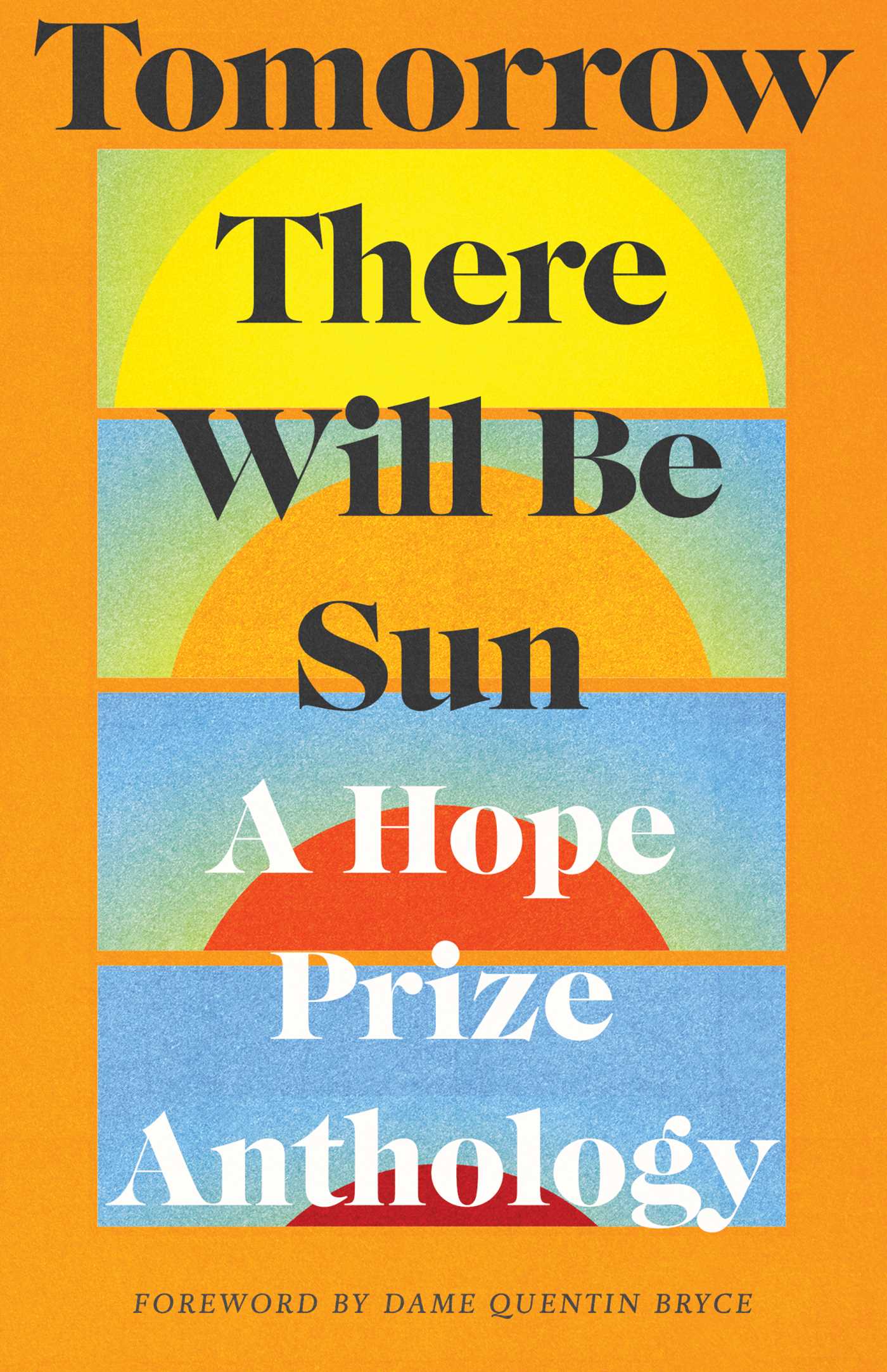
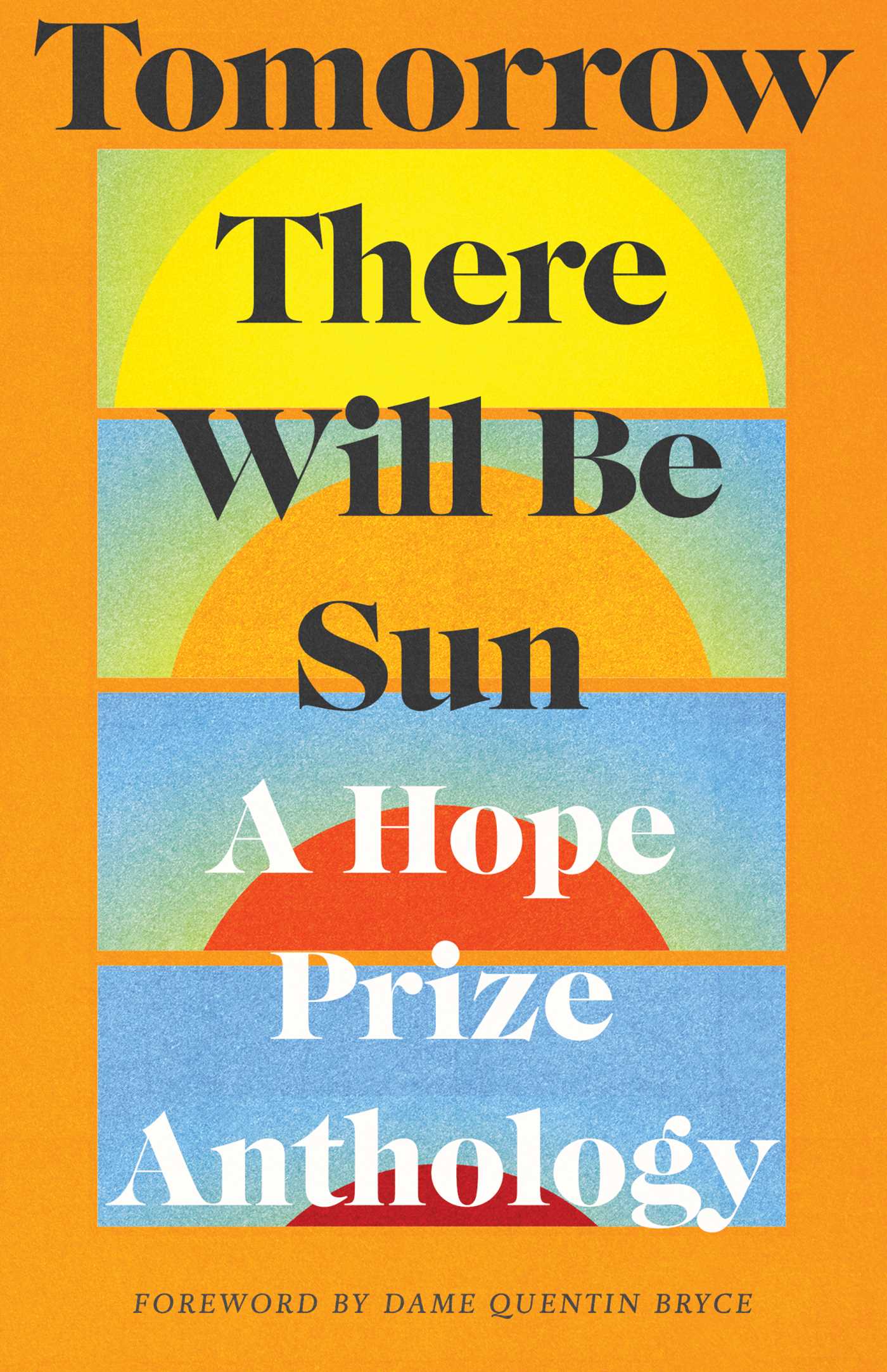
The Hope Prize is one of the world’s leading short story competitions, and this collection of winning and shortlisted stories aims to delight, move and inspire you.
From two lovers in Nigeria navigating uncertain futures; a homeless man in Melbourne holding fast to his dignity against the backdrop of an indifferent city; a former prisoner stepping back into the world; and a mother in Ireland who is unknowingly whisper-close to her long-lost son, these stories grapple with issues that define our time – mental health, poverty, war – in a way that feels both intimate and urgent.
In Tomorrow There Will Be Sun some of the world’s most promising literary voices remind us that no matter the challenges we face, through the strength of the human spirit and the power of connection, we can move through darkness and into the light. In a tapestry of unique perspectives, this engrossing and entertaining collection is a balm for the soul.
Hope isn’t passive. It’s something we create, together. And in these pages, you’ll find hope well and truly alive, waiting for you to carry it forward.
Judges of the 2024 Hope Prize included Honourable Dame Quentin Bryce AD CVO, Dr Tony Birch and Julia Gillard AC.
All royalties from the anthology support Beyond Blue, Australia’s leading mental health charity.
Extract – Read a shortlisted story
The Best Pieces Not from Me
by An Ngo Lang
Shortlisted
Yours was the first name I uttered, or so I was told. Just two simple letters to make a word, with a descending accent mark and a falling tone: Bà. How comforting it was to let it plummet from my lips each time you were near. In our tongue, it means grandmother, but for me, it meant a smile of black lacquered teeth like piano keys, lips stained ruby red from the betel nut you loved to chew, broad shoulders that blocked the sun above, and a barrel-sized waist perfect for my little arms to hug.
That day, our steps were in unison on the dusty ground, mine clad in pink clogs – the ones I wore because I thought they made me a princess – and yours bare. I couldn’t help but stare at your big toes. Instead of lining up with the rest like soldiers, they curved and jutted out like thumbs. Mom said it was because you were a true Vietnamese woman, descended from the original people who came to our land, your bloodline pure. I wasn’t sure what that meant, so I said it was because your big toes must have tried to run away but couldn’t escape.
With one hand, you held mine, and in the other, a bowl of leftover braised pork, and together, we passed your vegetable garden of stripy luffa and red chili with your dogs at our heels, their tongues long and lolling, hoping for a morsel. I stroked the leaves with my free hand as you did when you watered and tended them, willing them to grow tall and abundant. The branches of the giant mango tree arched over our heads, and when I looked up, oblong green fruit hung like the dainty jade earrings Mom wore when she went to elegant dinner parties with Dad and left me with you.
And under that tree, we reached the pond with lily pads on top and fish underneath. Dragonflies did what they did best – shimmer and flit up and down over the water’s surface, their wings a blur. It was next to your house, which I learned years later you had built with your two hands and made into a home from mud, straw, bamboo and dirt after you fled from the North to the South from those people you called the communists. And in this home, surrounded by rice fields and banana trees, the laughter of loved ones echoed, rice cooked, babies cried, chopsticks clacked and incense burned.
You told me to sit on the bench by the pond with the long wooden table at my back. This was where our clan, your six children and their families, gathered every Sunday over lunch. It was my favourite time of the week. My legs swung back and forth, and I admired how fast they could go while you pierced a small piece of meat with a silvery fishhook, sauce – amber and sticky – sliding down your fingers. Your movements were slow, your voice gentle and warm next to my ear like summer air as you showed me how to hold the rod with both hands, and together we cast the thin line out to the middle. Bubbles rose and popped on the lime green water. I looked at you, and your eyes shone like twin moon slivers. I’ll never forget this.
But then the morning came when the people who made you flee from the North rumbled with their tanks and guns to the South, surrounding our city. We trembled and cowered inside the house. Mum prayed, and I followed, but I didn’t know what to ask. I tried to think of the big words Mum and Dad always said but only remembered one: Help! And so, I covered my ears and whispered it over and over even while the walls shook, and rockets whistled and boomed outside.
Dad said, ‘We must escape, or else we die.’
My thoughts were like seashells tossed and tumbled by crashing waves. I said, ‘But what about Bà? Isn’t she coming too? We must go to her home.’
Dad’s eyes got wet as he shook his head. ‘She wants to stay. She’s tired of fleeing.’
I shook my head and thought, No, it can’t be true; we should not leave you.
Then I remembered. I had been your shadow, watching you when you weren’t aware. All those times you used to sigh long, drawn-out full-chested breaths, and said, ‘Family is everything.’ Or when you bowed with a lit joss stick between your palms and prayed at the altar to the ancestors to keep watch over everyone. It wasn’t just for us, your children and grandchildren; it was for the brothers, sisters, and parents you left all those years ago in the North. One day, you would be reunited; this was the hope you guarded in your heart.
But now, this family, the one you made, was splitting apart.
Dad said, ‘Hurry!’ So we all ran to the car, leaving everything behind: our home with the black and white tiled floor, the pretty dolls with round open eyes in the glass case, and you in your home, alone. And inside of me, it rained, but I didn’t let it show. Surely, Mum and Dad would be proud that I could hold it all in, just like them.
Clogging the streets outside, scooters weaved, women cried, holding babies and bags, and men carried televisions on their backs while helicopters roared overhead. Along the way to the airport every grandmother I saw I thought was you. But they clutched other children’s hands while mine were empty.
After we came to America, I trusted you would join us. Your hope grew in me that we would one day be together again. As you sat by the pond, did you believe it, too?
When the weather turned cold, I imagined you shivering, just like me, in thick, woolly coats and matching mittens, your breath melting the snow on top of my head. Here, signs displayed No hat, No shoes, No service so your feet could no longer be bare, and those toes would be wrapped warmly in socks.
I knew you would take care of me while Mum and Dad worked hard, and I wouldn’t have to go to a place Mum called day care. Because I remembered how it used to be: you, me and stories before bedtime, but the days became weeks, and the weeks became months. I had so many firsts in this strange new land that I wanted to share with you – like the time Mum went shopping for food. Instead of an outdoor market with raw meat and fish and flies abuzz, Mum and I walked into a store with rows of fragrant fruit, fresh meat wrapped tight in plastic, and soothing music. Or that here bathrooms were places for showers and toilets and located in a house, not like the shed at the back of your home where you bathed me from a bucket of water teeming with mosquito larvae, and your toilet was merely a hole in some planks on the bridge that spanned the pond. Or that televisions were in colour, that people walked their dogs to exercise them, that cars obeyed traffic rules and stopped at red lights, and grandmothers baked cookies, and their lips were red only from lipstick, not betel nut.
I often thought to myself, if only the rest of you had taken heed of your toes and fled with our family, my todays would be like my yesterdays.
A woman from church – with short, white, curly hair, a tall nose, and eyes the colour of the birds I later learned were named blue jays – told me I should call her Grandma. I didn’t mind calling her that as long as I didn’t have to utter the word that meant you. Instead of brown, callused hands and short fingernails rimmed with dirt, hers were blue-veined, soft, and fragile pink. Her teeth were white, and she took them out at night. When I told her you had to dye yours black when you were a girl to look less beautiful to the Chinese invaders, she looked at me, and her eyes became pools. We played cards and the piano, coloured in pictures of castles and puppies, and read books with words that had rhythm and rhyme written by a man whose first name was Doctor and whose last name was Seuss. I took naps in her big, soft, pink, patchwork-quilted bed, and I felt like a princess again, but without my clogs and always without you.
Then there was day the news arrived, many months after the fact. Mum was in the kitchen preparing dinner while I watched. She answered the phone, her face turned white. Her other hand gripped long chopsticks as if they were weapons to ward off something bad.
You were no more.
A bed. Your lifeless body. The still, humid air – drenched with the pungent scent of moist earth, stagnant pond water, and notes of sweet jasmine blossoms. Outside in the rice field near your home, a water buffalo lowered his head, huffed, and silence descended. This was how I imagined it must have been, but I will never know the truth.
Mum said she missed you so. She knelt to my height and held me close, making circles with her palms on my back. I said nothing, only nodded; my fingers coiled around her bouncy hair, my throat tight. I thought about the last time when there was a you and me, back to the pond, the fish, the dogs, the dragonflies, and the mango tree. And I remembered.
I never said goodbye.
There was no rain in me this time, only pieces that splintered and scattered like the fallen autumn leaves outside.
The years passed, as did the festive times like birthdays, Christmas and New Year. For me, at home, it was just Mum, Dad and two big brothers. School friends talked about their treasured moments, get-togethers punctuated with the laughter of grandparents, aunts, uncles and cousins too. I recollected when our family knew the same, a blurry vision, and my loss loomed large. I wondered whether these children knew how lucky they were to have memories with family, enough to fill closets, while I had so few. I longed for more, especially everything that had to do with you: your lined cheek like the bark of a tree next to mine, the way you never called me by name but mụn đàn bà or little woman, long before I understood what it meant to be one; and those times, as long as you were near, even in our quiet, there were tethers that wrapped me to you.
And then the strangest thing occurred as time went on. When I thought of you, no matter how hard I tried, I couldn’t remember you as a whole, only parts: your legs clad in loose, black pants; the smell of sweat and fish sauce that lingered in my nose when you took me in your arms; the way you shuffled rather than walked; your inky hair rolled into a black cloth that looked like a halo on your head. You, like me, had fractured and could never be complete again.
Until the day I was a teenager, and my body changed. Dad winked and said, ‘You look like Bà.’ Were you once like me before you married and gave away your innocence, and the war etched lines of worry onto your face?
I snatched your black and white photo from the altar and held it close to my chest. To the full-length mirror I ran, my body twisted this way and that, desperate to glimpse what he could see, and I could not. Sparse black eyebrows led down to a roundish nose. Long black hair fell onto broad shoulders and hips that curved out. My skin was tawny but could turn just as dark as yours when under the sun. Short, ridged fingernails that looked familiar. Same body. Same skin. Same hands. In the mirror, I saw my lips curve; my eyes became thin crescents. And in that moment, I understood. Fragments of you lived on in me. You are with me.
ABOUT THEA UTHOR
 An was born in Sài Gòn, Việt Nam. She and her family fled in 1975 and resettled in the American Midwest, land of big open skies, golden wheat fields, and buffalo steaks. She is fluent in Vietnamese and English and holds degrees from Wichita State University and Marquette University.
She has spoken about her refugee experience at schools, international organisations, and in her local community hoping to not only spread awareness but to move others from judgment to compassion and unity for displaced people.
Her literary work has appeared in The Manly Daily, Hope: an Anthology of New Authors 2021, diaCRITICS, The VVA Veteran and forthcoming work in the other side of hope, a literary magazine founded to provide a home for refugee and migrant writers. She was shortlisted for The Hope Prize, a global literary award, and her short story is featured in the 2024 Hope Prize anthology. Through her writing, she hopes to evoke emotion and compel readers to reflect on their own lives, sparking conversations and promoting positive change in the world.
When she’s not writing, she juggles a career in acting and modelling and has made a presence in Australia, appearing in films, television commercials and series, print ads, corporate and educational videos, and online social media campaigns.
She currently lives in Sydney with her family and Jack, their dog.
0 Comments