



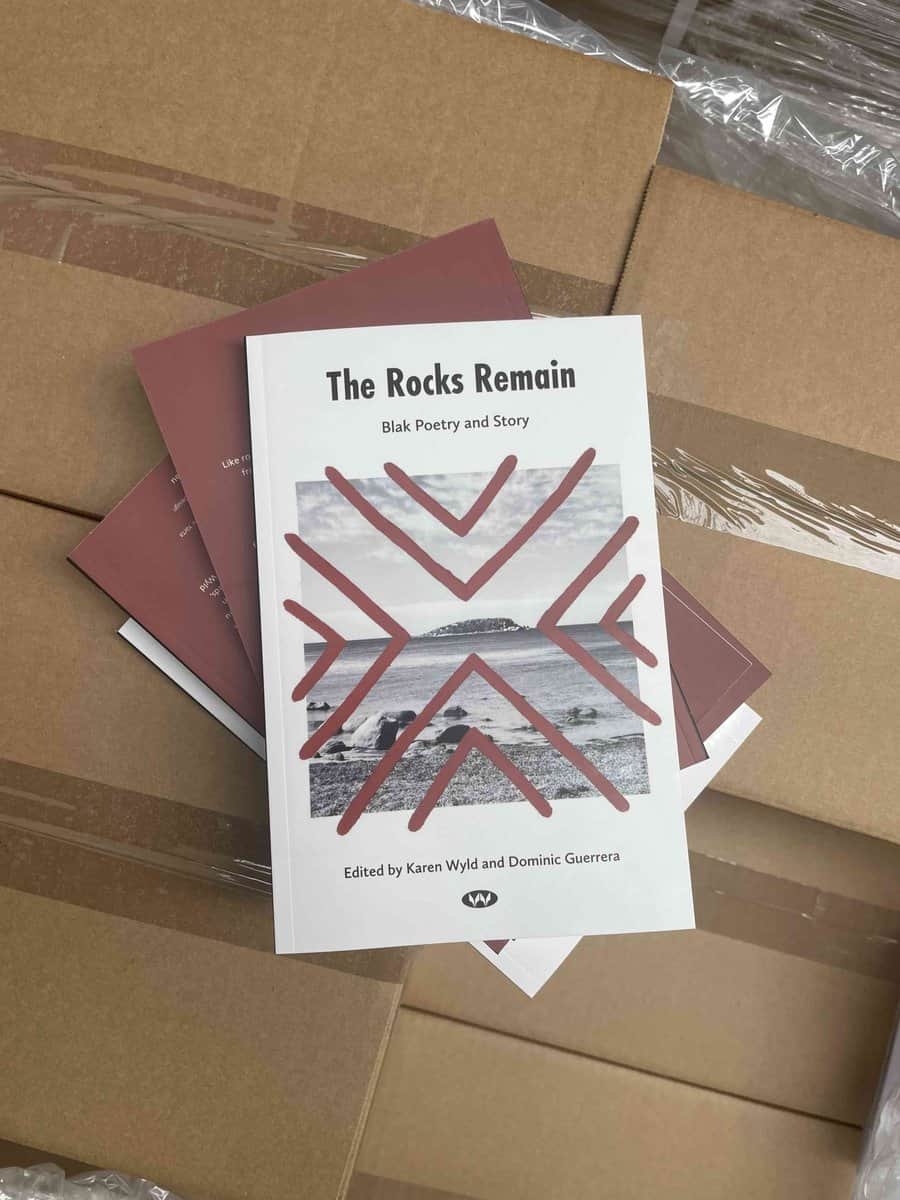
Through poetry and prose, 25 Aboriginal writers share narratives that embody: strength of family and community; love found and lost; enduring relationships with the Land and nonhuman others; honouring Elders and Ancestors; expressions of place and belonging; asserting sovereignty; talking back to the colony; and envisioning Blak futures.
The Rocks Remain entwines voices of new and emerging writers with writers of renown, with a strong representation of writers with connections to South Australia.
Good Reading chose a short story to share.
Vermin-Proof Fence
Rick Slager
Luke idled along in his ute, patrolling the boundary fence. Pasture on his side, dense scrub on the other. Watching and waiting for the approaching front, he steered with his knees to free up his hands to roll a ciggy. His UHF radio crackled with voices swinging between blame, panic, humour and despair, depending on their vicinity to danger and loss.
‘… where’s the help from the government?’
‘… getting away from us …’
‘… need pumps and radios …’
‘… no one’s ever seen it like this …’
‘… throwing resources at us if we were Abos …’
Popping the ute out of gear and rolling to a stop, Luke sat for a moment and sparked his ciggy to life, drawing deeply. He exhaled a plume of blue smoke, then hopped out to check the fuel level in the pump and water in the tank on the tray for what felt like the hundredth time that day, as he had done every day over the past two weeks. He’d thought stepping up and volunteering would be about saving lives; stopping the advance of the front, protecting towns, saving his Country. It wasn’t like that at all.
To the north and west the billowing cloud of smoke reached high into the atmosphere. It was growing in intensity with the heat, filtering the light and tainting the day sepia. The smoke looked like how he imagined a cyclonic storm would, except for the different hues: black, white, brown, depending on what was burning. An increasingly hot, gusty wind relentlessly rolled across the bush, dropping ash, burnt gum leaves and embers like a filthy black snow.
A spot fire burst to life in the dry pasture he was patrolling. He pushed up the throttle of his pump and jumped back in his old ute.
Adrenaline spiked his heart rate as he raced, bumping across the hundred metres of dry pasture, putting himself in front of the fire’s path. Opening the nozzle of his water hose he doused the flames before it could get into the heavily vegetated bank on the far side of the paddock.
Luke’s elevated heart rate escalated his headache which he’d had for more than a week from breathing in too much smoke – it throbbed behind his eyes. Pushing up his goggles, he spat the sodden cigarette butt out of his mouth and squeezed his eyes closed, pushing them with his filthy, burnt fingers, rubbing ash, dirt and sweat stinging into his eyes.
‘… getting away from us …’
‘Haha, what are ya doing …’
‘… it’s all gone.’
When Luke first ventured out to fight the fires he naively assumed a disaster like this would bring the community together, the whole community. Us versus the destruction of everything we hold dear. It wasn’t like that at all. The same old sides existed now as they did before.
It shocked him that protecting farmers’ boundary fences was the main objective.
Houses, sheds, machinery, stock and pasture also had varying importance but not necessarily in that order. You’d be laughed at if you mentioned protecting the bush and the native animals that lived in it. People saw the natural environment as the cause not something that needed protecting.
Stock made money but could be moved or covered by insurance
Pasture fed the stock but if it burnt it would regrow and the stock could be fed hay. Boundary fences kept the stock in the paddocks and native animals off the pasture. Any grass the native animals ate was energy that could have been converted into growth of the stock and therefore money. Without a functioning boundary fence a farm could not make money. Rebuilding it after a fire was a massively time consuming job (if the materials could even be found in a post-fire market when everyone would be after them)
Luke let the nozzle of his hose dribble cool water over his burnt hand. The pain from the blisters, now burst, was unrelenting. He had picked up a twisted steel star-dropper from the remains of a destroyed fence to avoid anyone puncturing a tyre, but it was hot from laying on the smouldering ground. The pain brought unwanted memories of patrolling other fence lines during the fires. Things he now dreamt about, things he knew he’d never forget and would have to witness again. Guilt bubbled up in his chest
He got back in the ute and attempted to roll another durrie but the paper tore apart in his wet fingers. Flicking away the soggy mess he resumed his crawling patrol, looking for spot fires, trying not to think about what was coming. It didn’t work. The radio continued with its constant chatter:
‘… fucking national parks …’
‘… what were they thinking?’
‘… a lot to answer for …
Some of the shame he felt was justified but other ideas he knew were complex and unwarranted. The farmers blamed the national parks for not maintaining their fire breaks or acting quick enough when the fires started. But the farmers neglected any land under their control that wasn’t arable. And then there was the changing climate.
Warming up. Getting drier.
But isn’t all this Country really my people’s responsibility? He knew they had been shut out of the land since colonisation by the farmer’s fences
Unable to perform the ceremonies and caring burns that Country needed to maintain its health. So it’s not really my fault, is it? And Luke’s family had assimilated early, only now was he learning and reconnecting. Yet because of this he felt his ancestors watching. Waiting
Picking up his phone to check for coverage, the screen showed a thermometer and read, ‘Temperature. Phone needs to cool down before you can use it.’ That’s not going to happen. There hadn’t been any phone reception for a week anyway, but Luke kept checking, wanting to call his neighbour. He was worried about his dog, Millie, his best mate, shut up in his rented house back in town. He hadn’t seen her for days because he’d been camping out to fight the fires, protecting farmers’ fences.
He looked to the southeast, back toward town. The plumes of smoke were so big it made it impossible to guess how close the numerous fronts were to the town. He was almost glad his phone wasn’t working so he couldn’t look at his socials. The information he did get came from word-of-mouth or the ABC radio and was incomplete, out-of-date or plain wrong. Someone he randomly bumped into handing out cold toasted egg and bacon sandwiches and just out-of-date iced coffee swore the town would never be allowed to burn; last refuge, vital infrastructure and whatever. Then yesterday he’d heard on the UHF radio that the pub and the school were gone, sending terror lancing through his heart, but the story turned out to be bullshit anyway.
Another spot fire started up on the other side of the dam – he almost didn’t see it in time because the light was beginning to fail due to the increasing thickness and ceaseless approach of the main smoke cloud
When he did notice the flames he jumped out to turn up the revs of his pump, clambered back in and gunned the ute over to put it out.
In the end, the bare earth of the dam wall gave him the chance to get it under control as it starved the building fire of fuel.
 Turning the pump back down to an idle, Luke dried his shaky hands and rolled and lit a smoke. In the relative quiet he thought he heard the sound he’d been dreading but expecting. He killed the pump and listened. Sure enough, he could clearly hear the roar of the front now. His heart rate began to ratchet up again.
‘Luke. Are ya there?’ The radio jolted his awareness back to the ute.
Fumbling with the radio he pushed the button and responded,
‘Yeah, Luke here. What’s going on?’ He didn’t know who was on the other end and it didn’t much matter.
‘Are you ok over there? Has it got to that fence line yet?’ The disembodied voice asked.
‘Not yet but I don’t reckon it’s far off.’ Luke let go of the butt
Pressed it again, ‘Hard to tell though.’
‘We’re busy over on the north-eastern boundary.’ Luke had no idea where they were talking about. ‘You’ll be all right over there won’t you?’
Who the fuck knows. ‘Yeah. I’m alright.’
‘Let us know if you need a hand mate.’
‘Ok.’ If Luke had learnt anything over the last two weeks, and he’d learnt a lot, by the time he realised he needed help it was generally too late. But what could he say? The fire had rolled over everything that might have stopped a normal fire; bulldozed breaks, roads and creeks; first the CFS and then the farm units fleeing before it. But you had to try …?
As Luke pulled the rip cord, bringing the pump back to life, and pushed the throttle up to its maximum noise, the smoke started rolling through at ground level, so thick that his eyes and nose were streaming with tears and snot. He jumped back in the ute, pulled down his goggles and tried to clean them, smearing more sweat and ash across the gritty lenses. Pulling up his filthy dust mask from under his chin, he vowed he’d steal better ones out of the next CFS truck he came across, even though he hadn’t seen one for a couple of days.
They were a weak attempt at keeping the smoke out of his eyes and lungs but it was all he could do to prepare himself to protect the fence from the now imminent front.
Luke’s anxiety was building with the roar of the fire. He made the decision to abandon monitoring the spot fires in the pasture and let it burn. He started a slow drive up and down the boundary fence peering through the smoke into the scrub on the other side. It wasn’t long before he started to see the orange and red flickers of flame through the darkness of the dense bush and hear the crackle and pop of drought-dry eucalypt igniting over the general howl of the encroaching inferno
It was the moment he’d been dreading. At first it was the birds, landing on the fence and in the branches of the trees on the edge of the scrub, fleeing the fire, fighting their natural instinct to stay in the cover of bush. An owl, feathers aflame, flew and crashed into the tree canopy just over the fence. The guilt surged in his gut, up his throat, like ash on his tongue. In ones and twos, and then in dozens, came the wallabies, kangaroos, possums, echidnas, bandicoots, goannas, koalas and everyone else. Racing away from their usual refuges in the scrub toward the relative safety of the open pasture only to run headlong into the vermin-proof fence. The chest-high, ring-lock wire fence with chicken wire covering the bottom half and topped by double strands of barbed wire, held up by pine posts, was built specifically to keep out all but the bravest kangaroo – kangaroos willing to risk a bullet for the farmers’ precious pasture. The vermin-proof fence Luke was responsible for protecting was identical to so many he had protected and some he’d lost over the past two weeks. At every fence line he’d witnessed and enabled similar events as he watched them unfold before him.
Animals bolted up and down the fence mirroring Luke’s slow patrol on the opposite side as they looked for an escape from the burning bush, choked with decades of neglect. The fire was so close now that some fence posts were igniting from the radiant heat, even though the flames were metres away over the bare ground of the break, so Luke started to methodically hose them down one after another. The animals were bashing into, and tumbling over, each other in their panic, with the odd quietness of native animals, nothing more than their odd rasping calls to voice the pain of burning fur and fles
A huge buck kangaroo came bounding out of the burning scrub, more than half-blind with pain, making for the open pasture. He missed the jump, tumbling over the barbed wire in a mess of ripped flesh, burnt fur and ash. He picked himself up and continued on his mad dash into burnt, hot but relatively safe open pasture. As Luke turned back to the fence the whole scrub line was ablaze. He saw a koala in a sugar gum deceptively calm, attempting to remove the fire from its body but only managing to scrape away the burnt hair and skin revealing the pink and black flesh beneath. He raced along, his ute revving too high between fence posts, not changing out of first gear so it wouldn’t stall as he slowed every 10 metres to douse the flames eating each pine post. Not having a mate on the back of his ute to hold the hose, Luke could only fight the fire out of the driver’s side window. So at the end of each run along the fence he turned around and gunned it back to the beginning to start the process again.
Luke tried to saturate the animals at each post but he knew he was running out of water and the farmers would be angry with him for wasting time and water on them when it meant fence posts burning
The tone of the pump changed and the water spluttered out. He was empty. Luke jumped out of the ute, turned off the pump so it didn’t overheat from running dry, got back in and raced across the three hundred metres of smouldering grass to the dam to refill
Luke took the time waiting for the tank to fill to tell the others over the UHF that the fire was at the fence line and he needed help. He screamed it into the chaos of voices on the radio but it was a waste of time. Everyone was fighting their own battles as the fire swarmed all the farms in the area. The UHF was awash with panic. Men yelling over each other, breaking each other’s sentences into gibberish with their own calls for help, requests of what to do, asking where the fire was, men crying.
The water tank filled and Luke raced back to the fence and found animals piled up against it, a writhing mound of pain, hundreds of metres long. The intensity of the front had peaked, all the leaves of the eucalypts and the grasses and understorey were on fire. All the flammable material around the base of the fence posts had burnt away so the ones that were left would probably endure if he kept dousing them one after another. The animals wouldn’t.
Luke thought of Millie waiting for him at home. He looked at the animals that his people had lived beside forever, who, no matter how he looked at it, he had an obligation to care for. He looked at the pasture still burning in spots, carrying the fire towards the bush lining the creek on the other side of the paddock. Another paddock closer to town and his dog.
These people he was helping saw no value, held no respect for the bush or the native animals that lived on their land. Holding the land, making fortunes from its desecration had to mean they held responsibility for it. Not just the arable acres and domesticated animals and plants. All of it. They need to share the land with the other animals, not treat them as vermin or the non-arable acres as wasteland. Everyone must hold responsibility. We can’t let this keep happening.
Luke made up his mind. He chose a side. Rolling to a stop, he got out and picked up a pair of pliers out of the tray of the ute. Wishing he had done it the first time and knowing this would probably be the last time he’d get the chance, because he’d never be trusted to protect one again, but also knowing his ancestors stood beside him; he cut the vermin-proof fence.
Shielding his face from the intense heat, he tripped on the desperate animals streaming around him and fell to the hot ground. He crawled out of reach of the flames and stumbled to his ute, blind from the tears and smoke, nose streaming with snot and unable to take a deep breath. He leaned on his ute ripping off his mask, vomited and cried.
When Luke could see again and breathe a little easier he washed the vomit from his face and shirt with the fire hose, climbed back into the ute and cruised the vermin-proof fence one more time. Ignoring the posts now fully ablaze he stopped to cut it every twenty-five metres or so, letting the animals that were still capable of moving escape into the open pasture.
His eyes and nose were running so much when the farmer found him he didn’t realise Luke was crying. He was spraying down burnt animals with water if they didn’t run away and clubbing those that were too burnt to survive with a hardwood club he usually used to dispatch animals that tourists hit with their cars and left floundering on the roads.
‘What the fuck are you doing wasting time here? That fence is fucked. I’m going to help the Smiths over on Rifle Range Road,’ the farmer yelled before tearing off across the paddock.
Luke stood with a dead koala at his feet, waddy covered in both blood from the animals and from his burn-wounded hand hanging at his side. He stared at the dozens of animals on the burnt paddock standing in little groups. It was odd seeing them out in the open during the day, even in this madness. Many of them were alive. Almost all were burnt to varying degrees. Some without feet or eyes.
Too many injured beyond hope of recovery and suffering in their last agonising hours of life for Luke to put them out of their misery, and too few people capable or willing to give enough of a shit to help.
Luke chucked the waddy in the tray of the ute and flicked the kill switch on the pump, cutting its endless noise. He got in the cab and drove slowly across the paddock to the gate, then turned onto the gravel road, toward town and his dog Millie.


0 Comments