



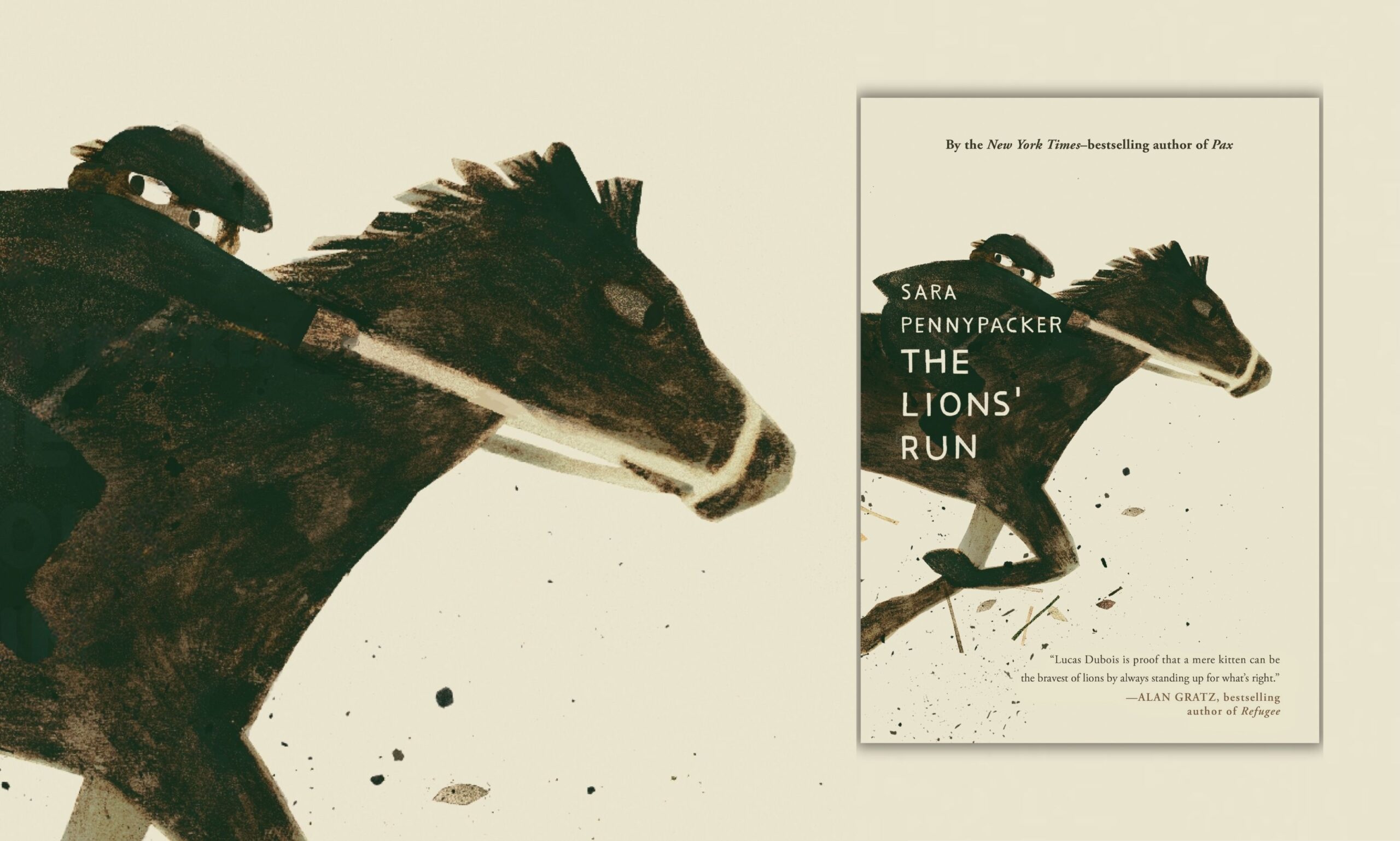
The Lion’s Run by New York Times bestselling author SARA PENNYPACKER delivers an unforgettable WWII novel about an orphan who discovers unexpected courage when he becomes involved with the Resistance in France during Occupation.
Read on for an extract.
ABOUT THE BOOK
 Petit eclair. That’s what the other boys at the orphanage call Lucas. He’s tired of his cowardly reputation, just as he’s tired of the war and the Nazi occupation of his village. He longs to show how brave he can be.
The chance arrives when he saves a litter of kittens from cruel boys and cares for them in an abandoned stable. There he meets Alice, the daughter of a horse trainer, who is hiding her beloved young horse from German soldiers.
Soon Lucas begins to realise they are not the only ones in the village with secrets. The housekeeper at the German maternity home and a priest at the orphanage pass coded messages; a young mother at the home makes dangerous plans to keep her baby from forced adoption; and a neighbour in town may be harbouring a Jewish family.
Emboldened by the unlikely heroes all around him, Lucas is forced to decide how much he is willing to risk to make the most courageous rescue of all.
**********
EXTRACT
ONE
Lamorlaye, Occupied France, March 31, 1944
A little freedom. Lucas had only a few deliveries this afternoon, and if he was quick with them, he’d finally have a couple of hours to himself before he’d have to show up back at the abbey.
Lately, his life felt like a coat that was too small, so tight he could barely move. The same damp stone walls confined him while he slept, ate, and went to classes; nuns and teachers monitored his every step and the other abbey boys crowded him for trouble or position. And the occupation, of course, nearly four years of it. The Germans with their restrictions and checkpoints, the sharp ‘Halt!’ and ‘Nein!’ of their orders. A couple of hours wasn’t much freedom, but he knew just where he wanted to spend it. His prized fishing lure was already in his pocket.
First, though, to the greengrocers’ to pack up the orders. He hurried to his bike and even that felt like an escape. Just as he dialled open the lock, though, he heard a commotion of curses and cat yowls coming from the rear of the abbey grounds.
Lucas paused. He hadn’t been fishing since the fall. But those sounds. Sighing, he snapped the lock back on and followed them.
Two pairs of thrashing legs extended from the tool shed. Sister Marie-Agnes was standing beside the legs, waving an empty sack and shouting, ‘Get them all! Every one!’
Lucas easily identified the boys under the shed by their pants – abbey orphans had only two sets of clothes, ‘One for wear and one for wash,’ Mother Antoinette always said she pulled them from the ragman’s cart –and he took a step back to stay hidden. At 15, Marcel and Claude were the oldest boys at the abbey, both mean as cornered rats, and Lucas was their favoured target.
His heart fell as he realised who the cat must be. He’d been wondering for weeks where the church’s friendly tabby was hiding, hoping she’d find a better place have her kittens this year. The spring before, she’d chosen a pile of altar cloths in the sacristy. When the organ began playing one Sunday morning, they’d started mewling. Sister Marie-Agnes had stormed down the aisle, bagged them up, drowned them, and was back before the final hymn, the hem of her habit dripping canal water.
Now, she called, ‘Too many mouths to feed as it is. But spare the mother, she’s a good mouser.’
Claude and Marcel wriggled out, fists full of struggling fur, the mother cat tearing fiercely at their legs. Even from the distance he was keeping, Lucas sensed how scared those kittens were. Anger flared hot in his chest.
The little tabby kept fighting as they stuffed her kittens into the sack. Lucas cheered silently when she leaped to Marcel’s shoulder and slashed at his face, drawing bright red lines from brow to chin. But then Marcel flung her off and she hit the corner of the stone shed with a thud Lucas felt in the pit of his gut. The cat staggered back to cower under the shed, as if she understood there was nothing she could do.
When Marcel cinched the sack, Lucas squeezed his eyes shut. There was nothing he could do, either. Two against one; the two known to relish brawls, Lucas famous for running from them.
Still, when the boys left, the sack bumping off Claude’s shoulder, he made himself get on his bike and follow them at a safe distance. He had no illusions he’d suddenly grow brave enough or stupid enough to challenge those boys. Petit Éclair, that was him, after all. And he knew it would make him miserable for days to see the drownings. But he also knew he would feel ashamed if those kittens died alone without even a witness. And he was sick of feeling ashamed.
TWO
Lucas dropped off his bike and stood quietly a few yards back from where Claude and Marcel had stopped at a bridge. As they were prying up rocks to weight the sack, though, Marcel glanced around, as if to make sure no one was watching. ‘Hey! What are you doing here?’ he shouted, rising with a rock in his hand.
Lucas spread his hands. ‘I. . . Can I have them?’
Marcel and Claude exchanged looks, half-annoyed, half-amused. ‘Why?’ Marcel challenged.
Lucas approached a few steps. ‘Because. . . the greengrocers want a cat. They’re having a problem with mice. The baker, too.’
The boys scoffed at the ridiculous lie. No one was looking for a cat these days; dozens of them slunk through the streets, thrown out when food became too scarce to spare for a pet.
‘Just. . . please. I won’t tell Sister Marie-Agnes.’
Claude and Marcel looked at each other again. When Marcel smiled, Lucas suddenly realised how much trouble he was in.
Marcel, clever and sly, loved nothing more than to see other people fight. His crooked nose and the scar through his eyebrow indicated that he’d taken some beatings himself in the past, but now he strictly preferred fighting as a spectator sport. He had groomed Claude, who had nothing going for him but resentfulness and muscle, for his ready-made entertainment, feeding the bigger boy grievances like custard. Claude was too dim to question them, and Marcel could easily rile up the bigger boy until he threw some punches.
Lucas saw Marcel eye the plane tree beside them, its wide lower branches a safe place to watch a fight, and knew just what was going to happen. A shiver of sweat bloomed down his spine. It was all he could do to not run back to his bike.
‘Hey, Claude, you going to let a coward like him tell you what to do?’ Marcel goaded.
‘No, Claude, I wasn’t telling you what to do. It’s just. . . they aren’t hurting anybody. Let me have them. Please?’
Claude squinted, thinking it over. For a minute, it looked as if it could go either way. Then Marcel sealed Lucas’s fate.
‘He’s not listening to a petit éclair like you, begging for a few kittens like a girl.’
Claude took a step forward and Lucas took a step back. ‘Please,’ he pleaded. ‘Why don’t you just let them go? Look. You’re bigger than them. It isn’t fair.’
‘Fair? What. . . you think they should be able to fight us?’ Marcel sneered.
That was exactly it, actually. Fully grown cats could fight back, at least. He couldn’t help glancing at Marcel’s face, still oozing red from the mother tabby’s attack.
‘What are you staring at?’ Marcel snarled. Then, suddenly he reared back and threw his rock.
For a moment, Lucas stood there, his mouth filling with coppery blood. His whole body vibrated with the shock. Fists clenched, he leaned over and spat.
‘Oh, Petit Éclair is getting angry!’ Marcel taunted, his hands waving in mock alarm. He whispered something that made Claude snicker – Lucas caught only the word coward – and then they both crouched to fill the sack, their backs turned to Lucas in insult: He wasn’t even dangerous enough to warrant watching. Claude tossed in a last stone, then got up and hoisted the sack.
Lucas knew then that whether he stayed or left, those kittens were going in the canal, cold and deep below this bridge. He jammed a hand into his pocket to rub the horse chestnuts he kept there for times like these.
When he was upset, their smooth surface calmed him. And in his pocket, he found one more chance. ‘Wait!’
Marcel and Claude turned, as if they couldn’t believe their ears. He was asking for more?
Lucas pulled out his hand and offered them his fishing lure. Finely painted with iridescent scales and feathered fins, it had been a gift from a retiring teacher who’d taught him to fish. ‘I won’t tell,’ he promised again.
For an instant, it looked as if it had worked. Marcel grabbed the lure, then nodded to Claude.
Lucas began to thank him, but Claude didn’t hand over the sack. He swung it out toward the canal and let go. Then both boys ran off, laughing.
Lucas sprang to the rail. The bag was only partly submerged, the dry burlap darkening fast. He skidded down the bank and pulled it out. Kneeling in the mud, he lifted out six tiny bodies from the stones, wet fur clumped over fragile bones.
Five of them sputtered and mewed and shook beside him.
One body was still. Lucas lifted that one, gray-striped like its mother, and draped it over his fingers. It was impossibly light. He dabbed the mud from the kitten’s face with the tip of his shirttail, but the kitten didn’t stir. He blew at its face, but the kitten didn’t stir. He knew then. He knew. Still, he shook the little body softly; still, he pressed on its chest with a single finger, felt the tiny ribs give and not spring back.
At last, he stopped. ‘I see you,’ he mumbled because words had to be said, and those were the only ones he could find. ‘I saw you.’
Then he prized a big rock out of the ground and settled the dead kitten into the cavity. He held the rock over the hole – at least the body wouldn’t be picked apart by hawks or badgers – but he could not drop it over the grave. He could not leave this little body in this place, alone.
Lucas sat back on his heels. He felt sick, but he swallowed it down and scrubbed at his welling tears. Then he picked out the dead kitten and nestled it back in the sack.
He turned to the other kittens, now squirming away, their tiny claws grasping for anything solid.
He was their solid. It was their bad luck there was no one else.
ABOUT THE AUTHOR
 Sara Pennypacker is the author of the New York Times bestselling Pax and Pax, Journey Home; the award-winning ‘Clementine’ series and its spinoff series, ‘Waylon’; and the acclaimed novels Summer of the Gypsy Moths and Here in the Real World. She divides her time between California, Massachusetts, and Florida.



0 Comments