



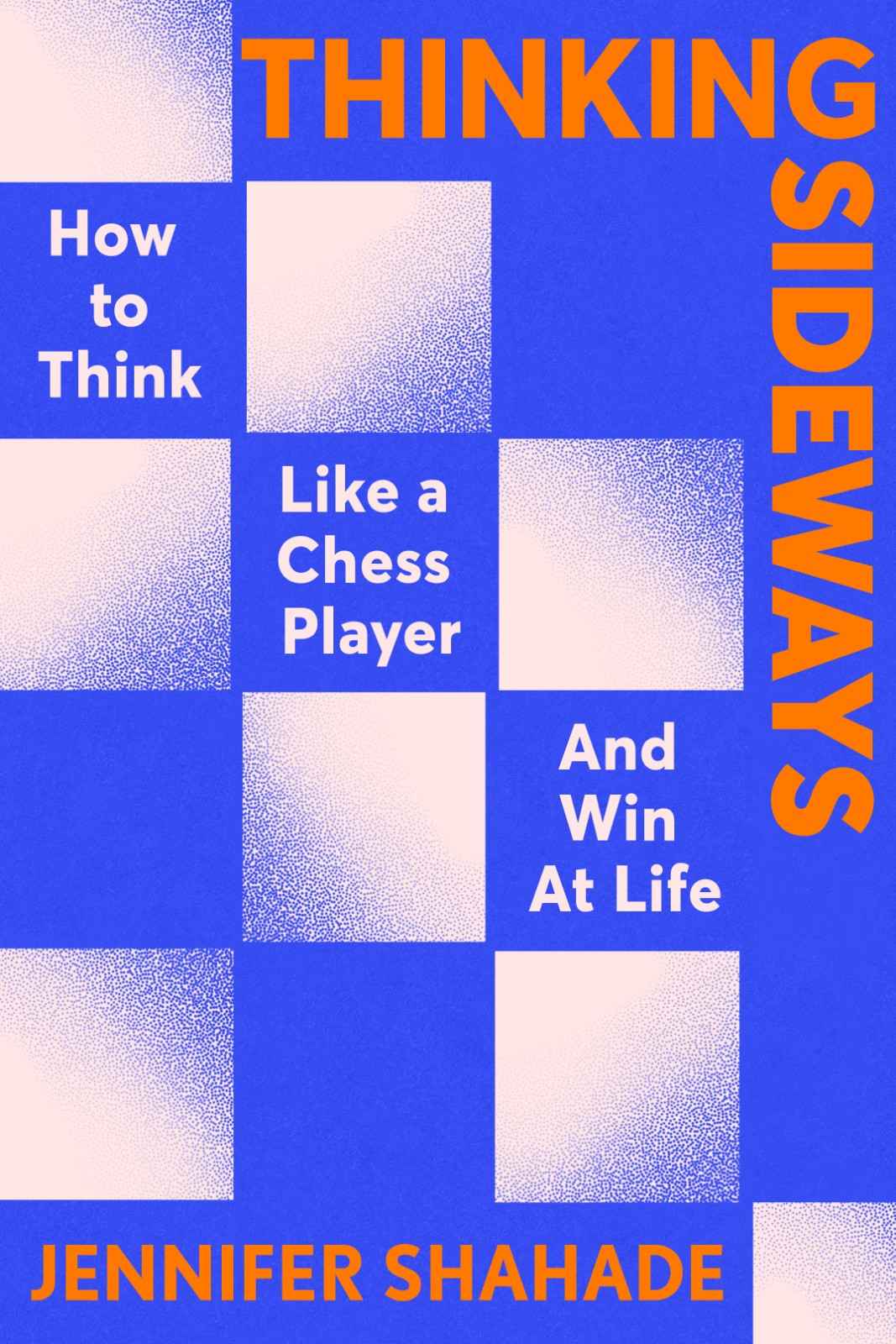
Thinking Sideways by JENNIFER SHAHADE is not just a book about chess, it’s about to take the essential life-lessons from playing chess and weave them into your own life. Read on for an extract.
ABOUT THE BOOK
 Chess is the art of the possible – after all, there are more possible chess moves than atoms in the universe.
Chess players are experts in considering their options, allowing them to seize an opportunity, idea, or move that no one else saw. Two-time U.S. chess champion Jennifer Shahade calls this “thinking sideways.” And in today’s hyper competitive world, thinking sideways can help you win at life.
In Thinking Sideways, Shahade shows you don’t have to be a great chess player to think more like a chess player. From building mind palaces to crafting decision trees, she reveals the most useful strategies from the ancient game that we can use in our daily lives. Drawing on examples from business, sports, and psychology, as well as her own experiences touring the world as a chess and poker player, Shahade transforms our understanding of what success looks like, and how to achieve it for ourselves.
This book is not about playing chess better, or even playing chess at all – it’s about how thinking sideways can propel you to success and happiness.
**********
EXTRACT
Decision Trees
Chess players think sideways. That’s what the British government were counting on when they enlisted a group of chess champions to break Nazi codes. As part of the now legendary Bletchley Park team, they were given the task of cracking the Enigma code, which encrypted critical Nazi messages during the Second World War. One of the Bletchley Park teams was led by the eccentric genius Alan Turing, who made one of the earliest chess computers and played a decent game himself. To relieve stress, Turing used to combine two passions: chess and running. One move of chess, run around the house, another move, another run around the house, and so on.
The brainy Bletchley Park team were vital to the Allied war effort though not everyone understood their unorthodox methods. But someone did. When the team warned prime minister Winston Churchill that they were running low on funds, they got a quick response: ‘Action this day’, with Churchill calling their work an ‘extreme priority’.
 Twice British chess champion Conel Hugh O’Donel Alexander, a key member of the Bletchley Park team, was one of the most skilled at breaking codes using a technique that became known as Banburismus. It was based on logic similar to what we now think of as Bayesian reasoning, which uses probability, in this case to predict text. This allowed the code-breaking team to figure out partial phrases on the way to reconstructing an entire message, which was much faster than trying to decode them by brute force. There were a mind-boggling 159 quintillion possible settings for the German Enigma machine. Even if you enlisted the entire British Armed Forces, testing each one was impossible.
To chess players, the idea of pruning such a large number of options into something manageable might seem oddly familiar. After all, chess has more possibilities than that, by many orders of magnitude.
It was the mathematician Claude Shannon who, in 1949, calculated there are more possible chess games than atoms in the universe.
His estimate, 10 to the 120th power, was coined the ‘Shannon number’. To imagine a number so large, take a 1 and add 100 zeroes: we call that a googol, a mind-bending number that inspired the name of the search engine. That’s still way too small compared to the number of possible chess games. Now multiply that googol by the number of possible Enigma settings. Finally, we are in the ball-park of the number of possible chess games.
Another powerful pruning innovation, allowing the Bletchley team to get closer to the correct answer by ruling out possibilities, was mathematician Gordon Welchman’s diagonal board, a 26 × 26 grid featuring the alphabet on both axes. This echoes chess, played on an 8 × 8 board. Chess has the power to make the complex seem simpler and it also can show us the hidden beauty and power of something that seems rudimentary, like a diagonal line.
Some historians estimated the Bletchley Park team shortened the war by two years, saving millions of lives. It wasn’t one big dramatic moment where they broke a code, discovered all the Nazi secrets, found Hitler’s location and the war ended. It was more like a slog, a constant back and forth as the Germans continued to improve the encryption methods and the Bletchley Park team responded. Rather than one long chess game, it was a series of games, that had to be strategised and played anew each morning (or each midnight for Alexander, who preferred the night shift). As Stuart Milner-Barry, a chess master who personally delivered the plea for more funds to Churchill, put it:
‘It was rather like playing a tournament game (sometimes several games) every day for five and a half years.’
To break the code, they created systems to ask better questions. It was not all about thinking more moves ahead, but thinking more systematically and finding the best possibilities to check further.
This applies to all sorts of stakes, from the monumental to the everyday. We won’t always be able to accurately predict what happens next. In these cases, thinking in breadth is even more important than thinking far ahead. When it’s our move, we still control the action. When we plan ten moves in advance, there are so many factors that are totally out of control, making it much more likely that our long-term plans will be foiled or moot. If he does that, I do that. When he does that, I’ll do that. It’s a constant back and forth. As Winston Churchill said in a 1945 speech to the British Parliament: ‘It is a mistake to try to look too far ahead. The chain of destiny can only be grasped one link at a time.’
Growing Decision Trees
 In 1971, Soviet champion Alexander Kotov introduced a powerful metaphor for optimal chess decision making: a tree.
It all starts with identifying the branches, representing the options you are considering. A chess player may find themselves torn between a bishop retreat or a knight check. But what about a rook move? Instead of starting analysis right away, Kotov insisted that students first identify all their options. Then look at each branch, one by one. This organised and deliberate way of analysing, Kotov thought, was critical. ‘You must not wander here and there, to and fro.’ He didn’t underestimate the task: ‘One must be a real Tarzan to move unscathed through such tangled thickets.’
When I read Kotov’s book as a teenager, I was bamboozled by his observation that even very strong chess players can have sloppy thought processes. A chess player should be as organised as a wedding planner, according to Kotov’s method, with systematic ways of thinking.
ABOUT THE AUTHOR
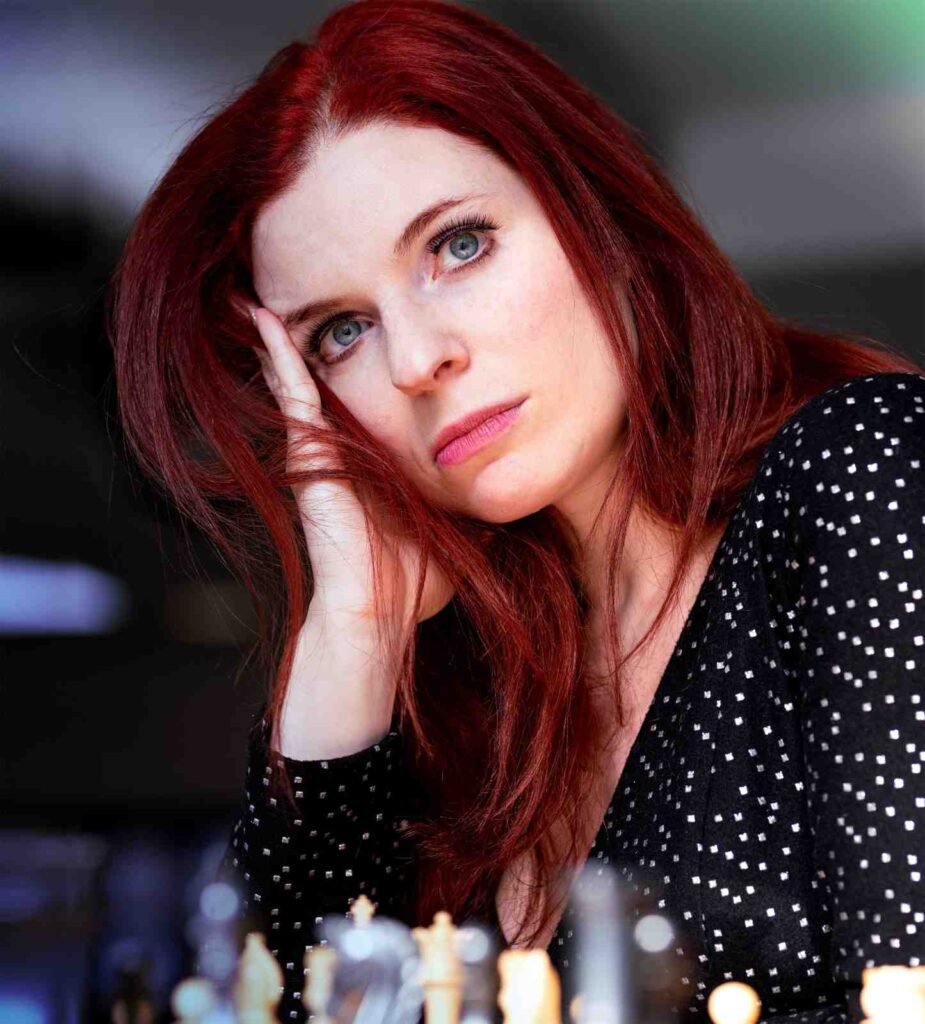 Jennifer Shahade is a three-time National Chess Champion, poker pro, speaker and author. Jennifer was the first female to win the US Junior Open, and won two US Women’s Championship titles. She is a two-time Global Poker Award Winner and has won poker tournaments all over the world. Her previous books include Chess Queens, Play Like a Champion and Play Like a Girl! Her writing has appeared in the Wall Street Journal, Washington Post, and Financial Times. She lives in Philadelphia with her family.
Visit Jennifer Shahade’s website here
Follow Jennifer Shahade on Instagram here.
Visit the publishers website here.


0 Comments