



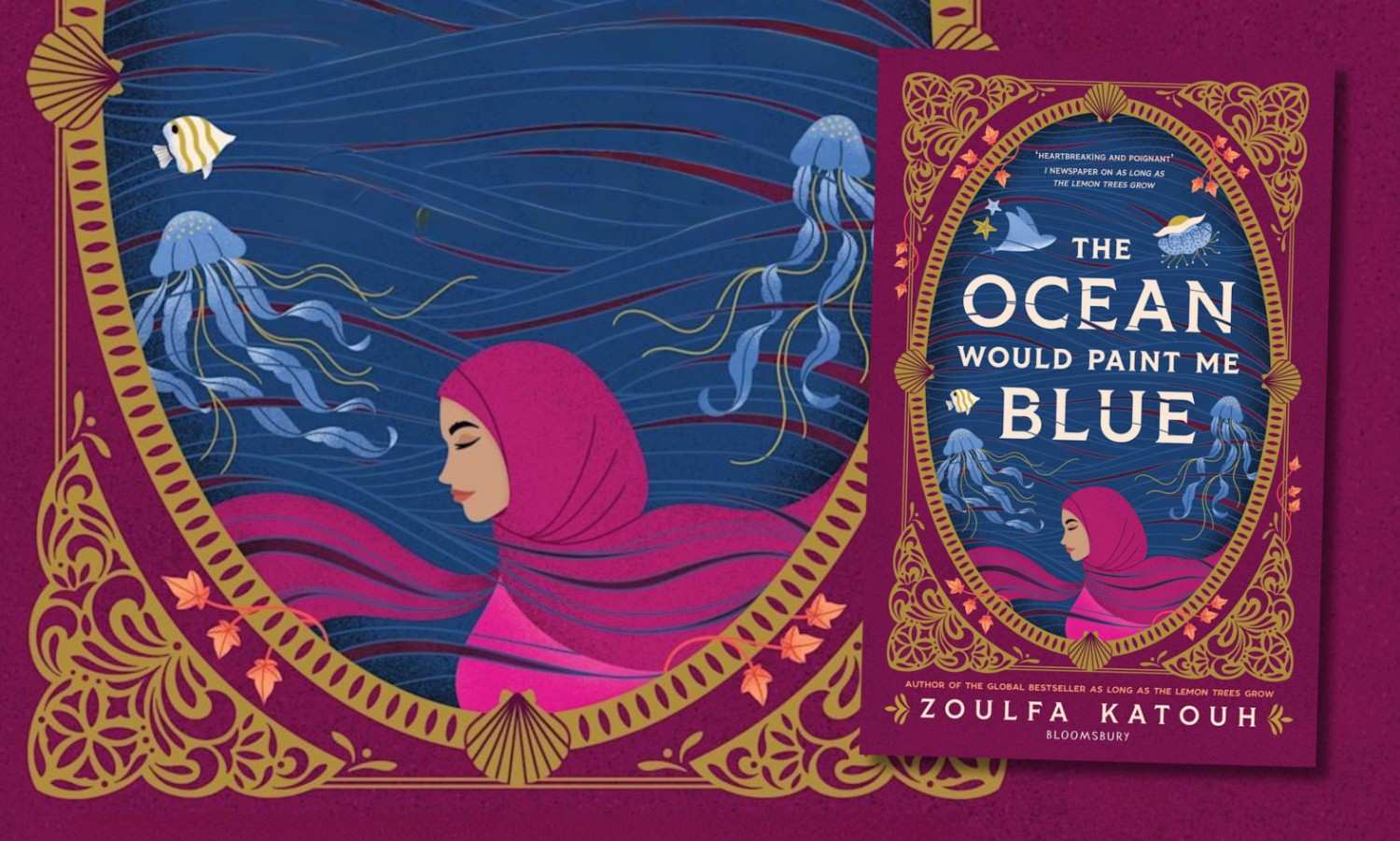
The Ocean Would Paint Me Blue by ZOULFA KATOUH is the story of a Syrian American teen, the only Muslim student in her class, as she navigates grief, identity and systemic injustice in contemporary America.
Read on for an extract.
ABOUT THE BOOK
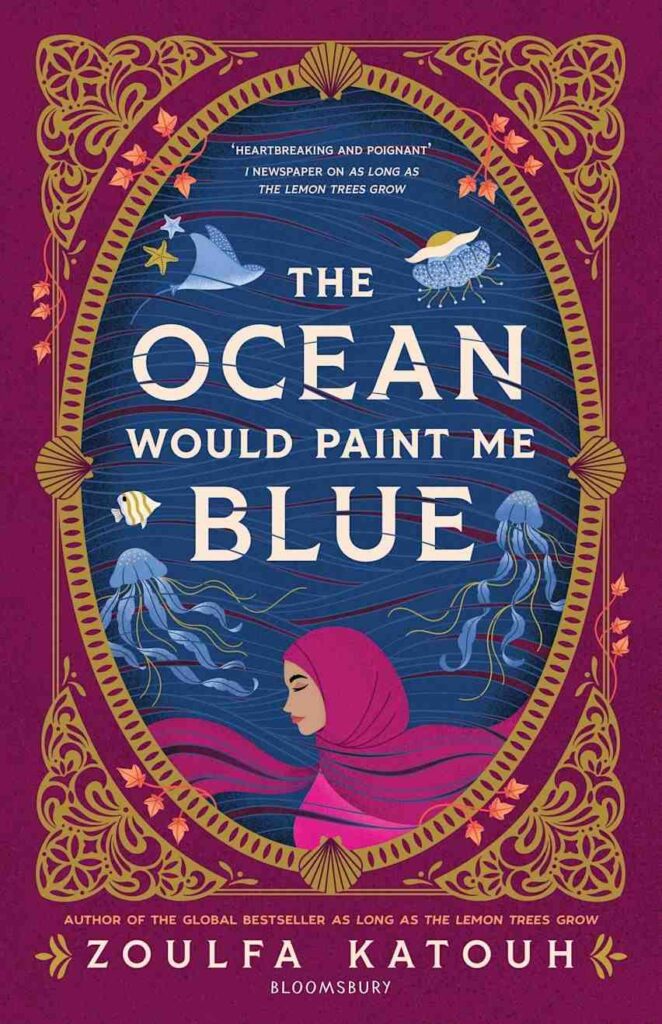 Joining an exclusive high school should be a fresh start for Jihad after her mother’s sudden death. But she’s the only Muslim student there; her hijab and even her name make her new classmates suspicious.
Only one person treats her with kindness but Jihad can’t help questioning his motives. It’s hard to trust anyone when she meets indifference or hostility all around her. As tension mounts, she finds refuge in an old sketchbook and in the stories her mama used to tell her. She is determined to focus on making it to art school and a brighter future, but as she starts illustrating her mother’s memories, her canvas becomes bigger than she could ever have imagined.
Can Jihad become as resilient as the true meaning of her name, and let the colour back into her life?
**********
EXTRACT
GREY
I see a speeding car from the corner of my eye. I shiver as if feeling the rumble of the pavement from behind the register.
When I blink, a colourless world unfurls in front of me. For more than a year now, I have been able to see only in grey; all the colour has disappeared from my universe.
The gas station Baba works at sits on the precipice of I-80, which connects New Jersey to the beaches of San Francisco. One straight line that leads to the Opus School of Art – the college of my dreams. It was founded by a winner of the Nobel Prize in Literature who used her earnings to open and fund the school. Those who have graduated from it have gone on to make their mark on the world through photography, painting, and museums. Sometimes during the quiet, boring moments here, I take out my phone, open Google Maps, and follow the line with my finger, trying to imagine the way there. But I can’t fully visualize it. Everything has become dulled, vague, like a pencil smudge.
The only thing that’s been consistent is the burning need inside me to be in San Francisco. Even if I can’t see the blue of the ocean when I reach it, it won’t matter.
Every dashing car is a promise. A wish made on a birthday cake with a flickering candle. I focus on the wishes. The big ones first, then the small ones.
I wish Opus would admit me.
I wish Amal and her husband would find jobs in San Francisco and move with me.
I wish Baba would look at me. Like, actually look at me. I wish I could finish senior year quickly.
I wish I could see colour again.
Once, my life was a burst of colour in shades of sunlight yellows, burning reds, forest greens, galaxy purples. My sketchbooks reflected that, painting what my eyes could see and others’ couldn’t. The colours danced. They swirled around me – hues reflected on my skin. They rippled like waves and splashed like waterfalls.
They were my entire life. And now they’re gone, leaving behind an eternal grey.
The swishing sound of the sliding door breaks the train of wishes, and I straighten up. Sam, one of the regular truckers who comes into this gas station, heads straight to the fridge to get his usual four-pack of Red Bulls before coming to the register.
‘Evening.’
I ring up the Red Bulls. ‘Long night?’
He nods, thick eyebrows knitting together. He’s in different shades of grey, but his beard and moustache are a lighter shade than his hair. I can’t seem to remember if his hair is brown or auburn. If his eyes are brown or blue.
I pinch my thigh to focus.
‘Have a delivery to Pennsylvania,’ he says gruffly before squinting at me. ‘Don’t you have school tomorrow?’
‘School isn’t for another two weeks.’ The register clangs. ‘That’ll be ten dollars and ninety-eight cents.’
He nods absently, taking out his wallet and handing me a couple of wrinkled bills. I watch him walk out, climb into his truck, and drive out the lot, joining the other blurs speeding by.
One day, I think, that will be me.
I rub my eyes. I’ve been here all day, helping Baba with the gas station. Although the real reason is to stare at I-80. It calms my thoughts, quiets the loud emptiness inside me. It’s the only hope I allow myself. Besides, if I’d stayed home, I’d have been in bed all day. Exactly how I spent the first few weeks of summer break, until my best friend, Alexis, pulled me out of my blanket fort.
Baba walks out from the storage room, ruffling his jacket. ‘Yalla?’ he asks in the same monotone voice he’s adopted for the past year. One that says he hasn’t been healing, doesn’t want to heal. One that says he’s been operating in survival mode for months. His hair is pale grey, and I wonder how that happened.
Helping around the gas station used to be fun. Baba helped build our fantasies until they became an intricate world that stretched as far as the eye could see. He came from the same town as Mama. His family was of the more practical type. But Mama came from something much more magical. It’s one of the reasons he fell for her. The way she expanded his life to be more than a monotony of going through the motions. She took his hand and showed him her world. His imagination was tentative but strong, and Amal and I spent many days fighting sea serpents and rescuing bags of chips from high ladders here.
We’re the last stop before travellers go on their journey, he used to say. It’s our duty to help them make it to where they need to go, and in a way, it’s like we’re going with them.
In moments like these, words splashed my world in colour. They became animated, not frozen. They danced like waves on the sea, shimmered like diamonds, and became alive. The chipped red paint of the gas station became lava, bubbling and moving with the wind. The dull yellow of the walls became as bright as stars, actually spilling to the floor. I could taste the colours.
When I told my parents how the colours whispered their stories to me, how they pulsed and breathed, I was worried they wouldn’t believe me. That this was a figment of a hyperactive imagination. But Mama said the blessing was awakening in my blood.
There are stories in my family. Blessings that brush the line between reality and magic. Passed down through the generations of women in my family like a gift. My great-grandmother’s house in Syria was the only one with sunflowers blooming all year. Through snow and hail, they had their petals stretched out toward the sun just because she grew them. Her daughter, my grandmother, could catch clouds with her bare hands and squeeze the moisture from them for the freshest, coldest water you’d ever drink. The village never went thirsty. Her sister could talk to the trees. They told her of battles never written in books and lost love stories never known. She knew how Arwad and Tartus came to be and when the lemon trees would release one final bountiful crop before passing away.
Mama was the one who could speak to everything that lived in the sea. She knew how to swim before she could walk. The jellyfish were her childhood friends and the Mediterranean her confidant. And even though Baba had never seen her speak to the jellyfish – she’d told him they were shy – he believed every word.
And I could see the colours.
The ones that make up a person, how the character of the person influenced the shades. I could sense sorrow on a stranger’s grey jacket. Taste the joy on a tree’s brilliant green leaves. A song on a daffodil’s yellow petals. Forgotten promises on a faded pink jewellery box. Every shade of every object danced and flared like musical notes, bleeding into one another.
I could see people’s cores, the colours that made up their souls and if they were dimmed or bright.
Amal and I grew up with stories from our village. Of vast endless fields and a horizon that stretched on forever. We tried to visualize it in our small two-bedroom Queens apartment. Peaches so sweet you can still taste them hours after you’ve had one. Sun so warm in autumn that a light jacket is the only thing needed. Mountains that rumbled, joining the Athan prayer from centuries-old mosques.
It’s these stories that shaped me, that kept the pain away. Now it’s these stories that bring the pain.
Now the colours are leeched, stripped forcefully from my sight. All I see are shades of grey. It happened after Mama was gone more than a year ago. I thought I was still stuck in a nightmare. I was too shocked to say anything, praying and hoping the colours would come back. It took me a whole week before I brought it up to Baba. The guilt gnawed at me when he took me to the optometrist because our co-pay is horrible. Even more when the optometrist couldn’t find anything wrong with me and declared it was probably all in my head. I don’t think he believed that.
So this is the world I see.
Baba gets into the car while I close up the gas station. He’s been spending more time at the gas station than at home these days.
I put on my headphones and press play on my playlist before jog- ging to the car. As soon as I get in the passenger seat, Baba puts the car in reverse and drives out into the road, taking us back into the belly of New York City.
I used to love my town. I was born here, grew up here. This place is all I’ve known. Our neighbourhood promised the American dream. A mesh of cultures all coming together from different parts of the world to find opportunity in this land of the free. While everyone spoke English, it wasn’t the most prevalent language. It was a symphony of Arabic, Portuguese, Chinese, and Romanian. And I loved it. I loved how I knew where each creaking stone in the pavement outside my apartment building was. I knew the stray ginger cat in the alley who has given birth to a litter of kittens every single year for the past five years. One that I wanted to adopt but Mama—
I turn up the volume on my headphones until it’s over the recommended range. I don’t listen to the words. They’re a garble against my ears as I lose my thoughts to the drumbeats and guitar strings.
We’re caught in the evening traffic for a solid hour. If there was no traffic, it would have been ten minutes.
The whole ride is silent aside from the buzz of the music I’m listening to.
Finally, finally, we’re home.
I get out, slamming the door, and hurry up the steps of our six- story building. I don’t even look back to see if Baba is following. We’ve become our own islands.
This has been my parents’ home ever since they came to the United States. The building is crammed between others like they are scared children, leaving no room to breathe. It might seem like the building is about to fall, knees wobbling, but I realized long ago this building will be here years after I die. The illusion of weakness doesn’t extend to its insides.
The salon run by our neighbour, Mrs. Gomez, and her daughters, is still open, and the sounds of rapid Portuguese flit out the open windows. My heart hurts, and I push back more memories threatening to play in front of my eyes.
The elevator isn’t working, which isn’t a surprise. I climb up the five flights of stairs, reaching our front door.
Stepping inside, praying I hear her voice. A prayer, a hope bursting in my heart unbidden every time I come home.
Praying the past year was just a nightmare. But it wasn’t. Of course it wasn’t.
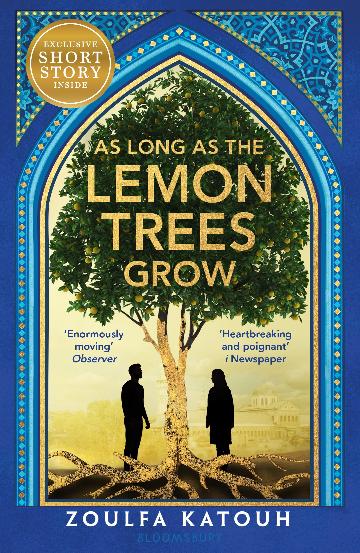
Read an article with Zoulfa Katouh on her debut novel.
Listen to our podcast with Zoulfa Katouh on As Long as the Lemon Trees Grow.
Read our review of As Long as the Lemon Trees Grow.
ABOUT THE AUTHOR
 Zoulfa Katouh is a Canadian writer with Syrian roots. A trilingual pharmacist, currently pursuing a master’s in drug sciences, Zoulfa is the first Syrian author to be published in both the US and the UK in the young adult category. When she’s not talking to herself in the woodland forest, she’s drinking iced coffee, baking aesthetic cookies and cakes, and telling everyone who will listen about how BTS paved the way. A dream of hers is to get Kim Nam-joon to read one of her books. As Long As the Lemon Trees Grow was her debut novel.
Follow Zoulfa Katouh on Instagram



0 Comments