




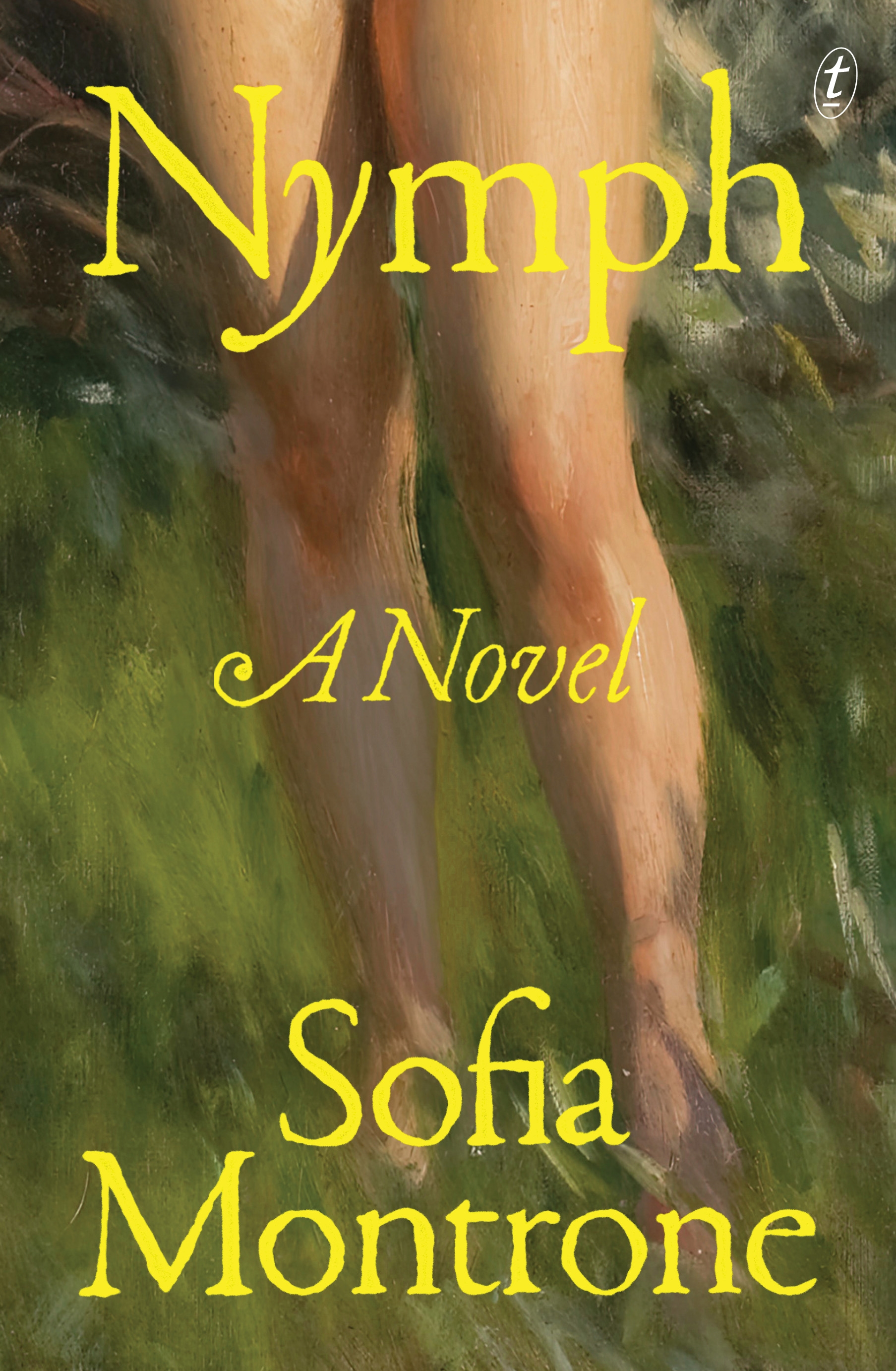
Nymph by SOFIA MONTRONE is the perfect summer read – a slice of life in the Italian countryside. Our main character Leo explores her sexuality with an American tourist and experiences the tragedy of first love, in a heady, romantic story for fans of Call Me By Your Name.
Read an extract from the first chapter.
ABOUT THE BOOK
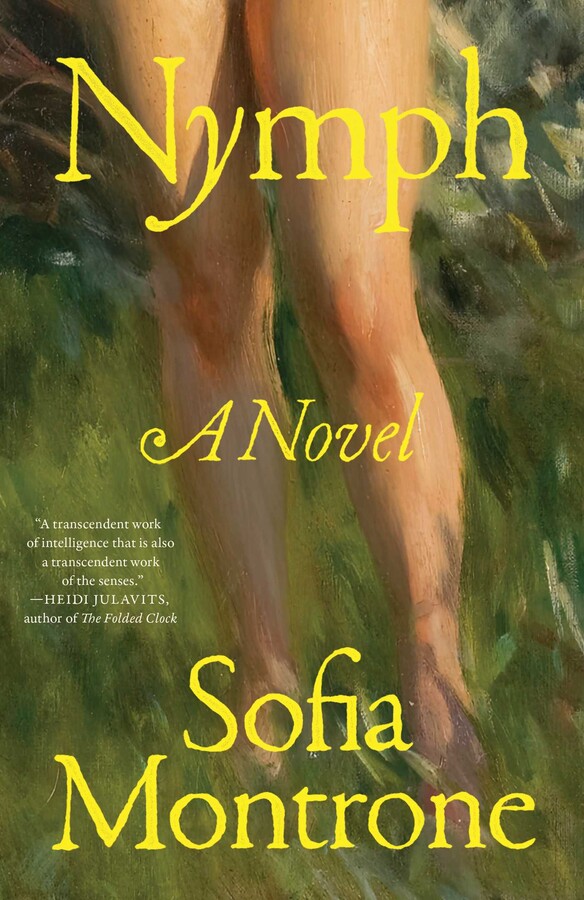 To ten-year-old Leo, life is a collection. She spends her mornings tidying the rooms of her Nonna Tina’s timeworn Italian agriturismo, carefully accumulating the curious bits of left-behind detritus from guests – a pearl earring, a lock of hair. Her nights are suffused with gathering the stories that flow from her father’s lips – liquor-spun tales of Odysseus and the Trojans in secret battle. But when an accident rips the gentle membrane of Leo’s childhood, she is left vulnerable to the pains and pleasures of growing up.
Years later, in a sultry summer not unlike the many that came before, the agriturismo is the only thing that remains the same. Nonna Tina has grown older, Leo’s brother Max is intractable and mercurial, and the curiosity Leo so loved to feed as a child has turned into something more confusing. When she meets Dolores, an American girl made brilliant by Leo’s perception of her, she can’t help but gather all the experiences first love promises, while shedding parts of the past she no longer fits into.
Sofia Montrone’s jaw-dropping debut revels in the exuberant highs and awkward lows of girlhood and captures the universal experiences of trying to hold on to what is elusive, to deny what cannot be faced, and to say what cannot be said.
**********
EXTRACT
The day is grey and luminous and her father is talking about wooden horses again. He sits legs crossed, ankle to knee, last week’s Sunday crossword folded over his lap. As he speaks, he gathers the air with his hands.
His story concerns Odysseus, who was, at that moment, crouched in the belly of the horse. Outside, the Trojans pressed their ears against the planks. Helen circled below, calling to the Greeks in the voices of their beloved, faraway wives. No one called back. Everyone was holding their breath, holding perfectly still.
Then, her father says, all up and down the beaches the Trojans began to cheer. They clattered their swords and poured wine onto the sand. They spat into one another’s hands, sobbed into their brothers’ necks. Lost in all the clamouring and singing – the carting of the horse into the city, past the famous, impenetrable walls – was the sound of a thousand Greek exhales. That night, the Greeks spilled out from their hiding place.
‘Just like that.’
Leo’s father points to a trail of ants dragging their bloated bodies behind them. The ants are all over the hotel, streaming across the patio stones and the ceramic tiles at the edge of the pool. Leo has even seen them marching through the grass with leaves pointed over their backs like fins. Fire ants can support five thousand times their own weight. Leo knows this because her father told her so, the second night in Italy, when he trapped an ant with honey and used a toothpick to break apart the bulbs of its head, thorax, and abdomen – naming each part as he went.
He continues: ‘Under the cover of darkness, the Greeks moved out of the horse and into the city where all their enemies slept and they slaughtered the Trojans in their beds.’
‘Even the women and children?’
‘Some of the women and children. They took the others back with them to Greece, along with the gold and armour and jewels. But before they left, they burned the whole city, even the horse.’
‘Why?’
‘Well.’ Her father scratches at the nicotine patch on his arm. He makes a circle on the table with the tip of his pen. ‘Maybe after ten years they were tired of looking at it.’
‘And then what?’
A fly orbits the surface of Leo’s parfait, which has glossed over in the heat. They have been by the pool since late morning. Leo is so excited that she cannot bear to eat. Her stomach jumps like a flea, like water off the surface of other water.
Her father stands, tucking the paper under his arm. All the light is behind him, so that he sways shadowy and enormous overhead.
‘And then they went home.’
***
The hotel has been in the family for a century and, in one way or another, has always been a place for people to pass through. Once, it was a vineyard, and at another time, a hunting estate. During the wars it was transformed into a country hospital, its great stone halls crowded with the dying and the dead. These days it is an agriturismo, where families come to teach their children how to feel nostalgic for nature. There are orchards where they can pick their own apricots, henhouses where they can collect their own eggs. People visit to marvel at the smallness of the fresh eggs, the sweetness of fruit plucked by their own hands, and the family waits on them.
The property is tucked into the mountainside so that from the north, south, and east, all one can see are the slanting hills gridded with rows of olive and lemon trees, and, in the autumn, trellises of black grapes. To the west, the hotel faces the valley and in the evenings guests congregate by the pool to watch the sun descend into the horizon. The sight is so beautiful that no one ever seems to tire of it.
Even Leo and Max go out to watch. They wedge their thumbs into the air, attempting to eclipse the sun on its way down. This is a complicated task, the thumb needing to be held at just the right length from their faces so that it appears, to their straining eyes, the same size as the distant, diminishing star. By the end of the summer, they will become so skilled at this that they will begin to predict when and where the sun will disappear behind their fingers. They devote hours to this game and to the others, each with its intricate rules, and these structure their days.
Leo and Max have visited the hotel every summer since they were babies and this summer is no different. They are ten and nine years old, respectively, born 394 days apart. They share everything in the manner of siblings who have not yet distinguished themselves with time. Their suitcases are a mess of Star Wars Lego sets and coloured pencils, Nintendo DS games, playing cards, and chapter books.
When Leo lost her first tooth, she made sure that Max was not far behind, wiggling his incisor free with her own fingers.
The days are slow. In the mornings they swim in the pool, where they play chicken and submarines and gaze up through the water, watching the dry world shimmer over their heads. At noon, when she returns from helping Nonna Tina clear the patio after breakfast, their mother calls them back to the kitchens where the groundsman, Davide, feeds them thin sheets of mortadella with cubes of melon and fresh cheese.
They like the kitchen, its ceramic pots and suspended bundles of dried peppers and herbs. Davide and their grandmother navigate the narrow space with the practiced give-and-take of dancers – platters of fruit balanced on their arms, tureens of stewed sausage and onion hoisted over their shoulders. In the corner the radio fizzles. On the stove something delicious, fragrant bubbles. When the time comes for Nonna Tina to bring in the newly wrung chickens, Davide covers their eyes with his hands. The hotel serves both breakfast and dinner. Nonna Tina and Davide begin work before dawn and cook through the evenings, though they rarely eat the food sent out to the dining room, preferring instead a simple acquacotta made from trimmings.
Sometimes the children’s mother, Violetta, takes them into the town at the base of the mountain, where she shops for silk scarves and sachets of lavender, treating them to gelato when the heat becomes unbearable. It is the summer of the World Cup, the summer of a thousand superstitions. All the shops have hung red cornicelli in the windows.
‘When Rossi scored the first goal in 1982, I was right here, sitting on this fountain. Was so excited I fell into the water and cracked my teeth. The dentist had to replace them but I keep the old ones in my pocket now, for luck,’ Don Carlino, the barber, tells Leo and Max as they wait for their mother to leave the butcher’s. The teeth in his mouth are bone white. He pulls a pouch from his trousers and spills the broken teeth into their hands. These are shrivelled, wormed with age. Their mother emerges and quickly shoos them away. She is always spoiling their fun.
Mostly, their mother spends her days in bed – the curtains drawn, her silk scarves unworn, still tucked in their paper wrappings. She is often sick. Easily tired, she is unable to work for more than a few hours at a time. Then there are the headaches. Dizziness. One moment, she is slicing tomatoes at the counter, the next, collapsing onto the nearest chair, clutching her face in her hands. In New York, she has visited a number of specialists, none of whom can tell her why she sleeps for sixteen hours a day. There is no cure for being very tired. Not to be deterred, Nonna Tina tries her hand. She brews muddy teas and lays slices of potato across her daughter’s forehead. She doesn’t care for doctors. She burns foul-smelling herbs and places a picture of Christ on the night table. Because of her ageless strength and herbal stench, her grandchildren suspect her of being a witch. All this greatly amuses Leo’s father, who is himself a believer in the panacean properties of Tylenol.
While Leo and Max play Floating Corpse in the pool and their mother sleeps fitfully in the next room, their father sits on the balcony and writes. He is a professor at a university where, each fall and spring, he teaches a popular lecture on the history of human conflict. He is working on a book, his fifth, about the war in Vietnam. His own father served in this war and deployed just after his son was born. He writes longhand on yellow legal pads. By his elbow, there is a carafe of coffee, prepared in the American style, from which he drinks throughout the day. Leo waits for him, for the evenings, when he might tell her about Odysseus.
***
Guests check out in the mornings after breakfast and this is when Nonna Tina and Leo’s work begins. They strip sheets, beat curtains, retrieve lost socks and frilly holiday panties, bikinis left strung over bath faucets and bottles of pills abandoned in night-stand drawers. There is always something to be rectified. Beds to be made. Cobwebs that need knocking from corners. Bathtubs filmed with dirt, which Leo and Nonna Tina remove using baking soda and wooden brushes. Nonna Tina’s knees are swollen, so Leo does the scrubbing while her grandmother fans herself with a tabloid magazine.
In her youth, Nonna Tina was regarded as a great beauty and her preternatural good looks were said to have attracted many people to the hotel. Nonna Tina’s father realized this early on and soon began to direct business through her. Farmers brought her their best crops, merchants offered special discounts on tiles and carpets. Boys from around the village volunteered to buck bales of hay and muddy their knees in the orchards, just for the chance to watch Ernestina as she swished to and from the kitchens.
The source of her power seemed to be her hair – blue black and so lustrous that her mother refused to cut it. On Saturday nights, she anointed her daughter’s hair with fragrant oils and braided it with strands of cloth. In the morning, the hair unspooled into thick curls that drew the eye of everyone at Mass. Even the priest, Father Rafello, took her beauty to be evidence of some divine hand and insisted on making the journey up the mountain to the hotel so that he could privately counsel her on the good book.
By the time he arrived for their lessons, he was perspiring so heavily that sweat seeped through the back of his clerical garments. He reeked like a cow field, but Ernestina, always fine-mannered, allowed him to share her garden bench and soon developed tricks for escaping his odour. She laughed often when he spoke and sometimes gave a revelatory gasp, each time demurely covering her face with her hand, in which she had concealed a sprig of lavender. After a purifying gulp, she would return her hands to her lap, Father Rafello none the wiser.
He was, she thought, a bit of a dope. He beamed soppily down at her and mopped at his brow, which seemed to sweat even more profusely in her presence. So too did his hands tremble as they turned the pages of her Bible. He would instruct her to read passages from the Gospels aloud and, as she bent over the text, he strained to glimpse her breasts through the gap in her blouse.
One afternoon, their heads bowed over Leviticus, he reached forward and stroked a single finger over her collarbone, drawing a long, tremulous line from her shoulder to the divot of her throat. Ernestina continued to read, squeezing the lavender in her palm until its buds popped loose from the stem.
His hand visited her again, this time as a hot weight against her thigh.
Father, she said. When she looked at him, she was surprised to find that his expression was no longer doting, but cruel. It only lasted a moment. The next second, he pulled contrition like a mask over his face. He fell at her feet and lay his head in her lap, the way a small child might.
‘He was talking a lot of spazzatura to me then, about how he wanted to marry me,’ Nonna Tina tells Leo. ‘He told me that life in the priesthood was filled with darkness and that a single touch to my chest had brought him back into the Lord’s light. Can you imagine?’
The magazine claps around her face.
Ernestina was so embarrassed that she could not speak. She watched, as if from a different bench, in a different body, as he prostrated himself before her with sweat and snot all over his face. Sensing her indifference to his plight, Father Rafello grabbed her foot and lavished it with a kiss. The shock of it caused her to kick out, right into his dripping, snivelling nose.
They both screamed and then, for good measure, she kicked him again. The crack of his nose was like a chicken’s neck snapping. A flash of blood. He tipped backward over the edge of the path and down the hill. Whore, he shouted up at her, tumbling through the ivy and dirt. Temptress! And then the shouting stopped.
‘I flew back to my room,’ Nonna Tina says. ‘I ran all the way across the grounds and up the stairs and I locked myself in the wash-room. I had blood and dirt and caca all over me. I hid the clothes under my bed and waited until dusk. While everyone was gathered in the hall for dinner, I went back out to the orchard with a lantern and one of my father’s knives to look for Father Rafello, but he had disappeared. All that was left of him was the Bible on the bench and some drops of blood among the brambles. I never saw him again.’
‘I must have been fourteen when this happened, because the next year my father took me out of school to work at the hotel full-time,’ Nonna Tina finishes.
She pulls her skirt up around her thighs. Her bad knees are thick and dimpled with black veins. Leo scrubs under and around her as her grandmother points to a recalcitrant smudge of dirt, a bundle of shed hairs.
ABOUT THE AUTHOR
 Sofia Montrone is a writer based in New York. She teaches at Columbia University, where she earned her MFA. Her short fiction and criticism have appeared in the Columbia Review, Quarto, and Adroit.
Nymph is her debut novel.
Visit Sofia Montrone’s website here.
Follow Sofia Montrone on Instagram.
Read more on the Text Publishing website here.


0 Comments