



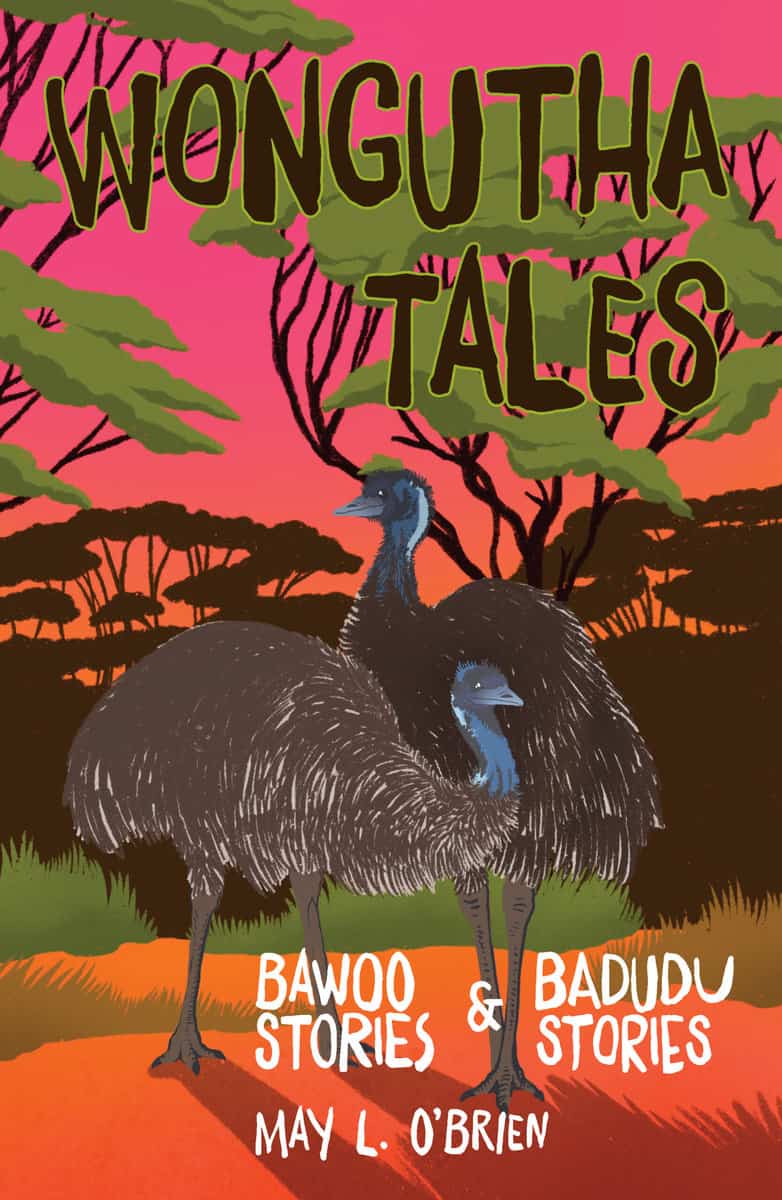
Wongutha Tales includes four wonderful traditional teaching stories of the Wongutha people, plus May O’Brien’s stories about her early life as a Mission child.
We’ve chosen a the short story, ‘How Crows Became Black’, for you to enjoy.
How crows became black explains how the crows who were grey wanted to change colour because no one liked their silver-grey feathers. They felt left out and thought if they were black they would be accepted.
How Crows Became Black
Long long ago, on a hot and stormy night, a flock of crows flew into the Eastern Goldfields of Western Australia. It seemed as if they had been blown in by the storm. No one had seen them in these parts before. They were not like the crows of today. Those crows of long ago were silver-grey and they travelled in large flocks. However, like the crows we see today, the silver-grey crows perched in the tall trees where they built their nests on the highest branches. From these high perches, their sharp eyes could see everything below.
Each morning, when the sun rose in the east, the crows soared lazily, high high in the sky. They flapped their wings occasionally, while they waited for strong gusts of wind. These gusts took them gliding over the hills and plains below. As they flew, the sun touched their feathers making them sparkle and glitter. From below, the crows looked like twinkling stars or something from outer space, moving in and out of the low and wispy clouds.
The crows loved the bushland and soon knew every tree, hill, creek and valley. They loved the freedom to fly over all they could see. Only one thing about their new home spoilt their happiness.
The other birds didn’t like the silver-grey crows at all. They were jealous of the way the crows’ feathers glistened and sparkled in the bright sunlight. They never missed an opportunity to make nasty remarks about the crows as they passed them in the bush.
‘Look at old shiny feathers,’ they would jeer as the crows flew by. This teasing upset the crows.
The animals didn’t like the crows either. They were frightened by the glinting of the crows’ dazzling feathers. The kangaroos and wallabies moved to the plains and far-off hills, where they would eat without being disturbed. The lizards scurried to the trees. They buried themselves under leaves and dead branches and waited until it was safe to come out. The snakes too became restless. They grew tired of staying in stuffy holes and logs whenever the crows were near.
The crows annoyed the Wongutha people as well. Every day the men hunted for food and every day they came home empty-handed. They searched over the plains and in the nearby hills, but the animals had gone. The people became hungrier and hungrier and the men became angrier and angrier.
‘Ngaliba gugagu manu, bardu garngalu ngurluthunu’ (When we go hunting, those crows flash by and frighten everything), they growled. ‘Marlu birni ngabathi mungarra mabithangu’ (We will never get meat for our families).
No one wanted the crows near them. Each time they flew by, the people raised their fists in the air.
‘Wandigadi ngalibanha’ (Keep away from us). ‘Nhurra yunthugarranu, thanalgudu mabitha’ (Go somewhere, where you will not annoy anyone), they yelled at the top of their voices.
The crows were upset by the people’s anger and talked about it.
‘Gark! Gark! Why is everyone angry with us?’ they squawked.
‘All the bush creatures are angry with us,’ said a wise old crow. ‘The lizards and insects hide under leaves and dead branches and the snakes stay hidden in their holes when we’re near. The cheeky birds chase us whenever we pass by. We haven’t any friends at all.’ The other crows looked at each other and nodded.
‘What can we do to make everyone happy again? Why don’t other creatures like us?’ croaked the old crow as big tears began to trickle down his silver-grey face.
The crows, seeing the tears on the old one’s face, all started to cry and the trees shook with the noise of their loneliness.
‘Gar-ark, gar-ark,’ they cried. ‘Gar-ark, gar-ark.’ The wailing of the unhappy crows floated through the bush and gullies. The other birds and animals were surprised and wondered what was wrong.
Day after day, day after day, the crows went on and on. Their tears flowed down their faces and onto the ground. There, the tears formed creeks and made salt lakes on the plains. The animals wondered if the crows would ever stop.
After a long time, when the crows could cry no more, they turned to the old crow for advice.
‘What can we do? How can we change, so that we can make friends?’ they asked. The old crow thought for a while.
The crows, seeing the tears on the old one’s face, all started to cry and the trees shook with the noise of their loneliness.
‘It’s our silver-grey colour that gets us into trouble. We must change to blend in with the bushland,’ he said. The young crows thought this was a good idea.
‘The Wongutha people have dark skin. We should be like them,’ said one.
‘But how can we become black?’ asked another.
‘Sometimes, the Wongutha men paint white ochre on their bodies. We can do the same with black ochre,’ replied the old crow.
The next day the crows flew off to look for black ochre. They searched in dry creek beds and looked in caves. They flew over plains and over the salt lakes. But they couldn’t find any black ochre. The crows flew to some red sandhills and started to scratch in the sand, but all they found was fine red sand. Some of the crows searched among the trees. All they found here was some sticky gum. They found no black ochre.
The tired crows sat in the trees and watched the women below. They were cooking their meat on the open fires. The meat was red when they put it into the flames and black when they took it out.
‘That’s what we must do!’ exclaimed one of the crows. ‘We must go into the cooking fires to become black.’
‘No, we don’t have to do that,’ said the wise old crow. ‘We can wait until the men burn the bush. Then the flames make a wide path.’
A few weeks later the Wongutha men started to burn off the bush. They did this to make it fresh and green again. The old crow saw the men start the fires and called the others together. He told them what to do.
‘Stand still,’ he said. ‘Wait for the fire. Don’t move until I say.’
The crows trembled as they waited for the fire to come. Their sharp, beady eyes darted here and there as they watched. Nervously, they ruffled their feathers as they stood still.
They didn’t have long to wait. The crackling fire raced towards them. It burned through spinifex, dry grass and dead leaves in its path. Every now and then, flames shot high over bushes and small trees. The fire roared and crackled and spat out red, fiery cinders. Closer and closer came the leaping flames.
Soon the fire swept over and around the trembling crows as they stood in its path. How brave they were! Then, everything was silent and still.
The old crow stirred, opened his eyes and looked around.
‘It’s all over!’ he shouted. ‘It’s all over!’
Slowly at first, the other crows opened their eyes too. They looked around. The bush looked bare and black. They shivered as they turned and looked at each other. How horrible they looked in only their wrinkly skin. Their beautiful silver-grey feathers were gone.
The young crows silently gathered around the old crow and waited for him to speak again.
‘You have been very brave,’ he said. ‘Our feathers will soon grow again. Then we will be proud of ourselves.’
For what seemed a long time, the crows hid themselves while their feathers grew. They were worried. Would the new feathers still be silver-grey?
At last they came out of their hiding places. How handsome they looked. Their new feathers were shiny black. Proudly, the crows strutted about. Their white eyes gleamed happily as everyone looked at them.
‘Are they new birds?’ asked the animals.
‘No! They are the crows,’ replied the birds sharply.
‘They are beautiful new feathers,’ exclaimed the animals. The old crow turned, smiled and winked at the others.
‘Now, the animals and birds can move about in the bush without running away from us,’ he said proudly. ‘Our new feathers make us more like them. We must also try to live apart and never to fly in big flocks.’
Today, we can still see the salt lakes made by the tears of the silver-grey crows of long ago, and also the salt bushes that soaked up their salty tears. The black crows are now an important part of our Australian bush. They are not the same as those silver-grey ones of long ago. Crows no longer travel in large flocks and they keep apart from everyone. They never make good friends with other bush creatures and small birds still chase them away.
ABOUT MAY O’BRIEN
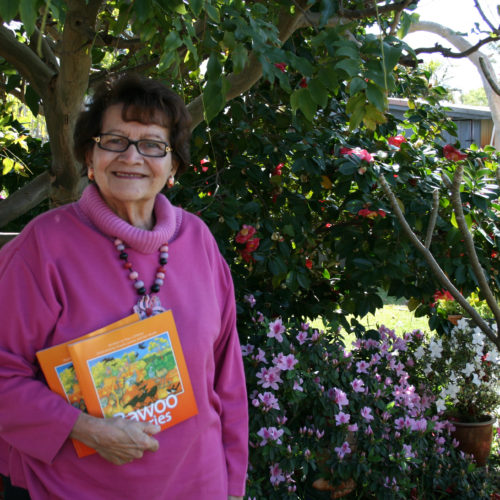 May O’Brien was born in the Eastern Goldfields of Western Australia, and at the age of five, was taken to Mount Margaret Mission where she spent the next twelve years. She taught in Western Australian rural and metropolitan primary schools for25 years. May served in a number of other positions before being appointed Superintendent of Aboriginal Education, a position she held until her early retirement in 1988.


0 Comments