


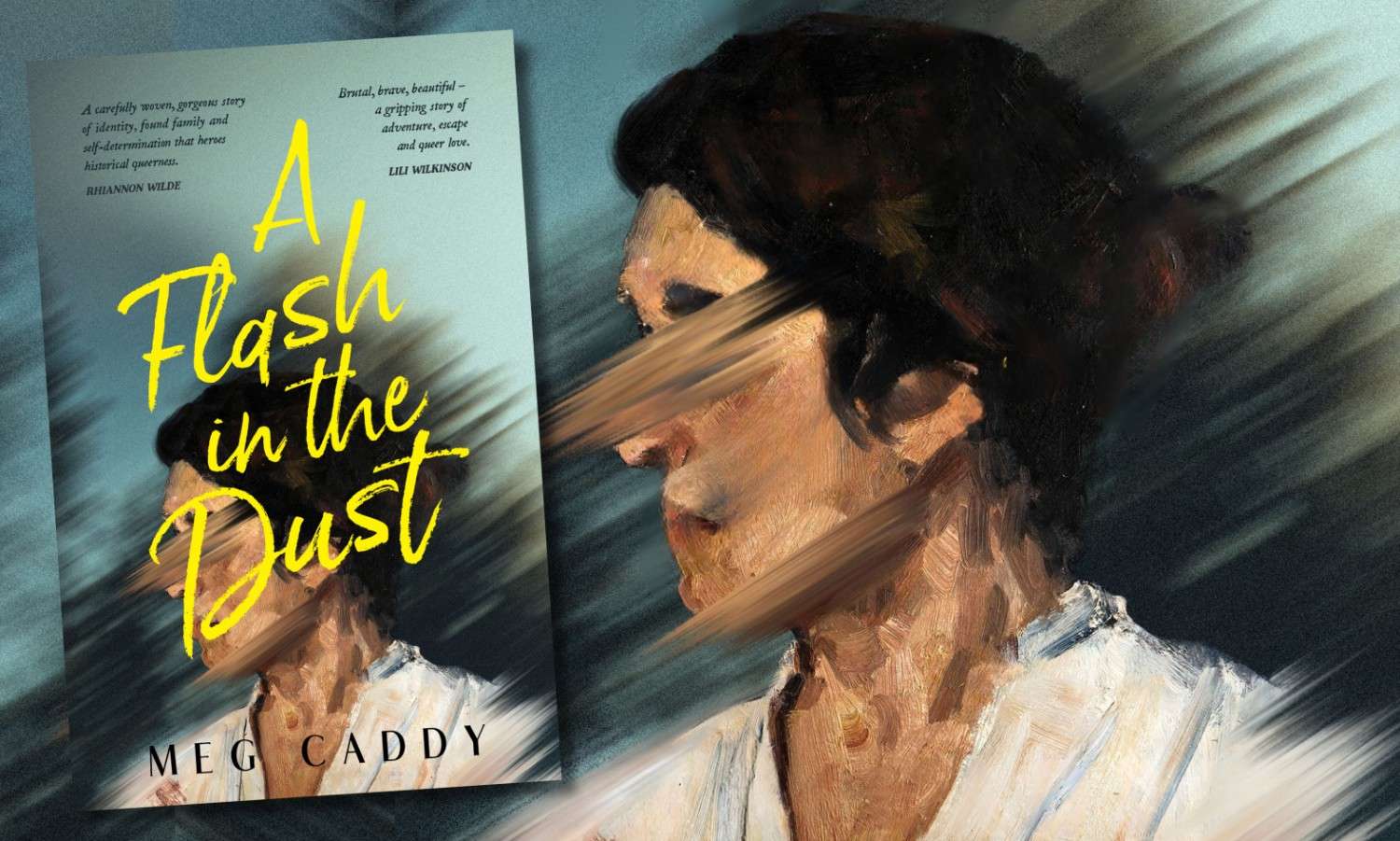
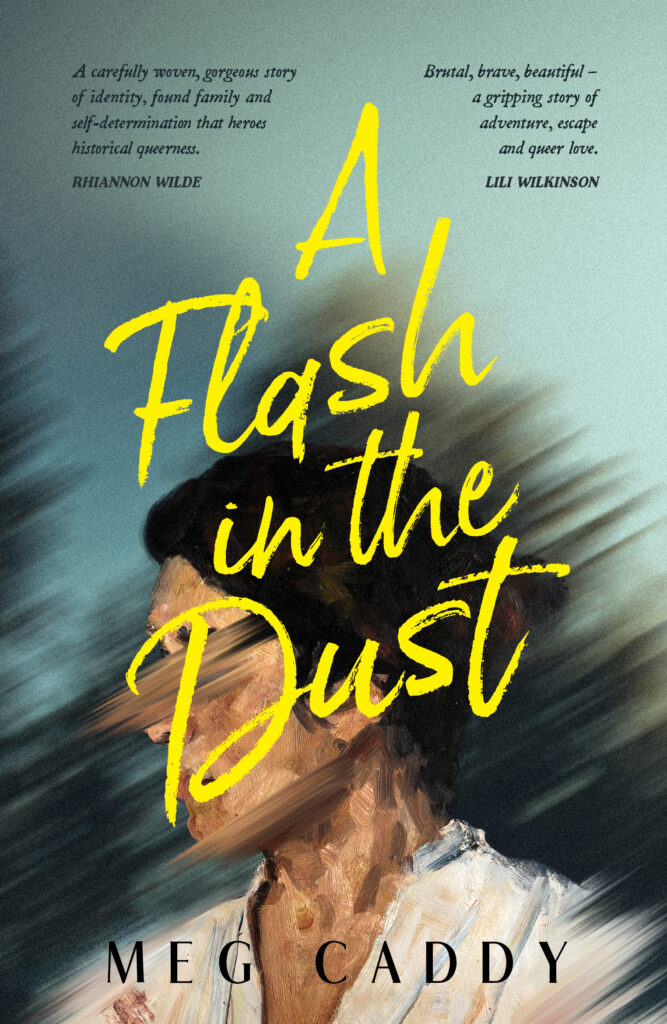
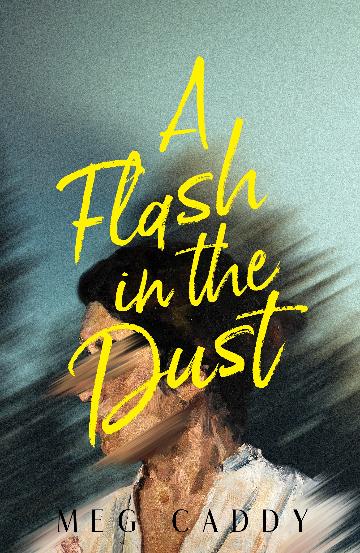
Looking to read the bushranger version of Fingersmith? MEG CADDY’S A Flash in the Dust is a gripping historical thriller with a dash of queer romance. Read on for a Q&A with Meg about the inspiration behind this new novel.
MEET MEG CADDY
What inspired you to write A Flash in the Dust?
When I write historical fiction, I’m always looking for gaps. What is the untold story? Who has been forgotten or ignored?
As a result, my PhD was concerned with writing against the grain of the dominant histories by searching for perspectives that are typically overlooked. It felt really natural to write about queer perspectives, and I was particularly looking at how queer people were criminalised and how they found freedom and agency within criminalised spaces.
The novel begins in Fremantle Asylum – what drew you to this setting?
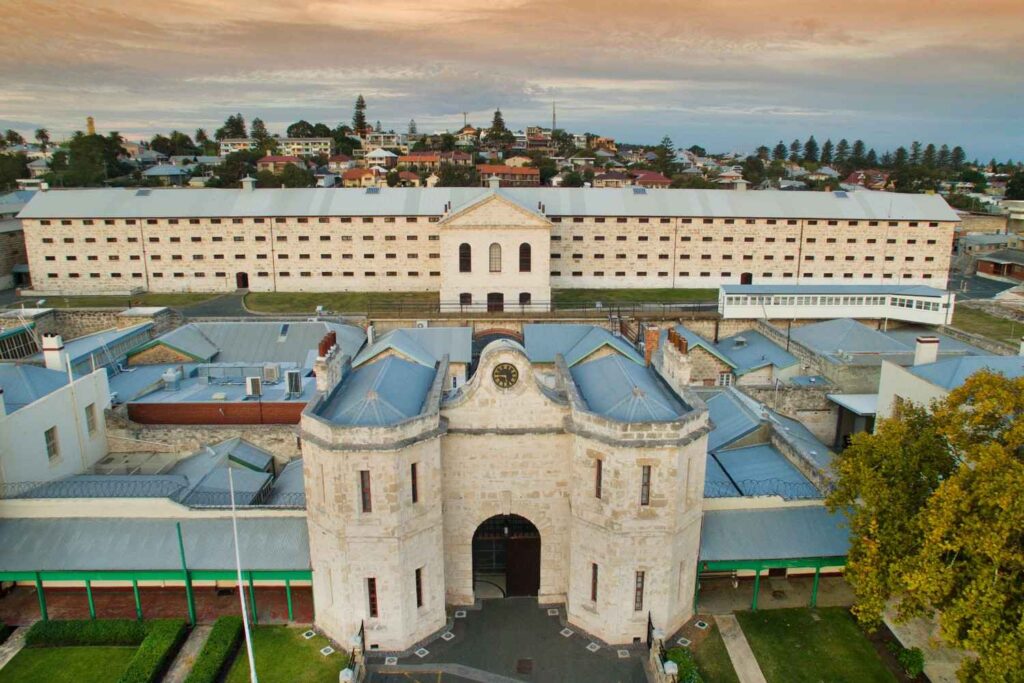 In the 19th century, only certain types of queerness were considered criminal (in a legal, prosecutable sense). For those who could not be prosecuted for queerness – primarily those assigned ‘female’ at birth – there was always the asylum. It was a grey area, where legal and medical lines crossed over. The asylum was frequently a ‘dumping ground’ for people who were considered difficult to categorise, and that resistance to categorisation is an important part of the novel.
Fremantle Asylum is particularly interesting. At the end of the 1800s it was in crisis – underfunded, overcrowded, and riddled with disease – and its inmates included women with postnatal depression, domestic violence victims, people with substance addictions, children with epilepsy, and convicted criminals who were considered too difficult for the nearby Fremantle Prison. In my archival research, I found one record of a woman being diagnosed with ‘morbid sensuality’ (no more details given), which sparked some of Gilberta’s story.
The asylum is now an Arts Centre. It feels meaningful that a place with such a difficult past has been turned into a site of expression and creativity, but I also think it’s important that we remember the darkness of our history, and its many victims.
How did you approach developing Gilberta and Norah’s relationship over the course of the story?
Gil and Norah are in some ways polar opposites. I think poor Gil got all the bits of myself I struggle with: the anxiety, the awkwardness, the tendency to overthink and say the wrong thing. Norah is very different from me, but she is tenacious, and that’s always been what I like most about myself (though other people sometimes find it challenging). Unlike Gil, she is confident and charismatic.
I knew they had to teach one another throughout the novel. Gil eventually learns from Norah’s ability to connect with people, and Norah learns from Gil’s gentleness. But they also had to find common ground, and that came in the form of poetry, something they both love.
The group forms an unlikely gang with Kedalak and Malkar – what interested you about creating this kind of found family?
I think the ‘found family’ trope resonates on a particular level with queer people, who often have to build family in unconventional ways. Personally, I always find stories of platonic bonds to be more compelling26 than romance, and so building the friendship and kinship within this group was really important to me.
It was also important that they shouldn’t always see eye-to-eye on things or have the same priorities. Gil and Norah will always move through colonial Australia in a very different way from Malkar and Kedalak, and
I didn’t want to lose sight of this.
As you say, this is also an unconventional bushranging gang. Most of the bushranging narratives we see in Australian fiction are preoccupied with straight, white, cisgender masculinity. We know from history that this wasn’t always the case: that there were female bushrangers, First Nations bushrangers, cross-dressing or genderqueer bushrangers, and gay bushrangers. So from the outset I wanted my bushranging gang to reflect that more nuanced history.
The novel draws on real histories of queer Australians – how did that research shape the way you wrote the story and its characters?
 As a young adult, I felt disconnected from Australian history. There seemed to be no space for queerness in the world of Ned Kelly and Captain Cooke and Governor Phillips, and these were the types of histories that were told most often and in most detail. So when I started the PhD I was worried that I would find very little overt and explicit evidence of queer lives in Australia pre-1900 beyond the occasional arrest record. I also feared that all of these stories would end in grief.
I’ve never found so much satisfaction in being wrong.
Once I learned to decode the euphemisms for queerness (‘abomination’, ‘unnatural’, ‘impersonation’ among them), I found the 19th century newspapers were fascinated and occasionally obsessed with LGBTQIA+ Australians. Beyond the papers, I found photographs of these Australians, and sketches, and then letters and even memoirs. The more I read, the more I felt connected to Australian history, in a way I never had before. And while there was much sorrow, there was joy there too, and resourcefulness, and incredible courage.
I didn’t want to pull my punches in Flash. 19th century Australia was a brutal time. But I also wanted young people reading the book to see more than sorrow and injustice. I want them to see that they belong in Australia’s history, and in its future as well.
What can you tell us about the Whistling Man?
Although he makes claims about his morality, the Whistling Man is all about transgression. He is a man who carefully curates the way the world sees him, but his violence spills over onto those who are most vulnerable to it.
The song he whistles, ‘The Wild Colonial Boy’, was labelled seditious in the 19th century, as it glorified bushranging. He whistles it because – like many serial killers and domestic abusers – he wants to test what he can get away with.
When creating his character I researched modern and historical serial killers, looking for commonalities. I wanted him to be a sort of ‘everyman’ of serial murderers, so I thought a lot about demographic, features, childhood, and career choice. The details didn’t all make it into the book, but they all informed how he behaves on the page.
What kinds of stories or perspectives did you most want to bring to light in your novel?
Queer narratives have been erased for centuries, deliberately and systemically. If queer people couldn’t be hanged, they could be prosecuted and imprisoned, and if they couldn’t be prosecuted and imprisoned they could be shut up in asylums, and if they couldn’t be shut up in asylums they could be shamed and frightened out of public life. And if none of that was possible, well, at least no one would write about it.
So it feels really good – especially now, when trans people are being attacked by multiple billionaires who have bought their way into controlling public policy – to write about it.
I am keenly aware that I live and write on stolen land that has never been ceded by First Nations people. I am also aware that the same colonial machine that sought to erase queer bodies also committed genocide against the Indigenous people of Australia. It is not my place to tell First Nations stories, but it was important to me that they be acknowledged and respected in A Flash in the Dust.
ABOUT THE AUTHOR
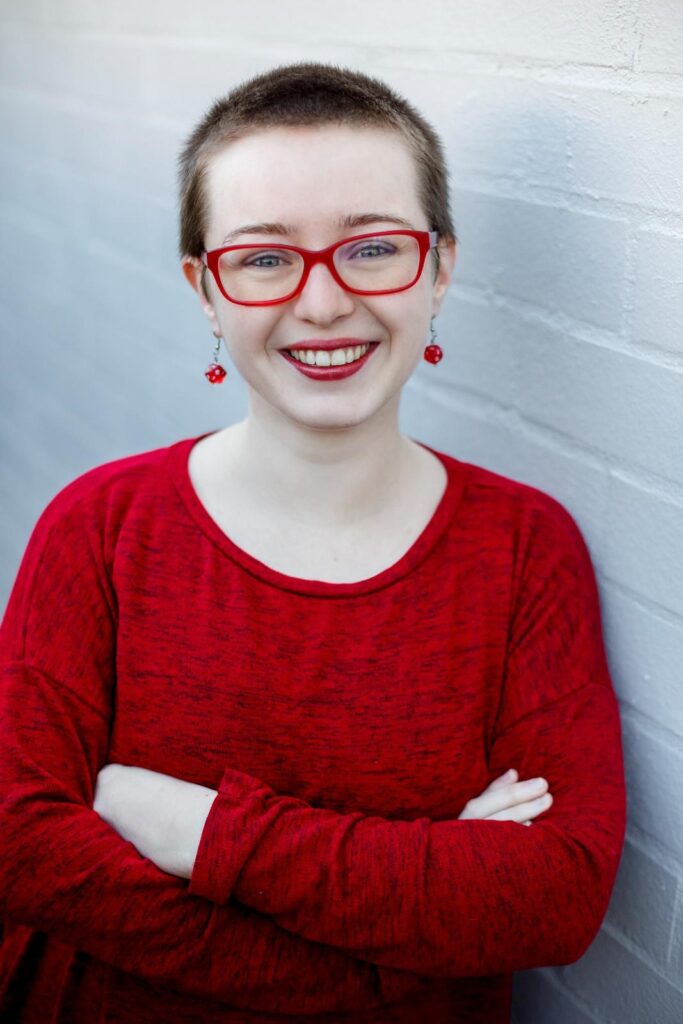 Meg Caddy is a West Australian YA novelist with three published novels. Their first three novels, Waer, Devil’s Ballast and Slipping the Noose, have been short- and longlisted for awards including the CBCA Book of the Year Award, the Readings Young Adult Book Prize and the ARA Historical Novel Prize. Meg is nonbinary and asexual. They have completed an Honours degree in English/History, writing on the Golden Age of Piracy, and a PhD in Creative Writing. When they’re not writing, elbows-deep in archives or chasing around their toddler, Meg plays an unhealthy amount of Dungeons & Dragons.
Visit Meg Caddy’s website here.
Follow Meg Caddy on Instagram here.
Read more on the publisher’s website here.
0 Comments