




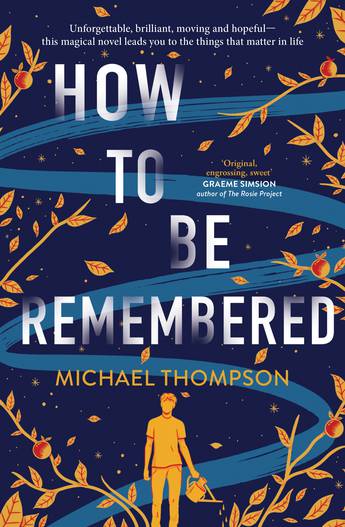
MICHAEL THOMPSON has been a journalist, producer and media executive for the last 15 years. His debut novel How to be Remembered is a heartwarming and inspiring novel about the important things in life. Read on for an extract.
ABOUT THE BOOK
Some lives are simply unforgettable …
On an ordinary night in an ordinary year, Tommy Llewellyn’s doting parents wake in a home without toys or nappies, without photos of their baby scattered about, and without any idea that the small child asleep in his cot is theirs.
That’s because Tommy is a boy destined to never be remembered.
On the same day every year, everyone around him forgets he exists, and he grows up enduring his own universal Reset. That is until something extraordinary happens: Tommy Llewellyn falls in love.
Determined to finally carve out a life for himself and land the girl of his dreams, Tommy sets out on a mission to trick the universe and be remembered. But legacies aren’t so easily won, and Tommy must figure out what’s more important – the things we leave behind or the people we bring along with us.
EXTRACT
ONE
Leo Palmer had a party trick, although even he knew it wasn’t much of a showstopper. He could calculate on any given day exactly how long it would take the 457 bus to get from the city centre to his stop at Ingleby, adjusting for traffic, weather and an array of other complications. He could do it for other routes too, but that was barely of interest to him, let alone other people.
He’d demonstrated it once at his office Christmas party. He figured a bunch of accountants would appreciate something like that. His colleagues had been unenthusiastic, but that was a fairly natural state for accountants. Leo didn’t mind. It was the numbers that he found fascinating. The people were a distant second.
Well, that wasn’t entirely true. There were two people he cared about more than any numbers – more than a balance sheet, more than the timetable of the 457. His wife and his young son belonged at the top of this particular ledger, and as far as Leo Palmer was concerned, that’s where they’d stay.
All of this was somewhat standard fare, to be honest. An accountant with a fondness for numbers was pretty normal. So too a family man who loved his wife and son. In fact, Leo’s life was actually quite ordinary, which is, really, the point: Leo and Elise Palmer were average. They didn’t do anything to be singled out for what was to come. They just were.
Of course, like any normal couple, they had their fights. They had one on the very day they signed the lease for their one- bedroom flat: ground floor, weathered bricks and a cracked concrete path with dandelions that came up to their knees.
‘Jesus Christ, you’re a tight-arse, Leo,’ Elise had exclaimed as she gazed at their new home. She was only half-joking, and her husband rolled his eyes.
‘You knew that when you married me,’ he retorted, tugging at one of the weeds with both hands. At last it came free, and he threw it to the side with a satisfied grin. ‘It’s not forever. Just stick with The Plan, and we’ll be fine.’
‘The Plan,’ Elise repeated, and smiled despite herself. The Plan (it was always rendered with capital letters in Elise’s mind, such was its importance to Leo) had been debated at length. Stage one of The Plan was five years in Ingleby, two promotions for Leo, three pay rises and then they’d move on. Stage two was somewhere else entirely: a backyard, two bathrooms, two cars in the garage, three bedrooms and a couple of kids to fill them.
The baby boy who arrived just over a year into their lease had never heard of The Plan, and had no regard for the fact that he’d disrupted stage one. But—and this was the biggest surprise of all to Elise, even greater than the pregnancy itself – Leonard Palmer welcomed the alteration. It turns out some people are just born to be dads, and Leo was one of those. He gladly revised The Plan to include a round- cheeked, fair-haired boy in that one-bedroom flat in Ingleby. He also slashed two years off stage one – determined that the cot would soon move out of the living room, and the occupant would have his own bedroom. And the backyard, and all those other things that came with being a normal family. Because that’s what they were: normal.
Elise knocked loudly on her neighbour’s door – louder than would have been considered polite, but Mrs Morrison was north of 70 and could barely hear her own TV. Elise could hear it, though, every night. She didn’t mind; it reminded her of her grandma.
The door opened a crack, and a watery grey eye framed by wrinkles peered through the gap.
‘Hi, Mrs Morrison,’ Elise said cheerily, and the door opened the rest of the way.
‘I’m sorry, love,’ Mrs Morrison replied. ‘I didn’t know it was you. Come in.’ She bolted the door behind them and shifted her gaze down to the boy nestled comfortably on Elise’s hip.
‘And you, you precious thing. You’re getting so big!’
Elise grimaced. The dull ache in her lower back was proof of that.
Mrs Morrison noticed. ‘Put him down, love. Still not walking?’ Elise lowered her son to the clean linoleum floor. ‘Not yet. Soon, I hope. He’ll be the last in his playgroup to do it.’
The old woman bent over in front of the little boy, and held out her hand like she was sprinkling invisible birdseed, trying to coax him to her. Unsurprisingly, he didn’t move. If he hadn’t got up on those stubby legs for his mummy and daddy, he was hardly going to do it for the old lady next door.
Mrs Morrison straightened, shaking her head. ‘Give him time. My Mark didn’t walk till he was two. He’s not even one yet, is he?’ ‘Nearly! It’s tomorrow,’ Elise said. ‘That’s why I’m here. If you’re not busy, would you like to come over for cake in the afternoon?
Maybe around three? Only if you’re free, of course.’
Mrs Morrison smiled. She loved having a family next door, especially one that made an effort to include her. Until they moved in, she’d felt like the last of her kind – a stubborn reminder of the way things used to be. The smile faded as she remembered her own son. Mark had been a sweet boy too, and a lovely man, and it wasn’t his fault how things ended up. It was those friends. And this neighbourhood. Now, every time there was a knock on the door she was sure it was the police, delivering more bad news.
‘You’re still locking your doors at night, love?’ she asked. ‘Of course, Mrs Morrison.’
‘I wish you could’ve seen it 40 years ago,’ the old lady murmured, almost apologetically, and Elise needed no further explanation. Her neighbour had said this every time they’d spoken, and she knew what came next. She needed to change the subject before those faded grey eyes started to tear up.
‘So three o’clock tomorrow. It’ll just be you and the three of us. Leo’s even calling in sick to work.’ This was a big deal, and certainly wasn’t in the original version of The Plan.
Mrs Morrison came back to the present. ‘The cake,’ she said. ‘Is your oven still on the fritz? You can use mine if you want.’
‘It’s alright, I’ve already made it,’ Elise told her. ‘It’s just the thermostat that’s busted. The edges are a bit burnt, but there’ll be plenty of icing. He won’t notice.’
The boy at her feet was playing with a doorstop as though it were a rocket ship. Elise scooped him up and he waved a fat little hand at the kindly lady next door. Mrs Morrison waved back as they left, heart swelling with the pride of an adopted grandmother. She looked around the room, wondering what she could wrap up and give him for his birthday. She needn’t have bothered; Mrs Morrison wouldn’t be attending any afternoon tea. Nor would Leo or Elise Palmer, for that matter. Not that any of them knew it.
It was long after dark when Leo’s return from work was announced by a key sliding into one lock, then another. He tiptoed inside and danced silently over the toys strewn in the entrance. He was sure kicking one – even the barest nudge with his toe – would mean waking the boy asleep in his cot against the living room wall. Leo looked in at his son, thumb tucked firmly in his mouth, a slight rise and fall of his chest as he dreamt. The metal bars of his cot gleamed dully in the light from the bedroom door beyond.
Elise lay on her side of the small double bed, propped up on pillows with a book in front of her. Of course she was reading; there was a mound of books on her bedside table.
‘Sorry I’m late,’ Leo whispered. ‘Big day. Think I can feel a cold coming on. Don’t reckon I’ll make it in to work tomorrow.’ He winked, and his wife smiled. ‘I’ll be back in a sec,’ he said. ‘Just want to check out the cake.’
He tiptoed to the fridge. A beer bottle rattled as he pulled the door open, and he held his breath.
No noise came from the cot. A minor miracle.
Leo admired Elise’s handiwork. Two plain butter cakes had been transformed into an impressive reproduction of Thomas the Tank Engine, the birthday boy’s favourite TV show. The blue frosting looked thick and deliciously sweet, although Leo suspected it might be masking some burnt edges beneath. He grinned. It’d be the thermostat’s fault. It always was.
Next to a small vase on the living room table he spied the present he’d picked out. It had been carefully wrapped by Elise and now sat ready to be torn open by an excited child. He looked down into the cot, gazing fondly at his son’s sandy-coloured hair and soft, smooth skin.
‘Night, buddy. See you when you’re a one-year-old,’ he whispered, so quietly he could barely hear it himself.
Then he crept back into the bedroom and Elise switched out the light.
He tiptoed to the fridge. A beer bottle rattled as he pulled the door open, and he held his breath.
‘Leo!’
He stirred.
Elise elbowed him in the chest. ‘Leo!’ she hissed again. ‘Mmm?’ he mumbled sleepily.
‘Wake up! There’s someone out there!’ Her voice cracked with panic.
Leo’s eyes flicked open instantly and he felt a rush of adrenaline. He listened, barely moving, for whatever had distressed his wife so much.
There.
A small sound, almost like a snuffle. Then silence.
Again, a noise. Rustling this time. It was in their living room.
Leo had known this might happen since the day they’d moved in; an intruder wasn’t part of The Plan but had always been a footnote, the implied risk of paying a pittance in rent. He’d sometimes wondered if he’d choose fight or flight, or even option three: cower.
But it wasn’t a conscious choice at all. Without thought Leo sprang from his bed and stood at the doorway to the living room, listening hard.
He took a deep breath, reached around the corner for the light switch and flicked it. Harsh yellow light flooded into the bedroom and he charged through the doorway, then stopped suddenly, blinking.
Silence.
‘Leo?’ Elise called shakily. ‘Are they still there?’ Her heart was hammering so loudly she was sure Leo (and whoever was in the living room) would hear it.
Then, at last, her husband responded. His voice was strained.
Confused, even.
‘Come out here. Quick.’
A lone police car arrived just eight minutes later, its lights strobing as the driver parked without haste or care at the front of the rundown block. Constable James Elliott had only been two streets over, but was more than happy to let them think he’d rushed here. Good for the image, he thought, and looked up at the low-rise building.
He laughed humourlessly as he realised he’d been here before. Only once, though, about 10 years ago, on his third day into what he was sure was going to be a stellar career of medals and honours and promotions (he’d been wrong, so far). His supervising officer had parked in pretty much the same spot, and sat in the car watching the young probationary constable shuffle nervously to the door of one of the ground-floor flats. Blooding the new recruit with his first death knock. Elliott grimaced, remembering the old lady’s eyes filling with tears as he told her that her son had died in his sleep in a house nearby. He didn’t tell her he’d choked on his own vomit, or that Elliott thought 44 was too old to still be living in a shithole with three other deadbeats.
He wondered for a moment if the old duck was still alive, and a moment later had his answer. Mrs Morrison’s door opened a few inches as he walked up the cracked, weedy path. She’d seen the flashing lights while making her way slowly to the toilet (it was nearly two o’clock after all, and a woman of her vintage couldn’t be expected to hold on all night).
‘What do you want?’ she called defiantly through the gap, almost daring the officer to bring her bad news.
‘Fuck me,’ Constable Elliott muttered. ‘It’s her.’
‘Did you call about the kid?’ he asked her, voice echoing in the still night.
She looked at him blankly.
‘Was there a kid here?’ he asked. The same confused stare.
‘Go back inside,’ he ordered.
Mrs Morrison did as she was told. She really needed the loo. ‘Fucking geriatric,’ Elliott said to himself, and checked his notepad. He knocked on the door next to Mrs Morrison’s, still shaking his head.
It was opened by a tall man with thick fair hair, who introduced himself as Leonard Palmer.
‘You’re the guy who called about a missing kid?’ the constable asked.
‘Well, yeah,’ Leo replied. ‘In a way.’
‘What’s that mean?’ Elliott snapped, his patience already gone.
Ten seconds, he thought. Might be a new record.
‘We haven’t lost a kid,’ Leo said slowly. ‘We’ve … well, we’ve kind of found one.’
Three times Leo and Elise told their story to the officer – once next to the cot, then twice more seated across from him at the dining table. Elliott pulled an assortment of faces and scribbled furiously on all three occasions.
‘Right,’ Elliott said. ‘And whoever it was who left the baby … they set up the cot too?’
They nodded.
‘While you were both asleep.’ Nodded again.
‘And what woke you up?’
‘We heard him,’ Elise said, her face pale and drawn, still process- ing why they were being interviewed at the table where she usually ate breakfast.
‘The person who left the cot?’
‘No,’ she said. ‘Him.’ And she pointed to the small boy sitting up, sheet tangled around his legs. His eyes were darting curiously between the three people gathered near his bed, as if fascinated by the commotion.
‘And then you called the police. Because your baby woke you up.’ Constable Elliott sighed. ‘Fuck me,’ he said, not quite under his breath.
Leo opened his mouth to respond, and Elise put a hand on his arm. Leo paused, composing himself.
‘We’ve told you. It’s not our baby. We … we don’t have any kids. Yet.’ He wanted to add that it wasn’t in this stage of The Plan, that babies were in stage two, but didn’t think the cop would care.
He was right.
Elliott stared at them both again, then made an exaggerated display of looking around the room, as though inspecting for hidden cameras. Something didn’t feel right here.
‘This is a joke, right?’ They shook their heads. ‘Okay. What have you taken?’
Elise and Leo looked at each other, confused.
‘What are you on?’ the officer asked. He sighed, not even trying to hide his frustration. ‘Look, people don’t break into apartments and leave behind a baby. So let me tell you what I think actually happened. You two had a big day on God knows what. Then you thought you’d waste my time with a call at two o’clock in the morning because you forgot you had a kid you’re supposed to be looking after. Am I right?’
But even as he said it, he wasn’t sure – not that he’d admit it to them. They didn’t look like addicts. They looked more like teachers on a school camp, dragged out of bed in the middle of the night to tell the kids to go back to sleep. And the air in the living room didn’t smell like stale pot. It smelt – well, it smelt like a baby. Like nappies and talcum powder. And milk.
A tiny hammer of a headache started to beat above his left eye. The flat looked rough from the outside, but in here it was neat as a pin: clean floor, nice furniture, shelves and shelves of books, pictures hung level on walls. (The presence of pictures in frames was actually pretty uncommon – in half the places he visited there’d only be a poster or two; some ratty heavy metal band covering a hole punched through the wall.) The table next to the cot was completely bare, save for a small vase with a posy of pink and white flowers.
‘We’re not on anything,’ Leo insisted. ‘We don’t know what’s happening. I know it sounds strange—’
‘Oh really?’ the cop interrupted. ‘You think so?’
The little boy started to cry. Leo and Elise looked at each other again, but didn’t move.
The tiny hammer tapping inside the cop’s skull grew slightly bigger.
‘Aren’t you gonna pick him up?’ he asked as the child wailed.
Elliott just wanted the noise to stop.
Elise got up and reached into the cot, lifting the boy out. She stood there, holding him uncomfortably under the arms.
That’s weird, Elliott thought. Even the fucked-up ones hold their babies on their hip.
‘Wait here,’ he instructed. ‘I need to call this in.’
Fifteen minutes later he returned, looking like he’d received bad news, or like he wanted to be somewhere else. Possibly both. The boy had stopped crying and was now sitting on Elise’s knee on the couch, playing with her hair, twisting it around his pudgy fingers.
‘You two have jobs?’ Elliott asked, trying to sound casual but increasingly desperate to confirm his theory that they were everyday addicts.
‘Of course we do,’ Elise replied. ‘Leo’s an accountant, and I tutor English. High school. But I can do university level too,’ she added awkwardly, as though wanting to prove herself.
‘Right,’ Constable Elliott said, waving her answer away. Something was off, something he couldn’t quite identify, and he was counting down the minutes until it became somebody else’s problem. ‘Here’s what’s going to happen,’ he said. ‘Child Services will be here soon. They’re going to talk to you about your kid.’
‘He’s not our—’
‘Just stop. You’re going to be drug tested. And they’re gonna ask you why you never registered his birth.’
‘What do you mean?’ Leo asked.
‘There’s no record of him living here.’ Leo and Elise both started to protest, but Elliott held up his hands. ‘Hey, it happens. At least, it does round here.’
Elise jumped to her feet, seemingly forgetting she was holding a child, and the boy playing in her lap slid to the ground with a painful bump. He screeched, a piercing noise that made Elise and Leo wince.
Elise picked him up again, and Elliott exclaimed loudly over the boy’s hoarse cries.
‘Can’t you shut him up? I dunno, give him some milk or something?’
Leo opened the fridge. The beer bottle in the door rattled. They were out of milk; in fact, apart from the beer in the door, a packet of cheese and three sausages on a plate, the fridge was completely empty. ‘Forget it,’ the cop said. He’d heard a knock at the door. ‘I’m out of here.’
Two officers from Child Services introduced themselves; the man and woman were both wearing suits, with rumpled shirts and no tie – the uniform of night shift workers who hadn’t expected a call-out.
James Elliott briefed them quickly in the doorway, pointing back to where the couple sat on the couch. Leo now held the boy, the same dazed and confused look on his face that his wife had worn a few minutes earlier.
If I ever have kids, thought Elliott as he strode outside, I hope
I look like I know what I’m doing. He hasn’t got a fucking clue. Give the kid a toy to play with, something to distract him.
He was halfway back to his car, ache in his head pounding away, when it hit him. There were no toys. Not a car, not a building block, not a teddy. Nothing in the living room. Even junkies have toys, he thought. Dirty ones, but still something for the kids to chew on while Mum and Dad sleep off a bender under the watchful eye of Led Zeppelin, hiding those fist-holes ploughed through the wall.
But there were no posters in that house, just framed pictures hung neatly.
Pictures of Mum and Dad, together. No baby.


0 Comments