



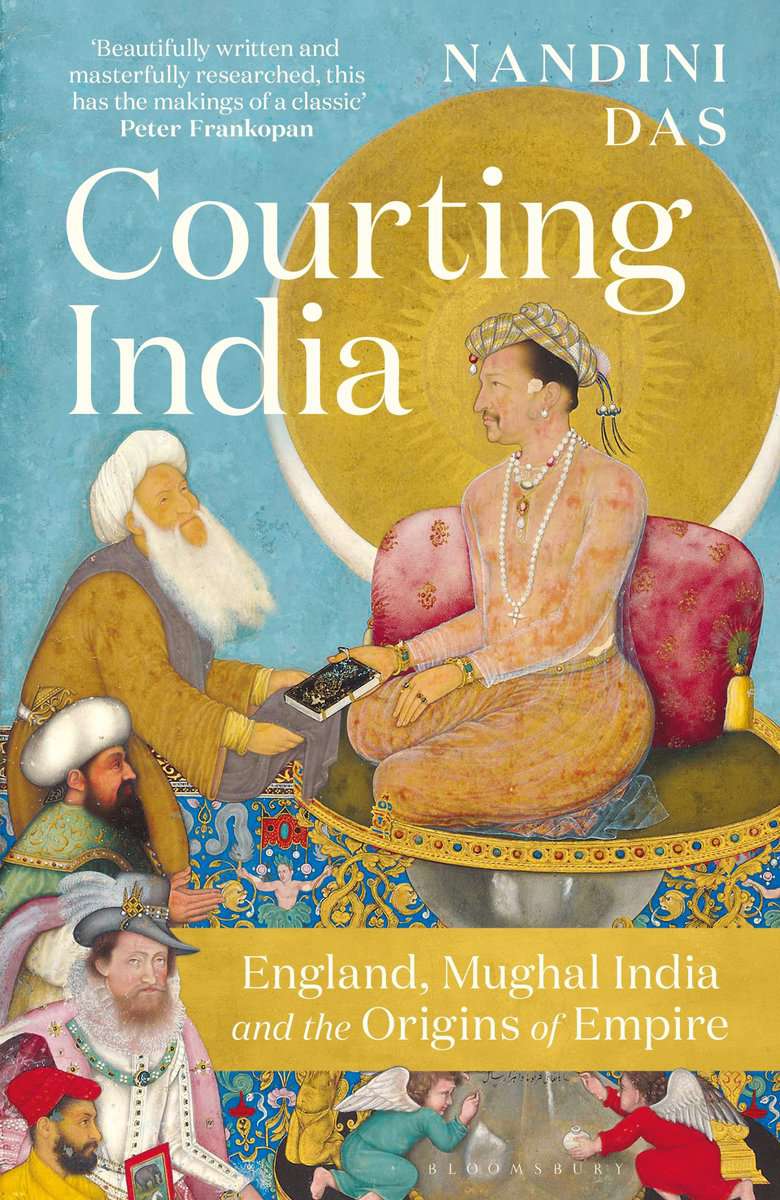
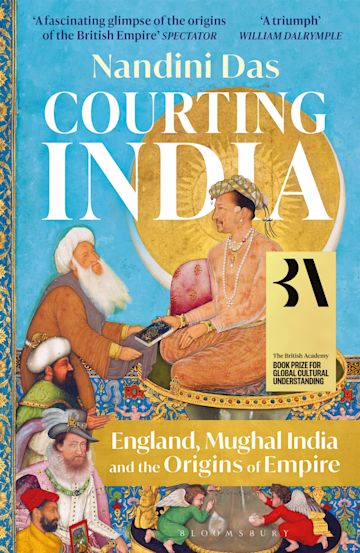
In this extract from Courting India by NANDINI DAS we travel with Sir Thomas Roe, English Ambassador to Mughal India, as he sets off on behalf of the East India Company.
For Roe’s voyage alone, the account in his own journal is supplemented by the journal of Captain Keeling, written aboard the flagship, the Dragon; the journal of Walter Peyton, captain of the Expedition; and the journal of Thomas Bonner, who started as the master’s mate of the Expedition and later became its master. Each volume raises its own ghost, with its distinctive voice and preoccupations. Bonner’s is a dry, business-like recording of daily navigational data. It is supplemented by Peyton’s genial interest in people, from his superiors on board, to ‘Corey the Indian’ with his wife and children. Roe’s mutterings about friction with various people on the fleet are put in perspective by Keeling’s detailed record of everyday life on deck.
Many of the entries reveal the challenges of maintaining discipline and something resembling a working relationship within a small group of men who are confined in a pitching, swaying wooden box infested with rats. Peyton hated the creatures with a passion: ‘the innumerable many Ratts, which we have had in our shipps all this voyadge’ had not stopped at eating through both provisions and sails. ‘It is almost incredable the noysomnes of that verment [vermin], whoe have binne redy to eate us lyving (for they have bitten us in our sleepes), but some menn that dyed this voyadge in the nights, before morning have had their toes eaten quite off, and other parts of their bodyes gnawen.’
Among the living, the ordinary sailors were whipped, ducked and put in irons regularly for various misdemeanours. ‘I ordered 50 stripes w[i]th a whippe to Evan Lake for stealing things out of Will Hoars chest,’ Keeling recorded, and Coldicott, one of the conscripted prisoners, was ducked in the water as punishment ‘for stealing a cheese’. But Keeling also kept a close eye on the health and general fitness of the men, ordering ‘the due expence of our lemon water to prevent the scurvvie’. It was a practice that James Lancaster had introduced during the first East India Company voyage in 1601, although by 1617, the Company would adopt lime juice instead, unaware that it was a less effective remedy.
Day to day life on the ships was hard, and the men constantly at work repairing and patching up sails, tackles and boards. There was a seemingly never-ending round of checking on the state of the ships provisions, including the livestock to supply fresh meat during the voyage, and the cargo for trade. Their cargo of quicksilver, for instance, started leaking from its packaging, so Keeling had to arrange for it to be transferred to the stone bottles in which they had been storing their lemon water. It made him ‘wonder the [Company] have no more care, since it is reported they were informed of a greater losse of the same kind in a former voyage’. They discovered that John Woodall, the recently appointed Surgeon General of the East India Company, had been lining his own pockets by supplying ill-equipped surgeons’ chests, with mis-labelled ‘simples’ or medicines, ‘drugs rotten, unguents made of kitchen stuff’. ‘Boys that have no skill’ had been ‘thrust into place of chirurgeons’ [surgeons] on his recommendation. The Company factor, Richard Baker, was blunt about it in the letter he wrote from Saldanha Bay. Woodall, he thought, ‘is to be accounted guilty of the death of so many men as perish through his default’, although the Company did not appear to pay this any attention.
Roe had brought about 15 people in his retinue. He could depend on John Hall, the chaplain, for support and religious comfort, and Joost Smith, a Dutchman with knowledge of herbs and medicine, for his physical welfare, as well as his actual surgeon, Christopher Greene.
Later, Hall’s death in India would bring Edward Terry into the small group as Roe’s new chaplain, but that was still to come. There were a couple of musicians, a cook and a secretary, as well as a coachman, William Hemsell, who was going to drive the coach that Roe was going to present to the Mughal emperor as a gift from James I. Among his fellow smoking since tobacco had been introduced from the New World. Keeling had to ban it on the middle deck, after ‘one latelye beating his tobacco match a sparke got into a chest & fired some things therin’.
There is an old story about him ordering the men on the Dragon to perform Shakespeare’s Hamlet and Richard II during the earlier 1607 East India Company voyage, supposedly to keep them from ‘idleness’ and entertain William Hawkins and others on board. On Roe’s voyage, music, if not plays, helped to relieve the boredom for the senior officers and gentlemen at least. Roe’s viol makes an appearance in the records when Keeling sent him ‘some silke stringes for the violl’ on 8 March.
On the 30th, he received another musical gift when Boughton sent him ‘a sett of six Italian madrigalls’. Those exchanges were part of a regular exchange of gifts and hospitality among the ships. It was easy enough to row from one slow-moving ship to another in fair weather, and the men took advantage of that by inviting each other for meals and sending each other food to break the monotony of their own shipboard provisions.
At various points in the voyage, loaves of bread, pickled oysters, a leg of mutton, a keg of beer, ‘two minced pyes brought from England’ and ‘two faire sound limons’ changed hands.
Despite all that sociability, Roe’s relationship with the captain of his own ship, the Lyon, was at best coolly polite. Christopher Newport was a highly experienced sailor, who had helped to capture the famous Portuguese trading ship or carrack called the Madre de Dios in 1592, with cargo that had fanned the flame of English interest in the East Indies trade. He had then spent a long career in voyages for the Virginia Company. He was as protective of his prerogative as captain as Roe was of his status as ambassador. The combination did not bode well for shipboard mood.
ABOUT THE AUTHOR

06.08.17 Oxford
Professor Das’ research interests include: Renaissance romance, fiction and early travel and cross-cultural encounters.
Photo: Professional Images/@Profimages.
Nandini Das worsk on Renaissance literature and cultural history, with special emphasis on travel and cross-cultural encounters, and issues of migration and belonging. She has edited and written on 16th and early 17th century romance and prose fiction in Robert Greene’s Planetomachia (2007), and Renaissance Romance: The Transformation of English Prose Fiction, 1570-1620 (2011), among others, and has published widely on travel and cross-cultural encounter. Nandini co-edited The Cambridge History of Travel Writing (2019), which covers global Anglophone and non-Anglophone travel writing from antiquity to the internet. She also regularly presents television and radio programmes on topics related to her research.
Follow Prof Nandini Das on Twitter

0 Comments