



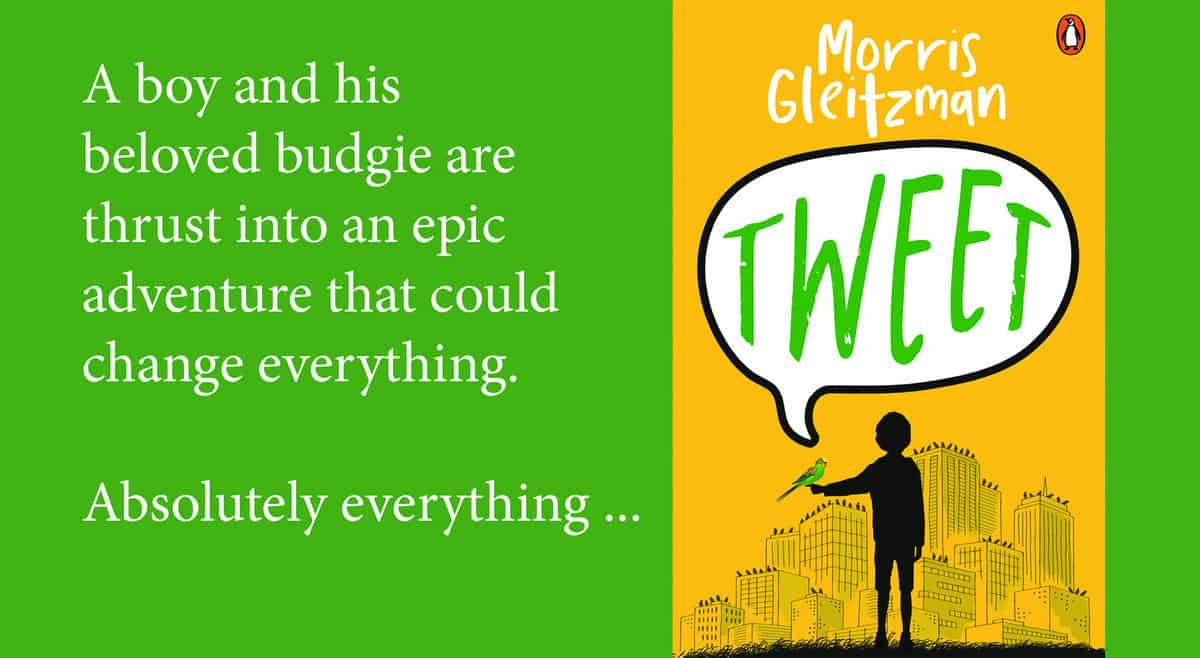
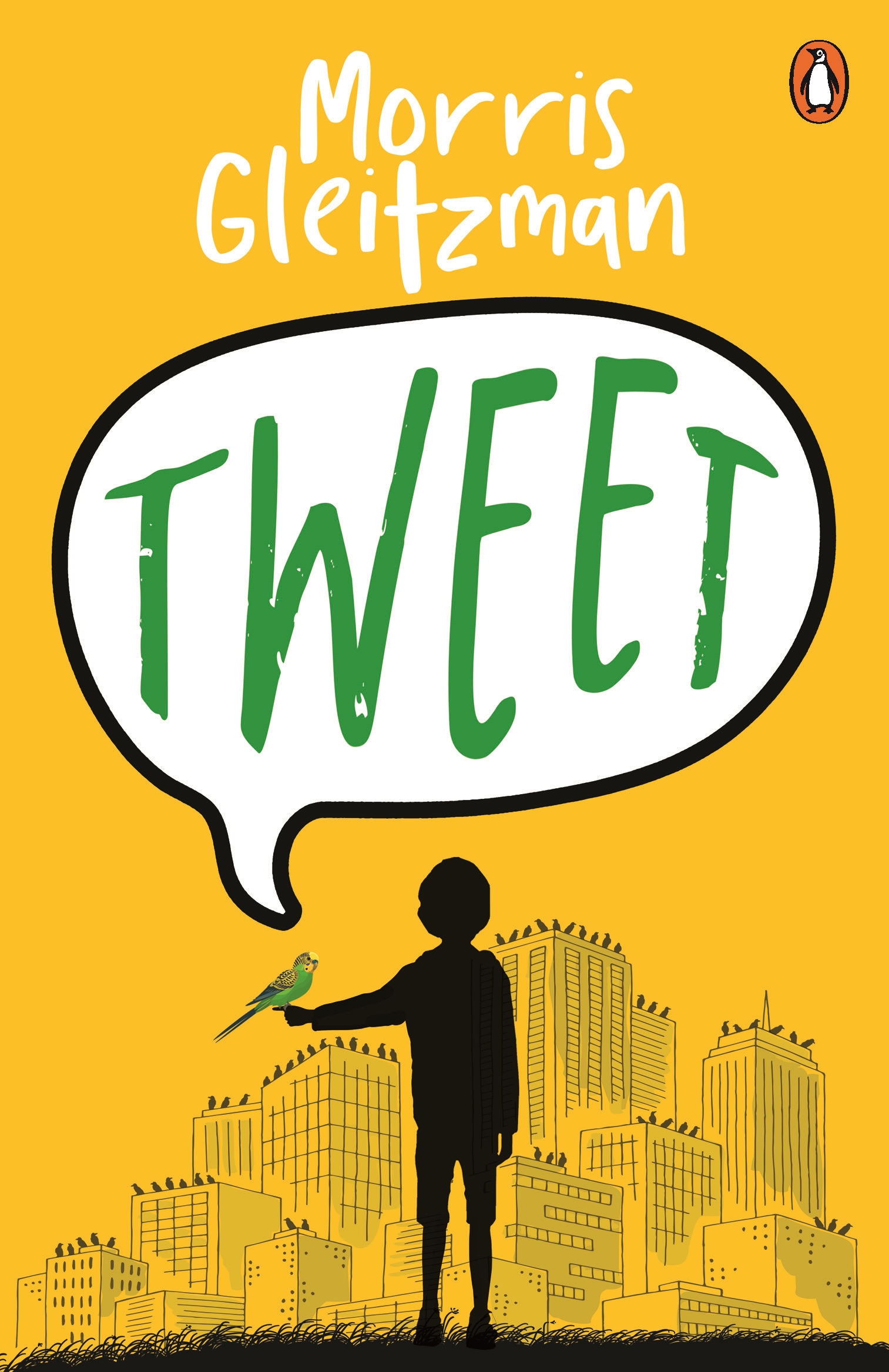
Morris Gleitzman is one of the most loved and popular Australian authors with 43 books to his name. His latest book Tweet is about a boy and his budgie.
Good Reading for Kids caught up with Morris to find out about the book and what he learned about birds while writing.
 How did the idea for Tweet develop?
I’ve always been interested in problems. How characters feel about having them. The creative thinking they’ll need to do on their problem-solving journey (there’s always at least one of those in a story).
I’m fascinated by how grappling with problems changes us in all sorts of ways. I can’t help noticing how we often have a better chance of solving or surviving a problem when we work in a group. But how sometimes groups make it easier to pretend a problem doesn’t exist, or to blame it on someone else.
Of course there are loads of different types of problems. A problem that feels small to one person might feel huge to somebody else. Some problems affect all of us and even the planet we live on. Some problems are too big and too complicated to be solved in a single story. But even then, a story can usually help us think about problems in different and useful ways.
Problems are my hobby as well as my job. And it’s a hobby that gives me heaps of ideas. Such as, one day in my imagination, seeing a group of birds, thousands of them, standing quietly and calmly on a busy highway, blocking traffic. Hundreds of groups actually, millions of birds, on busy highways all over the planet.
And soon afterwards, also in my imagination, I met two young characters who discover why the birds are doing this. And have to decide what to do with this information. And, at the same time, if they can, stay alive.
And 15 months later, Tweet was finished.
What can you tell us about those two characters?
Jay, who’s about to start year six, wishes his parents were there to drop him off at school instead of being lost in the jungles of Africa.
Clyde, Jay’s best friend, wishes they could both go to Africa, right now, straight to the beautiful but scary jungles, and come to a sensible agreement with the magnificent but terrifying animals there, and rescue Mum and Dad. But they can’t, not at first, because Jay is only eleven and Clyde is a budgie.
What kind of adventures will Jay and Clyde and their friends go on in this story?
Big ones. Across vast distances, because the grown-ups of the world are desperate to know why the birds have started disrupting everything.
And Jay and Clyde and their friends will also have big adventures inside themselves. Jay, for example, secretly wishes he was a bird, given the price of air tickets to Africa. And Clyde wishes he was a human, given how hard it is to rescue people when you haven’t got a helicopter, or thumbs.
Their friends Dora and Maxine join them on their adventures. Maxine is a bird expert who helps protect Jay and Clyde from crowds of wild creatures. Mostly humans. And Dora is a bird who helps Clyde be more human in a good way, but wants to be wilder herself.
What was your favourite part of writing this book?
Discovering so many things I wouldn’t have believed were possible. That you can fly across the world non-stop even when you only weigh about as much as a footy sock. That birds have ways of communicating that don’t involve yelling, pointing or tweeting. That you can write a 349 page book without your typing fingers bursting into flames.
What was the most interesting fact you learned about birds while researching for this book?
That if somebody calls you a bird-brain, it’s the biggest compliment they could give you. My dream is that one day I might have a bird brain.
Describe this book in three words.
Finished. New. Unusual. (In a good way.)
Teachers’ Resource – Tweet by Morris Gleitzman
ABOUT THE AUTHOR
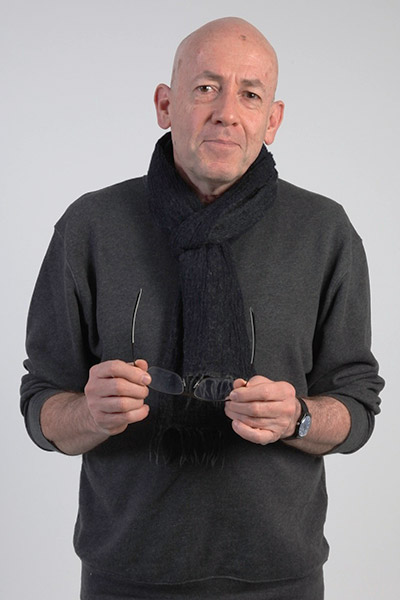 Morris Gleitzman is a bestselling Australian children’s author. His books explore serious and sometimes confronting subjects in humourous and unexpected ways.
His titles include Two Weeks With The Queen, Grace, Doubting Thomas, Bumface, Give Peas A Chance, Extra Time, Loyal Creatures, Digging Up Dad and the series Once, Then, After, Soon, Maybe, Now and Always.
Morris lives in Sydney and Brisbane, and his books are published in more than 20 countries.
0 Comments