



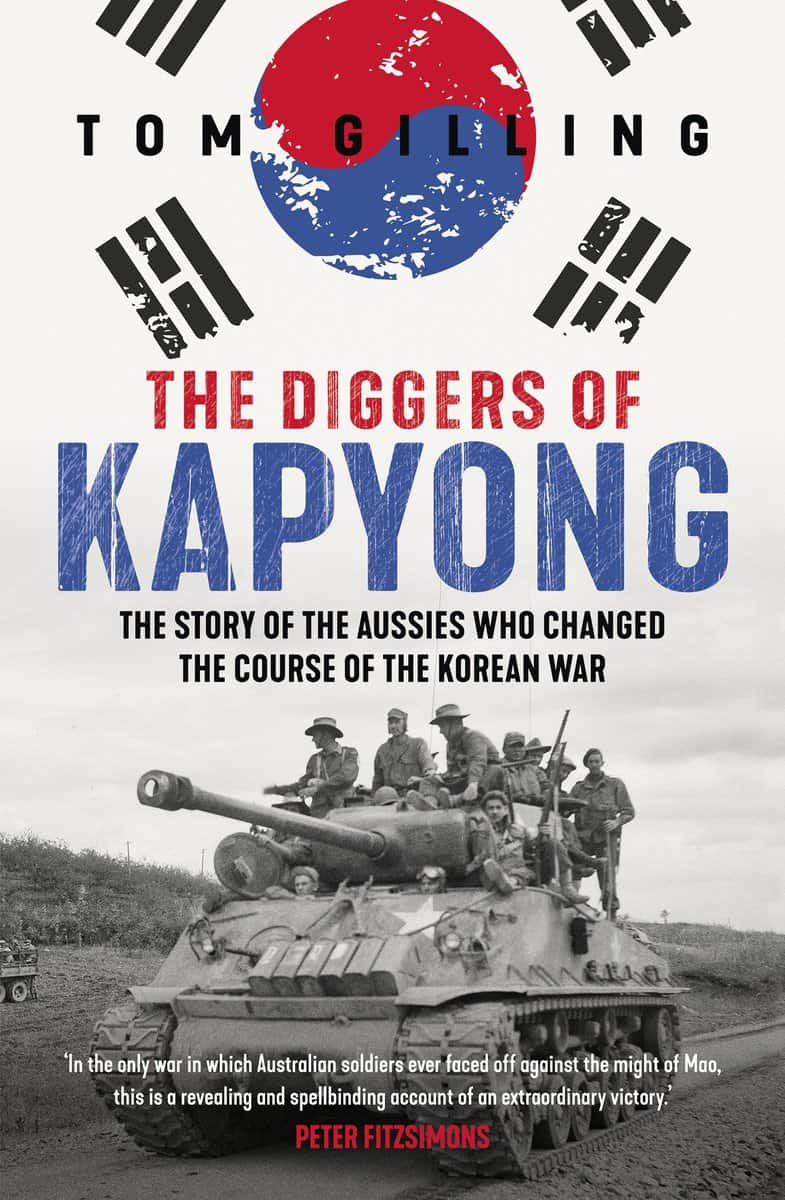
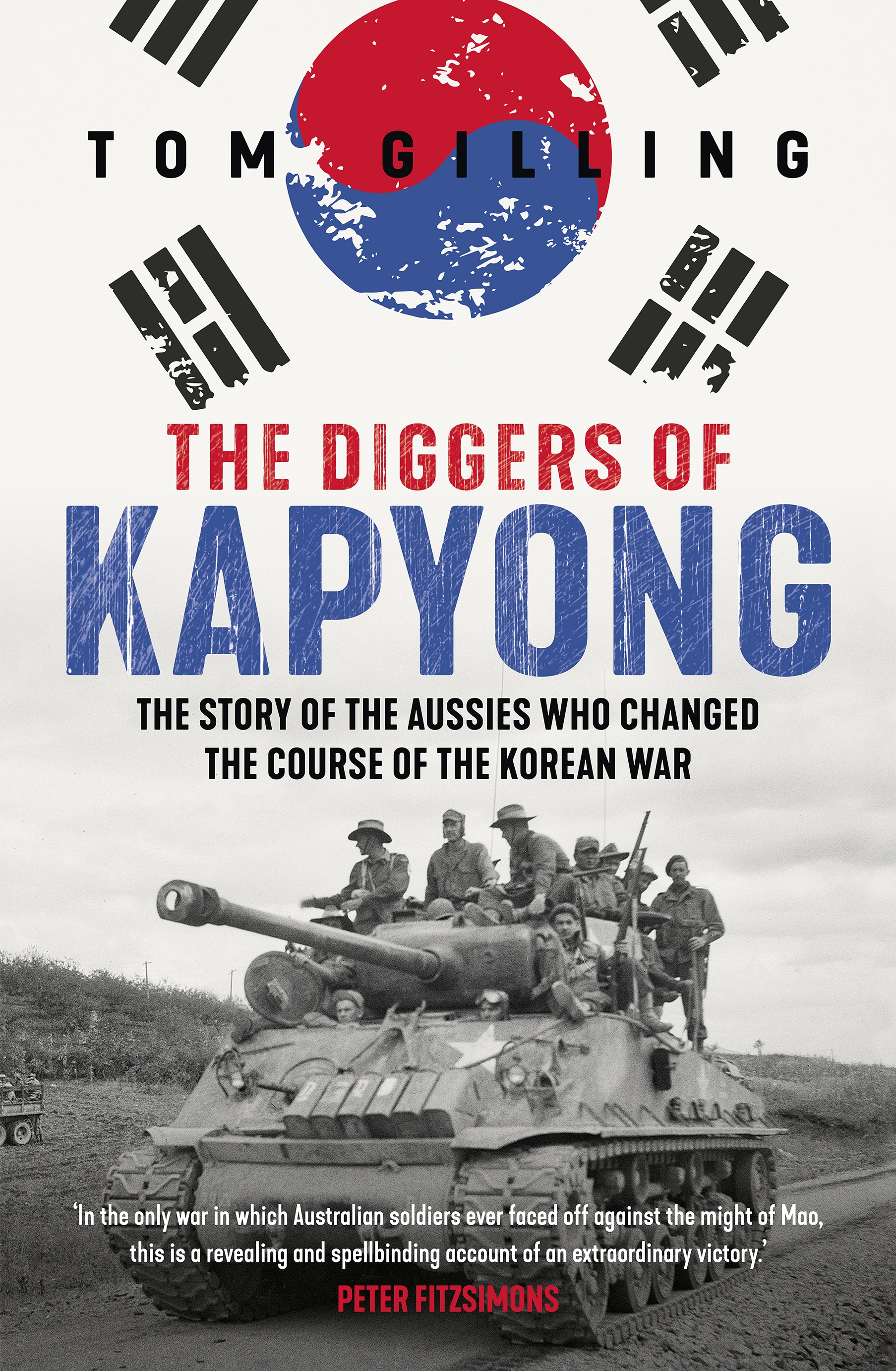
The Diggers of Kapyong by TOM GILLING tells the account of Australia in the Korean War and how 3RAR battalion held back an entire Chinese army division to prevent Seoul being overrun. It’s a story of mateship, sacrifice and heroism.
When the veteran US journalist and author David Halberstam was researching his book on the Korean War, he visited a library in Florida where he found ‘88 books on Vietnam and only four on Korea’ – a disparity, he wrote later, that ‘more or less sums up the war’s fate in American memory’.
In Australia, the war began to be forgotten while it was still being fought. After being wounded, evacuated to Japan and then sent back to Korea, Sergeant Jack Gallaway returned to Australia in February 1952, more than a year before the war’s end. He recalled ‘walking into hotels where I met old friends who said, “Where have you been?” And I said, ‘Korea.’ And they said,“What the hell were you doing over there?’’
Some Korean War veterans remembered being rebuffed by RSL clubs because ‘that wasn’t a proper war’.
While inevitably overshadowed by the two world wars that preceded it, the Korean War was one of the defining events of the 20th century, a product of Cold War machinations whose outcome remains bitterly contested to this day. After three years of savage fighting up and down the Korean Peninsula, the border between the communist North and the democratic, pro-American South had hardly moved.
The war ended without a formal peace treaty between the two Koreas. The armistice signed on 27 July 1953 left hostilities unresolved. As many as two million soldiers became casualties – dead, wounded or missing. Perhaps another two million Korean civilians died. Australian servicemen were more than twice as likely to be killed in Korea as in Vietnam.
The Royal Australian Navy (RAN) and the Royal Australian Air Force (RAAF) both played significant roles in the conflict, but most of
the hard fighting was done on the ground by soldiers of the Royal Australian Regiment (RAR). Of its three battalions, it was the 3rd Battalion – 3RAR – that served during the most intense period of the conflict, when the war came close to being lost.
This book is the story of a desperate battle fought by a few hundred Australian soldiers for a strategic hilltop in South Korea, and of the events that led up to it. During the long night of 23 - 24 April 1951, Major Ben O’Dowd’s A Company suffered nearly 50 per cent casualties fighting off wave after wave of Chinese infantry. As day broke, the surviving diggers, running out of food, water and ammunition, were reduced to scrounging bullets from their fallen mates.
American accounts of the Korean War rarely mention the Battle of Kapyong, although President Harry S Truman recognised its importance with a Presidential Unit Citation that credited the ‘courageous, indomitable and determined’ Australians with stopping an enemy breakthrough and turning ‘defeat to victory’.
Before 3RAR landed at Pusan on 28 September 1950, the United Nations’ army had been clinging to a foothold at the south-eastern tip of the Korean Peninsula. General Douglas MacArthur’s daring amphibious assault at Inchon, more than 160 kilometres behind the enemy lines, turned the war on its head. Within a fortnight of 3RAR’s arrival, the battalion was spearheading the UN army’s pursuit of the retreating North Koreans.
After a string of small engagements, 3RAR took part in its first major action at Yongju on 21 - 22 October, in what became known as the Battle of the Apple Orchard. Battles at Pakchon (23 - 26 October) and Chongju (29 October) took the battalion to within a few kilometres of the Chinese border. Chongju was as far north as the diggers would go.
The dramatic intervention by the People’s Republic of China (PRC) sent the UN army into headlong retreat, and 3RAR was withdrawn hundreds of kilometres to a new defensive line south of Seoul. When the UN forces went back on the offensive, 3RAR again took the lead, fighting the Chinese for control of a series of wooded hills before arriving at the Kapyong Valley, north-east of Seoul, a traditional invasion route for attacks on the capital.
It was here that Corporal Raymon Wilson, already carrying wounds from Pakchon and the Battle of the Apple Orchard, was wounded for a third time. Wilson had been pegged by his fellow diggers as unlucky and destined to be killed in Korea; before every firefight they would rib him and ask for their pick of his belongings.
Wilson’s platoon was attacking a hill when the assault was held up by an enemy trench. The position of the trench halfway up the tree-covered slope made it impossible for the Australians to bring it under direct fire, so Wilson and his mate Ron Cook crawled forward with two grenades and an Owen submachine gun.
‘I was just looking for a way to throw through [the trees] when we got rained with grenades,’ Wilson recalled later Ronnie went down, he got a piece of shrapnel … I got up, tossed my two grenades … just after I threw them we got another shower of grenades. I dropped down to the ground again and I felt this thing hit my back and the next thing I know it exploded I thought it had broken my back.’
One Chinese grenade had worked its way under Wilson’s haversack before detonating. Luckily for him, grenades explode upwards.
If the grenade had been underneath him, it would have killed him. As it was, Wilson’s thick pile jacket took much of the blast. Though not fatal, the injury to his back was serious enough for Wilson to need evacuating – first to a mobile surgical unit and then to Japan. Strapped to a wire basket attached to the side of an army helicopter, the wounded digger was on his way out of Korea, and out of the war. His mates, meanwhile, hunkered down on the rocky slopes of Hill 504 for a battle that would cost more Australian lives than any other single engagement, and change the course of the Korean War.
ABOUT THE AUTHOR
 Tom Gilling is an acclaimed novelist and non-fiction writer. His first two novels, The Sooterkin and Miles McGinty, were New York Times notable books of the year. His non-fiction works include Bastard Behind the Lines and The Lost Battalions. He is also co-author with Clive Small of the bestselling true crime books Smack Express, Blood Money, Evil Life and Milat.

0 Comments