



Prologue
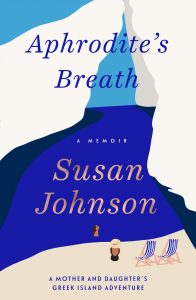
In life and myth, women are the ones who are supposed to stay home like Penelope, weaving at their looms, rather than leaving home like Odysseus. This is the story of two women, at the reckoning end of life, leaving their homes for the Greek island of Kythera. We took ourselves off, without armies or kingdoms, modern-day heroines to no one. It seems miraculous now, believing ourselves freightless, divested of troubles. We knew we were privileged in that we could leave home at all, since most souls in this world are tethered by the quotidian restraints of existence. We counted ourselves blessed in being able to choose a different route to the one prescribed, a path more usually trod by men, and by that I mean the path of desire. If men cover the universe with drawings they have lived, as Gaston Bachelard wrote, we wished to trace our own map, to follow nothing but the wind of our desires.
Given our ages – 62 and 85 – we were perhaps brave and foolish in equal measure. Possibly we were drawn to Greece, the land of immortal gods, because we found it impossible to imagine our own extinction. I know it’s hard to believe— possibly even pathologically hubristic – but neither of us thought for a second that my mother could fall ill and die in Greece, even though we went through the arduous process of securing comprehensive medical insurance for her. We discovered that no company in the world was willing to insure her for a year and possibly longer except one based in Monument, Colorado, specialising in expensive insurance for expatriates. My mother and I, together with my middle brother, Steven, contributed equally to the hefty sum, which ensured an emergency medical evacuation flight back to Australia should she need it. We went as far as discussing what would happen to her mortal remains should she succumb to the effects of type 2 diabetes, high blood pressure, high cholesterol, smoking (yes, Mum was still happily fagging away), or any of the other bodily catastrophes that cause 85-year-old women to fall off their perches. Mum was adamant she did not want us to fly her body back to Australia for a funeral; a committed Anglican who believed her faith would return her to God, she was happy to be cremated in Greece. I didn’t know until I investigated further that the Greek Orthodox Church – which exists as a sort of atmosphere permeating the lives of all Greeks – opposes cremation, believing in the resurrection of the physical body, and that it would be a million times easier to fly a body back to Australia than to find a crematorium on Kythera, or indeed anywhere in Greece.
But, really, neither of us believed anything disastrous would happen to her. In this we lived like immortals, or like any bloke throwing back his fifth tequila shot: we went forth, blazing, as if nothing could fell us. Kythera is an island of some 4000 people who, like those in small communities everywhere, tend to be suspicious of supposed truths proffered in their names. I have sometimes changed identifying details, not because Kytherians need protection – or because I do – but for the reason that whoever lives through personal experience is the one with the right to tell it, and my interpretation of mutual events might not tally with theirs. People hold entire universes within them invisible to everyone else, and only a very arrogant writer assumes to know the motivations of other people. I’m more usually a writer of fiction, in which I feel unfashionably free and arrogant enough to take any detail from life and transform it into an entirely new thing. But non-fiction is excluded from that shifty term ‘poetic licence’, and readers rightfully expect details to be indivisible from fact. While I’ve endeavoured to honour this contract, the book doesn’t pretend to be anything other than our particular story, and its shortcomings and biases are mine. It is an account of our time spent on the most southern of the Ionian Islands, in Greek myth the birthplace of the goddess Aphrodite, and it is as true as any story can be. But it is a crafted thing, and some events have been telescoped – their timelines changed – while others have been deliberately omitted, out of respect not only for other people’s privacy (especially my mother’s), but also my own.
 Mum belongs to the never-wash-your-dirty-linen-in-public school, now as quaint as a horsehair petticoat in a culture that has dissolved the boundaries between public and private. Today, it’s considered suspicious – even furtive – to withhold anything from readers, especially in memoirs which purport to present a version of truth. But I have, because I am a private person – even an obsessively private one – and because writing that seeks to reflect even a portion of the totality of experience can only be a narrative punctuated by spaces. Kythera is a place in which many people have a claim, and these claims are jealously guarded: everyone thinks they know the real Kythera, and I can already hear the voices claiming I have got it wrong. But the truth is that every born-and-bred Kytherian, every descendant flung far from its shores, every resident expat from somewhere else, and every blow-in visiting for the briefest of moments has their unique story of Kythera, and this is mine. Yet it is not solely mine to claim, because it is also my mother’s: we travelled to Greece together, in the under- standing I would write this book. If to photograph people is to violate them, as Susan Sontag suggests, turning them into objects that can be symbolically possessed, what does writing people do? Perhaps even before we left home, I was the violator, my mother the violated. Astronomers talk of the parallax effect, whereby the position or direction of an object appears changed when the object is viewed from a different angle. According to the angle of my mother’s vision, this book might be less true: it holds her story within it, a story which can never be read, no matter how penetrating the light. There is no word I can find – in English or Greek – for an object carrying within it an unseen object, causing it to stand ambiguous and changed. We set off together, foolish and fearless: here is a version of what happened.
ABOUT THE AUTHOR
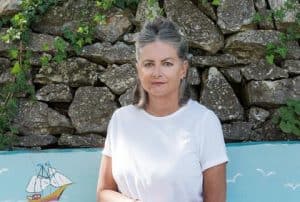 I was born in Brisbane but moved to Sydney at the age of three months, which is where I spent my childhood. My late father, John, was a Queenslander and my mother, Barbara, was from Sydney. I grew up around Sydney’s North Shore (St.Ives) and moved to Queensland with my family (to a pineapple farm) where I finished my last years of high school. I attended Nambour High (the same year as the Australian Prime Minister, Kevin Rudd, but I don’t remember him, and I am sure he does not remember me). My last two years were spent at Clayfield College.
I’ve written 10 books: eight novels; a memoir, A Better Woman; and a non-fiction book, an essay, On Beauty, published by Melbourne University Press. Several of my books have been published in the UK, the US, and in European translation (French, Polish) as well as in Australia.
My novel The Broken Book (Allen and Unwin, 2004) was longlisted for the Miles Franklin and the International IMPAC Dublin Award, and shortlisted for the Commonwealth Writers’ Prize, the Queensland Premier’s Prize for fiction, the Nita B Kibble Award, the Association for the Study of Australian Literature (ALS) Gold Medal Award and the CAL Waverley Library Award for Literature. Flying Lessons, (Heinemann, 1990; Faber UK, 1990; Faber US, 1990) was shortlisted for the Victorian Premier’s Prize for fiction; A Big Life, (Picador, 1993; Faber UK, 1993; Faber US, 1993) was shortlisted for the Victorian Premier’s Prize and the Banjo Award and my memoir, A Better Woman (Random House, 1999; Aurum Press, UK, 2000; Simon and Schuster, US, 2001) was shortlisted for the National Biography Award.
Several of my books have been released as recordings by the ABC and also as Louis Braille audio releases. My short stories have been broadcast on BBC Radio 4. I am a contributing editor of Agni literary magazine published at Boston University and supported by the graduate Creative Writing Program. I’m Adjunct Professor in Creative Writing at Queensland University of Technology, Brisbane. I work as a journalist at Qweekend magazine, the Saturday colour magazine of The Courier-Mail, Brisbane.
I’ve more or less been a full-time writer of fiction since 1985, when I received the first of three New Writers’ grants from the Literature Board of the Australia Council which allowed me to write full time. Before that I was a full-time journalist.
The same year I was awarded my first grant I co-edited and contributed to a collection of Queensland short stories called Latitudes: New Writing From The North (UQP, 1986). In 1989 I was awarded the Keesing Fellowship at the Cité Internationale des Arts in Paris. I’ve been a participant at most of Australia’s writers’ festivals and have a wide experience of readings, guest lectures and teaching work in universities in Australia, as well as in England, Hong Kong and the United States, including guest lectures at New York University, Amherst College, Boston University and Emerson College, Boston.
Throughout my years as a writer of fiction, I’ve continued to publish journalism and essays on mainly literary matters for newspapers and magazines.
My literary papers have been purchased for collection by the State Library of New South Wales, an ongoing acquisition program. My website has been archived as part of the National Library of Australia’s Pandora Project as a site considered by the library to be ‘of significance and to have long-term research value’. In 2011 I delivered the Ray Matthews Lecture at the National Library, Canberra.
I’ve lived in the UK, France and Greece but returned to Brisbane, Australia, to live with my two sons, Caspar and Elliot, in 2010. I’ve been married twice and will be very surprised if I go for the trifecta.



0 Comments