



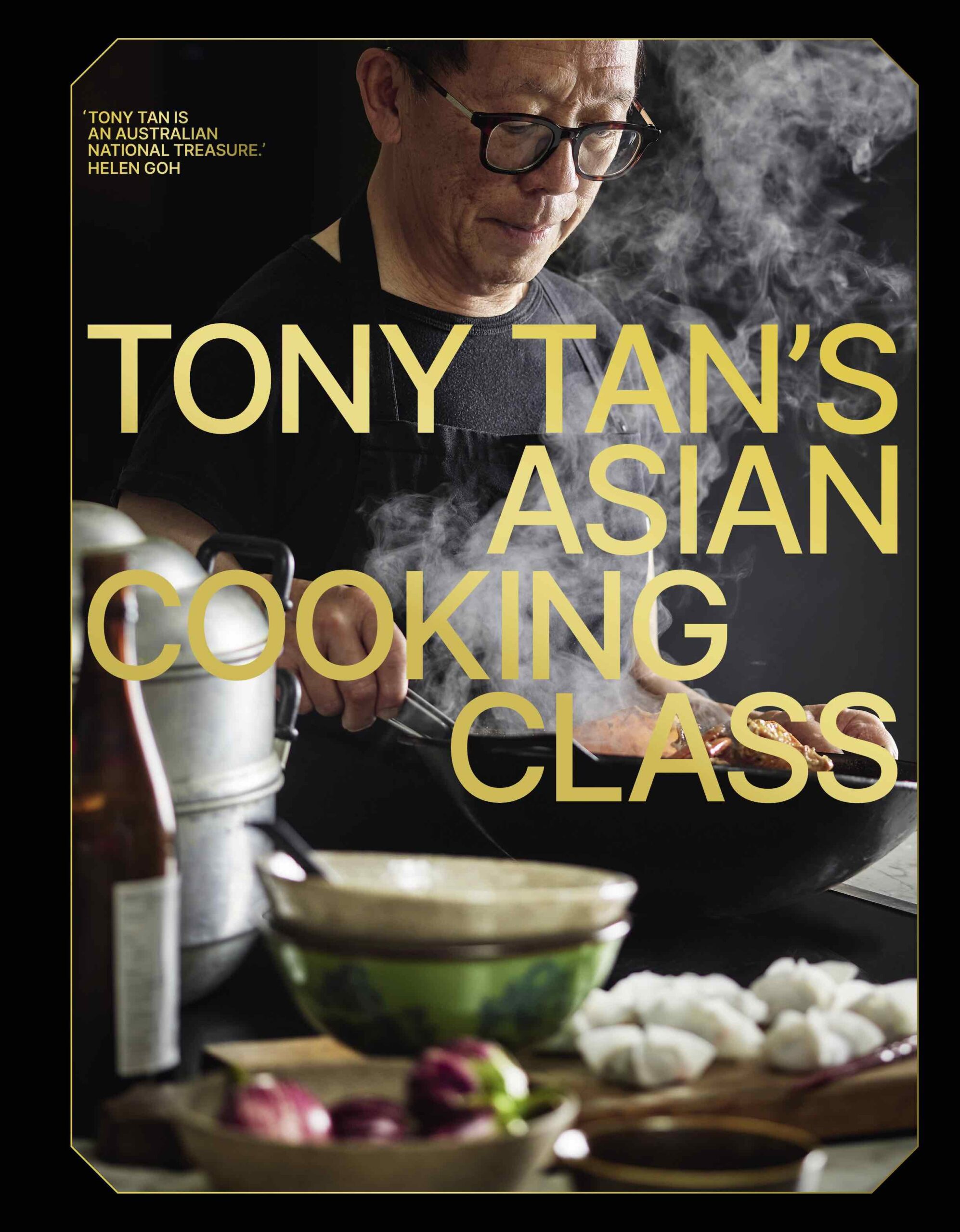
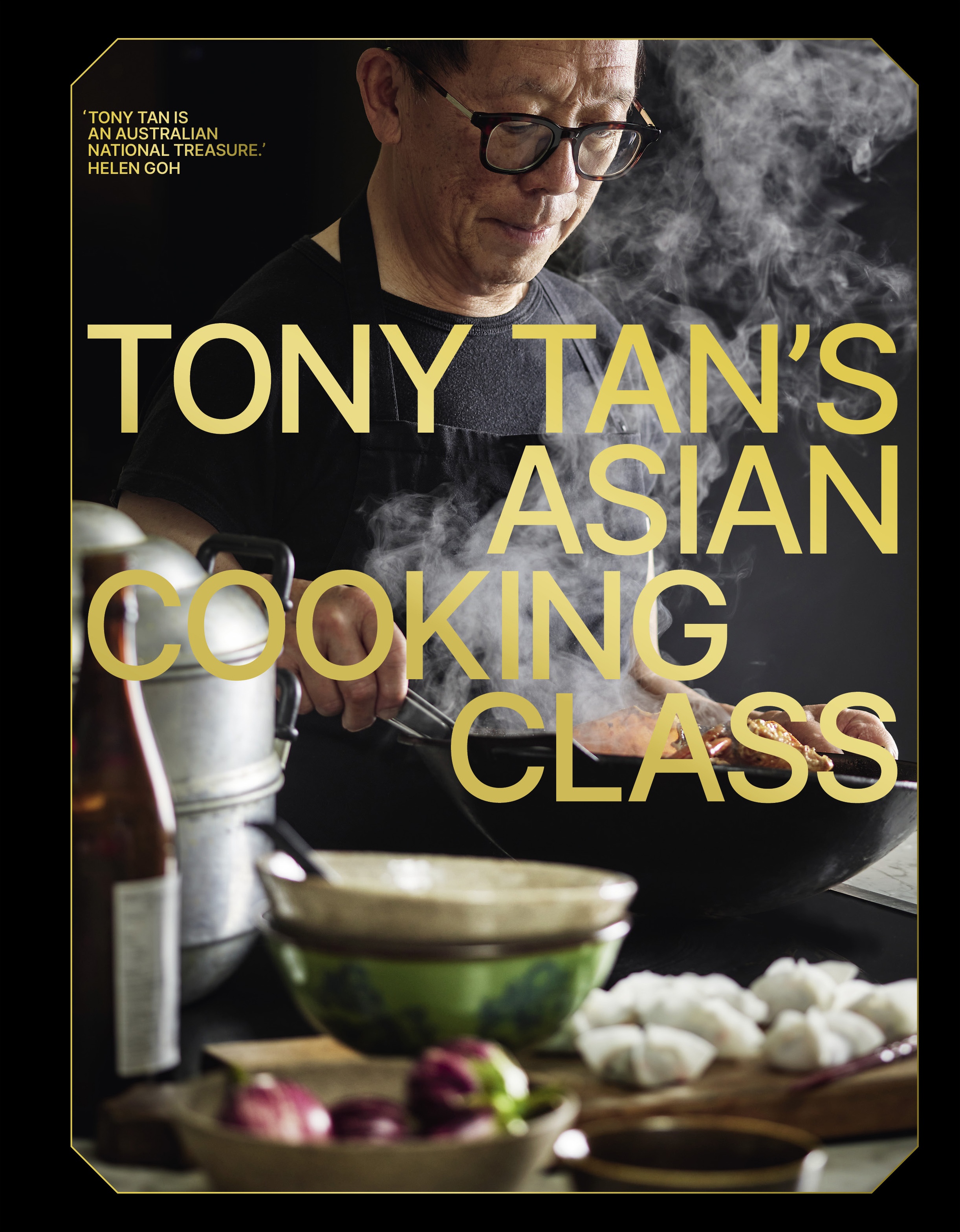
Tony Tan is an internationally regarded chef, teacher and mentor.
In his book Tony Tan’s Asian Cooking Class he offers us joyful recipes and gentle lessons in the essential ingredients, techniques and dishes of China, Malaysia, Singapore, Thailand, Vietnam and beyond.
Try out this yummy recipe.
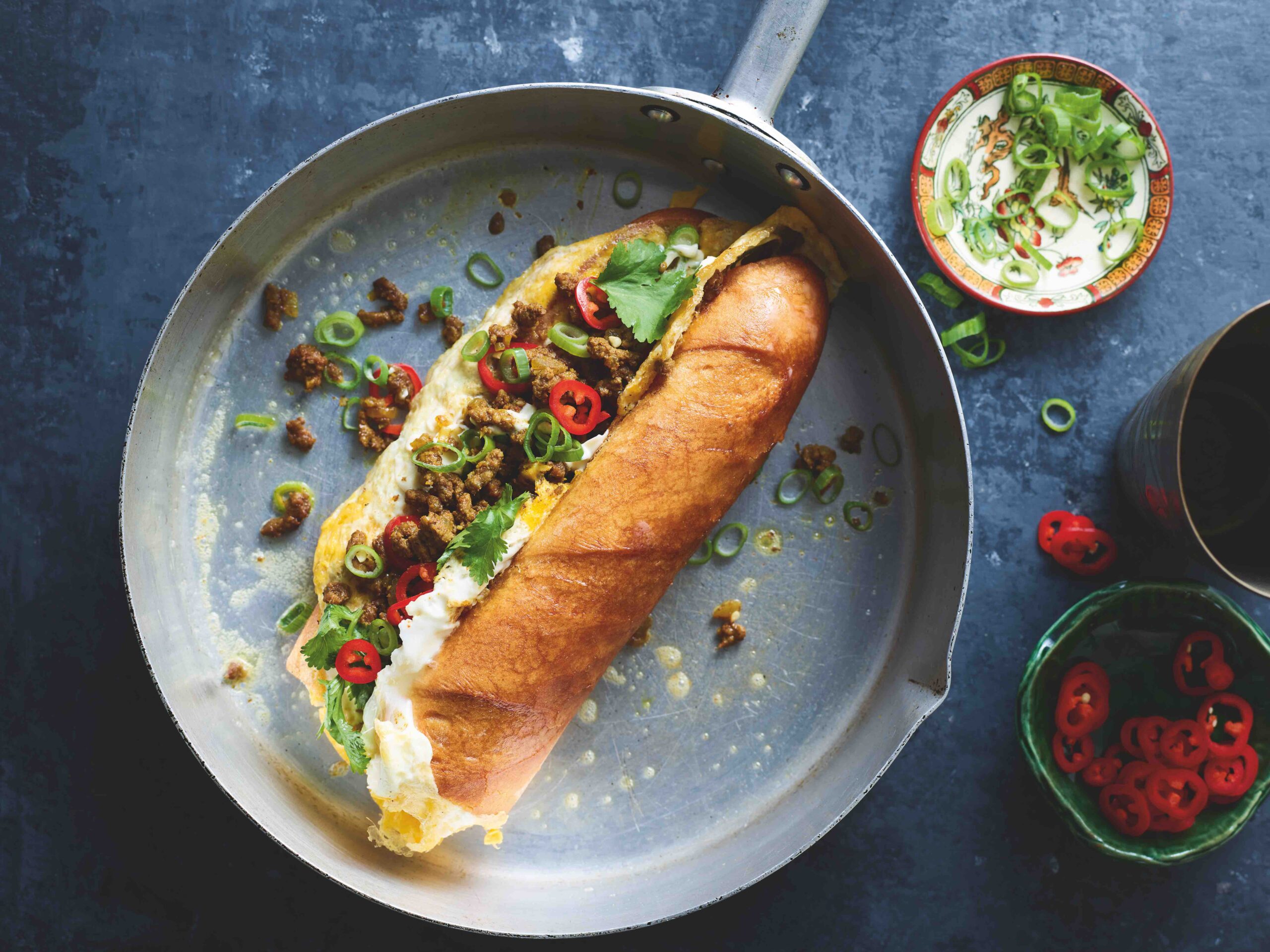
Roti John
This street food of minced beef or chicken with eggs slathered on French bread and fried is popular in Indonesia, Brunei, Singapore and Malaysia. This simple and delicious sandwich made its debut back in the 1960s when there was a British naval base in Singapore. Apparently, while the soldiers were stationed in Singapore, they would stop at a stall selling bread and omelettes. According to legend, as the stallholder saw all British soldiers as more or less the same, he would ask them this question: ‘Roti, John?’ Every British serviceman was referred to as John. Regardless of its origin, it really is a joy to eat. I’m surprised it hasn’t caught on in the West.
Serves 4
⅓ cup (80 ml) neutral oil or ghee
1 large onion, finely chopped
1 tablespoon finely chopped lemongrass
1 garlic clove, minced
1–2 tablespoons meat curry powder (such as Alagappa, or Cap Burung Nuri)
½ –1 teaspoon chilli powder
½ teaspoon ground turmeric
1 teaspoon garam masala (page below)
500 g (1 lb 2 oz) finely minced beef, lamb or chicken
Salt and white pepper, to taste
4 eggs
2 tablespoons chopped Vietnamese mint
1 baguette, cut into 4 equal pieces
Softened butter, for brushing
Coriander (cilantro) sprigs, to serve
Chilli sauce and tomato sauce, to serve
Heat a wok over medium-high heat, then add 2 tablespoons of oil.
Once it’s shimmering, add the onion, lemongrass and garlic and stir-fry until the onion turns translucent. Meanwhile, mix the curry powder, chilli, turmeric and garam masala with enough water to make a paste.
Add to the wok and cook for 2–3 minutes, stirring constantly.
Add the meat and cook, stirring now and then, until it is well coloured and the moisture has evaporated.
Season to taste with salt and pepper, and add enough water to cover the meat. Bring to the boil, then reduce to a simmer and cook until all the liquid is absorbed. Leave to cool.
Beat the eggs in a large bowl, then add the cooled meat mixture and stir to combine. Cut each piece of baguette in two lengthways (but not all the way through) and open them up.
Generously grease a large non-stick frying pan with the remaining oil, heat over medium-high heat, then add a large dollop of the omelette mixture and cook for 1–2 minutes, stirring and tossing until softly set.
Open out a cut baguette and place it on top of the omelette in the pan, crust-side up, pressing gently so the omelette sticks to it. Cook until the omelette is firm, brushing some butter on top of the baguette as it sets.
Remove the baguette and omelette with a spatula and fold together to form a sandwich. Top with coriander and serve with a mix of some chilli sauce and tomato sauce, to your taste.
GARAM MASALA
Meaning hot spices, garam masala has many regional variations and every home has its family recipe. It is added towards the end of the cooking process. Packaged garam masala is a pale imitation of homemade blends. Many recipes call for black cumin or shah zeera, aka royal cumin, which is often confused with nigella seeds. My recipe uses regular cumin to avoid this confusion. Some cooks dry-roast the spices separately before grinding them to a powder, but I don’t.
1 tablespoon green cardamom seeds
5 cm (2 inch) stick cinnamon, broken into bits
1 teaspoon whole cloves
1 teaspoon black peppercorns
1 teaspoon cumin
½ teaspoon grated nutmeg
Except for the nutmeg, place all the ingredients in a spice or coffee grinder and blitz for 30 to 40 seconds to a fine powder, then mix in the nutmeg. Store in an airtight container. I keep mine in the fridge.
Images and text from Tony Tan’s Asian Cooking Class by Tony Tan, photography by Mark Roper.
ABOUT THE AUTHOR
 Tony Tan is one of Australia’s most respected culinary teacher and chef specialising in Chinese, Nonya, Indonesian, Korea, Cambodian Thai, Vietnamese, Indian, Singaporean, Malaysian and cross-cultural cooking.
Trained at La Varenne in France and Leith’s School of Food and Wine in England, he has owned and cooked at Shakahari Restaurant in Melbourne and Tatlers Café in Sydney. Tatlers was an instant success and was regarded as one of the most innovative restaurants in Australia. He was principal of his cooking school in Melbourne which he established in 2001.
A graduate in Renaissance History and Chinese Language from Monash University, Tony is fluent in several languages; as a consequence, he hosts intensive culinary and cultural tours to countries in Southeast Asia, China and Spain. Tony has also presented several master classes around Australia and has been guest chef at hotels and restaurants throughout Australia, China, Malaysia, Vietnam, New Zealand and Spain including the Ritz in Madrid as well as at Alambique, one of Spain’s top cooking schools.
In 2007, Tony’s school is picked by the Australian as the state finalist in the Best Food Experience Category. In 2008, the school is listed as the two best in Australia by US Gourmet magazine as recognition for delivering in-depth culturally and historically accurate knowledge on the cuisines of Asia and modern Australia. He closed his school in 2012 to focus on tours and writing. The quality of Tony’s food tours is recognised by winning The Australian newspaper’s prestigious Travel & Tourism Awards in 2008. Aside from making guest appearances as visiting chef in restaurants in Melbourne, Sydney and Wellington, he was also Creative Director – Cultural – of the Melbourne Food & Wine Festival. Tony is currently writing a book on Hong Kong and the long awaited Nonya book.

0 Comments