



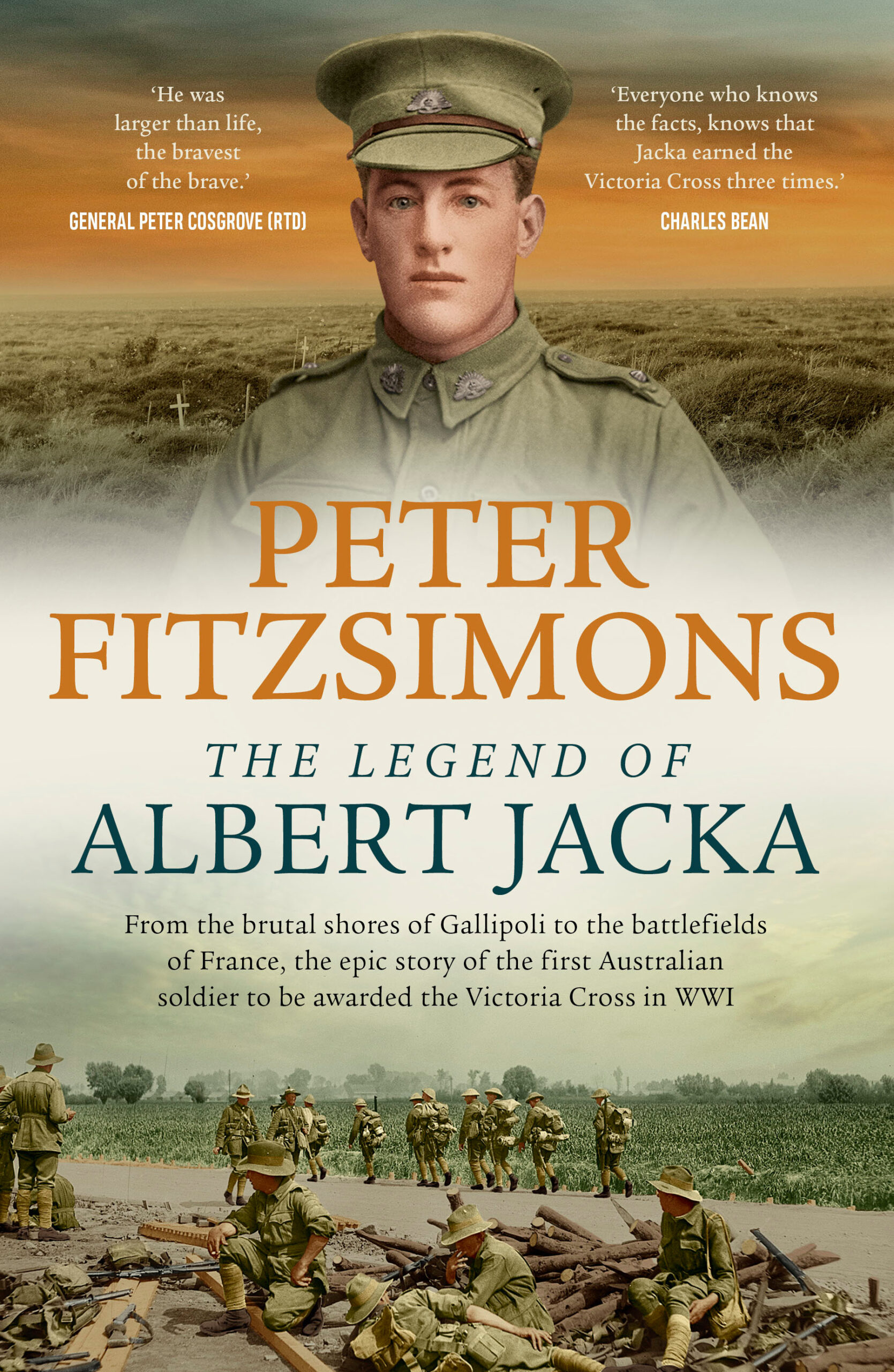
In PETER FITZSIMONS new book, The Legend of Albert Jacka, he tells us about the incredible story of bravery and sacrifice of one extraordinary soldier that takes us from the shores of Gallipoli to the battlefields of France.
ABOUT THE BOOK
Our heroes can come from the most ordinary of places. As a shy lad growing up in country Victoria, no one in the district had any idea the man Albert Jacka would become.
Albert ‘Bert’ Jacka was 21 when Britain declared war on Germany in August 1914. Bert soon enlisted in the Australian Imperial Force and the young private was assigned to 14th Battalion D Company. By the time they shipped out to Egypt he’d been made a Lance Corporal.
On 26 April 1915, 14th Battalion landed at Gallipoli under the command of Brigadier General Monash’s 4th Infantry Brigade. It was here, on 20 May, that Lance Corporal Albert Jacka proved he was ‘the bravest of the brave’. The Turks were gaining ground with a full-scale frontal attack and as his comrades lay dead or dying in the trenches around him, Jacka single-handedly held off the enemy onslaught. The Turks retreated.
Jacka’s extraordinary efforts saw him awarded the Victoria Cross, the first for an Australian soldier in World War I. He was a national hero, but Jacka’s wartime exploits had only just begun: moving on to France, he battled the Germans at Pozieres, earning a Military Cross for what historian Charles Bean called ‘the most dramatic and effective act of individual audacity in the history of the AIF’. Then at Bullecourt, his efforts would again turn the tide against the enemy. There would be more accolades and adventures before a sniper’s bullet and then gassing at Villers-Bretonneux sent Bert home.
EXTRACT
 For all the criticism of those who had planned this catastrophe, no-one was in any doubt that if not for men like Albert Jacka it would have been so much worse. He had found the sunken road, patrolled the wire, guided the tanks, and liaised with Battalion Headquarters.
Some think he will be awarded a bar to his VC for his efforts, while others think a DSO more likely.
For there have been lessons learnt from the bloody Battle of Bullecourt, the first of which is that if tanks and infantry are going to operate in tandem, the tanks cannot be under independent command, and sending soldiers and tanks forth without artillery support is – what was that phrase again, Jacka? – ‘pure murder’.
As Intelligence Officer it falls to Albert Jacka to write a report on the tanks. The clear protocol in such matters is to frame your language in such a manner that whatever criticisms there might be are referred to obliquely – lest it be seen as a junior officer being insubordinate to senior officers by criticising them. But Jacka is jack of it. He decides to go for broke, and go to town while he is there, and say what needs to be said about the tanks, their officers, and the whole wrong-headed idea of using them in the first place. He wants to set down how they should be used if they are used again.
He was there. He saw it up close. He was appalled. He is appalled. He can see what needs to be done and is happy to write it all down – using some of the writing skills he has recently picked up, attending Officer’s School and preparing lectures.
His thoughts don’t merely spill out onto the page, he brands them there in a tone of barely controlled righteous fury. When Jacka kept a diary at Gallipoli, even winning the VC was deemed worthy of no more than a sentence or so. But this is different. This was a rolling slaughter that must not be repeated and he is the man to put a stop to it. Each dithering disaster of the whole murderous affair is laid out in prose and skewered in type.
The tank co-operation in the attack made on the Hindenburg Line on the night of the 10-11th of April, 1917, was useless or worse than useless . . .
Tanks were late in arriving at rendezvous, which meant they were late in getting to the jumping off place. In fact, only three reached the latter place at all.
The tank crews seemed to know little or nothing of an attack by infantry, or nothing whatever about the particular oper- ation they were to participate in.
For instance: In the case of No 2 tank, the tank commander had not even synchronised his watch, his time being 5 minutes behind time as given to the infantry. Further: Tank crews did not even know the direction of the enemy. This is verified by the fact that they opened fire on our own troops, thereby causing us many casualties. One tank opened fire on our men at jumping off place, killing four and wounding others.
The organisation seemed to be bad and no-one appeared to be in direct command of the show. This was shown by the fact that tanks wandered aimlessly about in every direction, thereby drawing enemy fire on us and all our trenches.
One crew in particular, asked why they had vacated their tank, stated that it caught fire but gave no reason for same. This same crew returned carrying two sandbags, one containing enamelware and the other food. Personal safety and comfort seemed to be their sole ambition.
Another crew was asked why they did not go forward to help clear a communication trench. They replied, ‘They had no officer so could not do so’. This showed a great lack of initiative and that the whole affair, so far as this tank was concerned, to be the responsibility of one man, and that man gone; the tank could do no more though undamaged.
One tank returned almost to Reserve Battalion Headquarters, pulled up right on the skyline and in full view of Bullecourt, thereby making a splendid aiming mark and drawing severe enemy gunfire which made the route very dangerous for troops.
The whole outfit showed rank inefficiency and [in] some cases tank crews seemed to lack British tenacity and pluck, and that determination to go forward at all costs, which is naturally looked for in Britishers.
It ends with not just a punch, but a body blow to any delusional senior commander who still sees some light at the end of the tanked tunnel they are digging: ‘In my opinion, manned by the bravest of crews and placed directly under the Infantry Officers concerned in operation, they would be of great help but they should NEVER be relied upon as the sole arm of support in an attack by Infantry. Further, when tanks are being got into position, we think it’s absol- utely necessary that heavy barrage be put up by our guns to deaden the sound of the TANKS.
In our case not a shot was fired when TANKS were taking up their position, and so the whole operation was given away to the enemy.
SGD. A, JACKA. CAPT. FAD.
In short? The whole tank exercise has been a tragic farce, made worse by the insistence of the Fifth Army’s General Gough that his suicidal orders be followed. And it is not just Gough who stands accused. The report makes the very serious charge that the British tank crews had been guilty of nothing less than cowardice – a very grave charge, which, if accepted, will see court martials.
It is strong stuff. Far too strong for Jacka’s military career to survive. Even when on his best behaviour the man borders on insubordination, but this is explosive. And so, Peck and Drake-Brockman decide to take the bullets for him. Jacka’s scathing intelligence report on the lack of intelligence of High Command will be sent to higher commanders, but with Peck’s and Drake-Brockman’s names on it. Jacka’s entire report is retyped (and reset, his whacking CAPITALS for words like NEVER becoming placid lowercase, and ‘my opinion’ replaced by ‘our opinion’) and sent on, personally signed with a flourish by the commanders of the 14th and 16th Battalions of the AIF.
ABOUT THE AUTHOR

Peter FitzSimons AM is Australia’s bestselling non-fiction writer, and for the past 38 years has also been a journalist and columnist with the Sydney Morning Herald and the Sun-Herald.
He is the author of a number of highly successful books, including Breaker Morant, Burke and Wills, Monash’s Masterpiece, Kokada and Ned Kelly, as well as biographies of such notable Australians as Sir Douglas Mawson, Nancy Wake and John Eales. His passion is to tell Australian stories, our own stories: of great men and women, of stirring events in our history.
Peter grew up on a farm north of Sydney, went to boarding school in Sydney and attended Sydney University. An ex-Wallaby, he also lived for several years in rural France and Italy, playing rugby for regional clubs. He and his wife, Lisa Wilkinson AM – journalist, magazine editor and television presenter – have three children; they live in Sydney.

0 Comments