



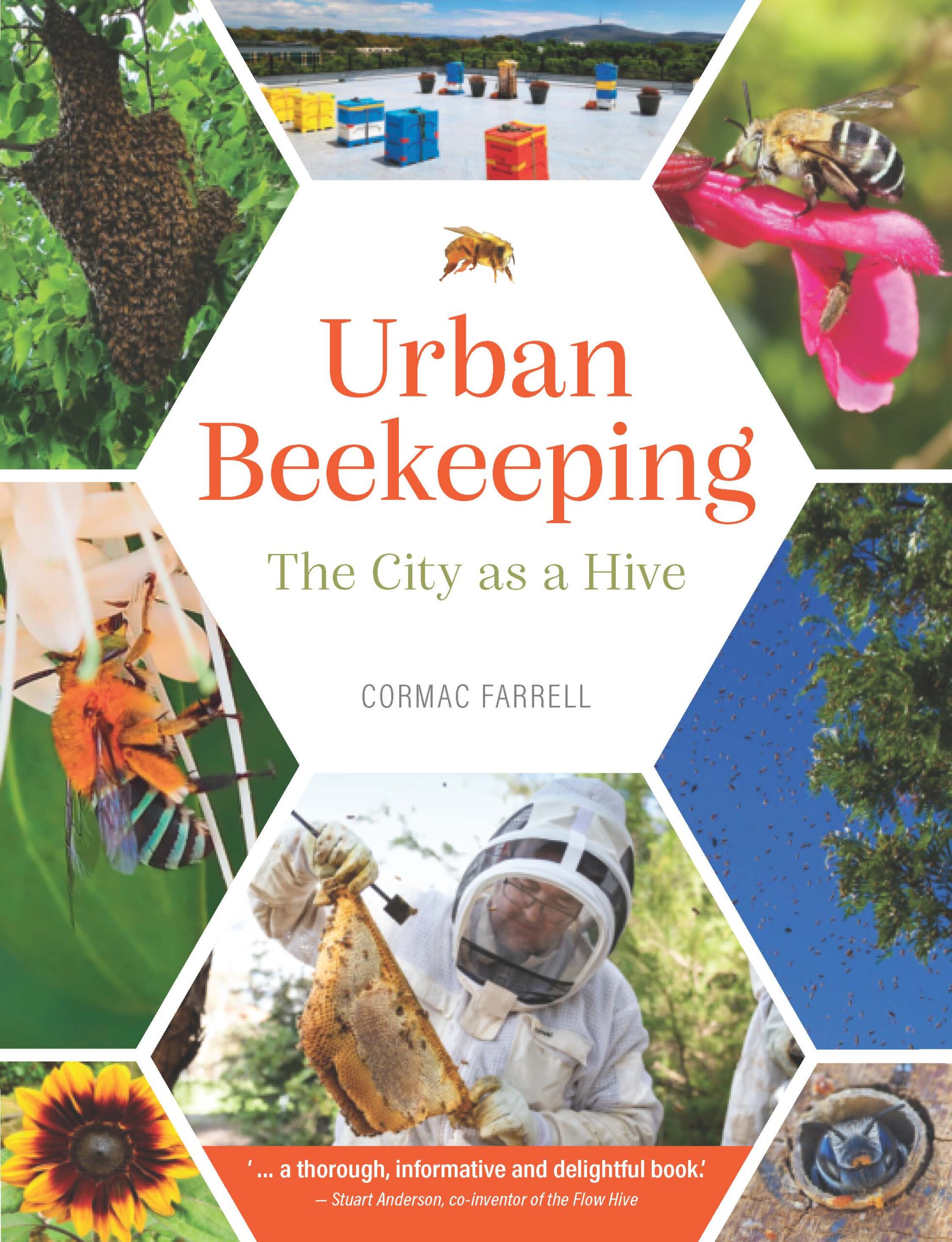
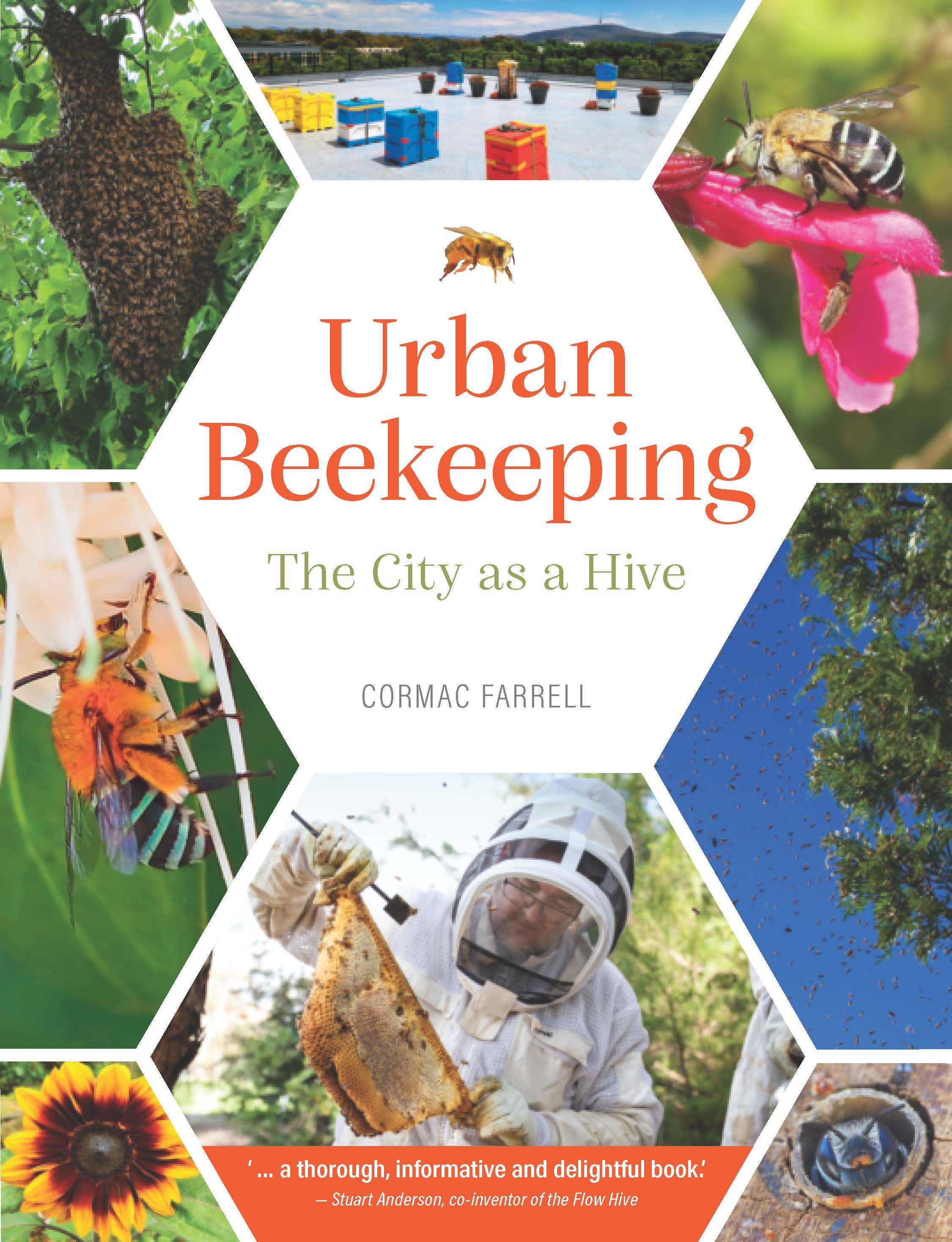
CORMAC FARRELL is an environmental scientist and beekeeper, best known as the Head Beekeeper for the Australian Parliament. We took inspiration from the introduction to his book, Urban Beekeeping.
It was the spring of 2013, and I had a big problem – my bees had swarmed. Not just anywhere, but onto my partner’s favourite yellow dress. She called me to impress upon me (at high volume, and with salty language) how important it was that the bees were off her dress pronto! Normally this is great for a beekeeper – swarms are a chance to establish new colonies – but I had another rule: only one hive allowed at home.
I didn’t realise it at the time, but this was a pivotal point that would impact both my beekeeping and my career. The solution was to convince my boss to let me keep the bees on a balcony at our office in the city. I knew that people had been keeping bees in the middle of cities for almost as long as we have had cities. New York City has a world-famous group of beekeepers, as do many Australian cities. I successfully convinced my boss that it was not an entirely crazy idea to have office bees as pets, and shortly afterwards we had a thriving office hive in the centre of Canberra. The bee colonies were a point of interest for the office, and in a strange way put us on the map; we were a small outpost of the larger offices, but suddenly we had company-branded honey jars highly sought after as client gifts.
Along the way I became known as the ‘bee guy’ in the company, which opened doors and started conversations, helping my team to build networks. It also opened my eyes to how bees are more than just a means to get more fruit and some honey – they are a pathway to changing how we see city environments and urban landscapes.
 Then came the really big jump: we had to move offices and the new place had no safe roof access for beekeeping, so we had to cast about for new digs for our homeless office beehives. The Australian National University beekeeping club was in a similar situation, with a new student accommodation building about to be dropped into their apiary site. They had some alternative sites, but they had a promising lead: our national parliament. A recent inquiry had highlighted the importance and vulnerability of bees globally.
As luck would have it, the Department of Parliamentary Services was keen to try something outside the box for their sustainability strategy and, after several months of negotiations, we were moving beehives into the Parliament gardens in the dead of night, and I was suddenly the new head beekeeper for the Parliament of Australia. Thus the transformation from backyard beekeeper to the nation’s ‘bee guy’ was complete!
It is a strange thing keeping bees. In many ways they are alien to us, acting more like a distributed ‘hive mind’ than a collection of individuals. Honeybees send each other detailed coordinates for flowers, using interpretive dance. That would be strange enough, but this dance is done in the darkness of the hive, with the surrounding bees sensing the steps and direction of the dance by the vibrations it sends through the honeycomb. Native stingless bees are just as ingenious, leaving a scent trail as they fly to allow their sisters in the hive to home in on flowers they have found.
Bees have fascinated people for millennia. Whether it be due to a casual use of honey on toast, their role in agriculture or the religious and mystical inspiration bees create, people have always loved bees. When many people think of bees, they immediately think of the ubiquitous honeybee, Apis mellifera, which underpins much of our agriculture around the globe. However, the actual role of the over 20 000 species of bees worldwide is now becoming increasingly apparent, not to mention all the other pollinators we rely on.
The one thing that all bee species are dependent on is abundant flowers that are free of pesticides, and this drives the most important change in your mindset that you have to make to be a successful beekeeper. Bees are intrinsically connected to the landscape that surrounds them, and as a beekeeper you will see the world through a different set of eyes. What previously looked like empty space or waste ground now looks like an opportunity for a flower garden. For me, this meant that the trees (which I already loved) became even more valuable if they flowered – these are the powerhouses of urban food production and habitat for all sorts of species. It also became critical for me to influence home gardeners to be thoughtful and careful in what they spray, lest this be carried back to hives in the surrounding suburbs.
One of the things I love most about my original career as a forester was how small and insignificant you feel when standing in an ancient forest. You come to realize that your time and place on this planet, for all the seeming importance that we get wrapped up in day to day, is really nothing. Bees tend to have a similar effect on me – I find it endlessly amusing (and humbling) that for all of our magnificent technology, literature and art, we are almost completely reliant on bugs in a box to feed ourselves.
One of the central conceits that beekeeping explodes is the idea that humankind is somehow superior to the other creatures on this planet, that other creatures are expendable in our quest for development, profit, life in general. The reality often dawns on new beekeepers fairly early: it is in fact the other way around. We are the expendable ones, and it is plants and their pollinators, soil microbes, and detritivores that are the really critical part of life on Earth. This flip in perception often changes people’s view of the world in a fundamental way.
When I was training at university to be a forester, we had an apiarist (as bee farmers are formally known) come in to talk about the value that forests held for bees and beekeepers. It was a revelation, particularly how complex proper nutrition for bees was, with the plants on the forest floor (that foresters too often ignored) in fact being critical for sustaining hives. I carried this lesson with me until many years later, when it became a critical part of designing sustainable urban forests for pollinators.
I want this book to be part instruction manual for urban beekeepers, and part manual for city planners, governments and citizens in creating a more sustainable way of life. When I was growing up there was a very clear sense that cities were for people, with green spaces to be carefully controlled, to look pretty but be basically useless. Wildlife and wild things were to be left in the bush. It always seemed a bit dull to me – why can’t we have some wild things in town? And why can’t we grow at least some of our food in our cities?
Of course, this means that we have to change the way we live, and the way we design our urban spaces. We have to be open to less concrete and more green, less control and a bit more give towards nature. In return we get cleaner air, more green space to help keep us sane, and delicious, unique food to be proud of. Seems like a reasonable trade to me.
0 Comments