



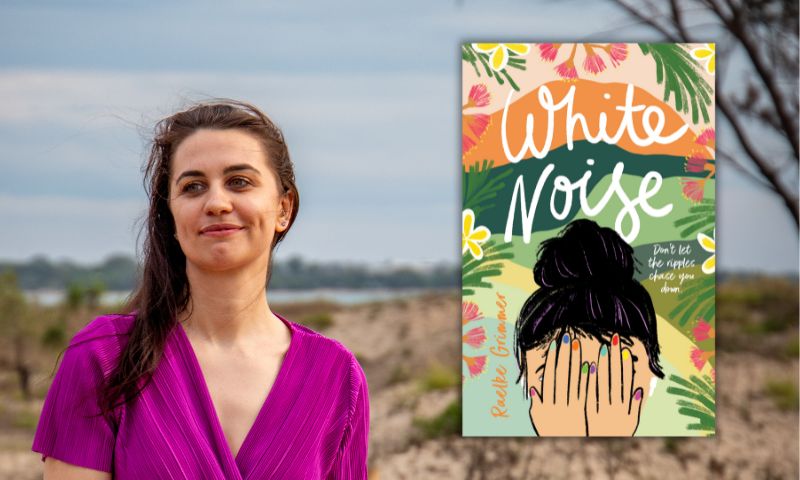
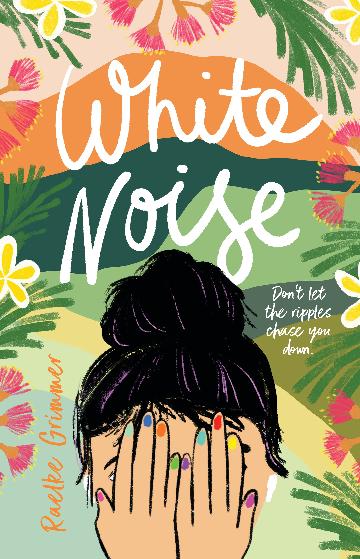
Good Reading for Young Adults caught up with author RAELKE GRIMMER to discuss her novel, White Noise, a moving portrayal of girlhood, grief, and autism.
What inspired you to write White Noise, and how did the concept of exploring grief, autism, and girlhood come together for you?
I always wanted to write a novel that explored what grief looks like years after the fact and how it changes from the initial shock and barrage of emotions into something perhaps more muted, but that still very much lingers and shapes a person’s day-to-day life. My father died when I was 10, and I‘ve always been fascinated by the different facets of grief and how differently they manifest in different individuals. This was the starting point for the book. From there, this image of two characters running East Point Reserve in Darwin together formed in my mind, and I picked up this image and just started writing. Part way through writing the first draft, I realised that I’d written Emma as autistic. I’m also autistic and I recognised in the way I was writing her that she is too, and that this also intersected in specific ways with her experience of grief and the grieving process. I wanted to explore how Emma navigated these aspects along with the day-to-day realities of being a teenager.
Emma’s relationship with her father is a central theme in the novel. How did you develop their dynamic?
It was important to me that Emma’s father is a character who, while clearly struggling with his own grief, also recognises his role as a parent is to be able to put that aside and be there for Emma and doesn’t have the expectation that she will hold him up. James is a good father and knows it’s not her responsibility to do that. Equally, Emma is such an empathetic character that she can’t help but worry about him. This really built the foundation of their relationship and created their dynamic in how these traits played out against each other.
What motivated you to explore change and the different ways we cope with it?
A lot of this stemmed from the exploration of grief. We grieve in so many different ways, not only lost loved ones, but also changing friendships or changing circumstances. There can be a real sense of loss that comes with change and I think sometimes we forget to acknowledge it, or can’t see the knock-on effects it can have on those around us, especially if we’ve experienced something similar and it perhaps affected us in a very different way to how someone else is experiencing it. There seems to be this idea that we’re allowed to grieve some changes over others, or that we are supposed to grieve particular changes. But why? If we understand that everyone grieves differently and it is such an individual experience, we also need to accept that what changes a person grieves will be different too.
What were some of the challenges you faced while writing White Noise, and how did you overcome them?
Finding Emma’s voice took some time to get right. I had this idea of how I wanted it to sound and it wasn’t quite coming together the way I wanted it to on the page. I created a playlist of songs while I was writing that had the tone and rhythm I was trying to create in the novel and spent hours and hours walking Darwin’s coastlines, listening to the playlist and thinking about the story. I’d then get home and sit and write for hours. Eventually, I walked and wrote my way into Emma’s voice.
Your novel is set in Darwin – how important is setting and what role does it play in your story?
Setting is crucial and there is so much you can do with it, depending on the relationship the protagonist has with the place too. The catalyst for this story was two characters running at East Point Reserve in Darwin, so from the very beginning, Darwin was an important part of the story and is another character in the story. It’s an isolated city on beautiful Larrakia Country, with such an extreme climate. Emma is very attuned to nature and finds solace in the elements, yet the whim of the environment also underscores key parts of the narrative. Apart from the natural environment, Darwin as a city is a transient place, with people constantly coming and going, and many people who live here live a long way away from family, so friends become family. These aspects also played an important role in the story, and in particular in Emma and Summer’s friendship.
Do you have any advice for young writers or readers who are dealing with similar experiences?
It’s hard. And it’s okay and important to acknowledge that something is hard, whatever that may be, it’s okay not to be okay and it’s okay not to have the answers right away. More importantly, if dealing with similar experiences, remember to always be kind to yourself. For sure be kind to others, but don’t forget to also be kind to yourself.
Where did you get your love of storytelling from?
I always loved reading. I grew up reading the ‘Baby-Sitters Little Sister’ and ‘The Baby-Sitters Club’ books. I still have my collection, over 200 of them, mostly found second-hand in op shops. I used to devour them. Mum would take me to the library and I’d borrow eight or nine and then go home and read them all that same afternoon! I’d re-read those books again and again. I read other books too, but I kept going back to the familiarity and comfort of the world in those books and those characters. I think it was that series that first made me want to be a writer, but I also distinctly remember in high school when I was 14 and I read Adeline Yen Mah’s autobiography Falling Leaves for the first time. The way that book completely opened my mind to a world and life I could not have imagined at that age gave me goosebumps and that was the moment I fully realised just how powerful storytelling could be.
What do you hope readers take away from your novel?
That there’s no one way to grieve and that there’s no expiration date on grief. I also hope that readers take away that grief and joy can co-exist- for all the heavy themes in the book, there are also some joyous moments of being a teenager!
READ A BOOK REVIEW OF WHITE NOISE BY RAELKE GRIMMER
ABOUT THE AUTHOR
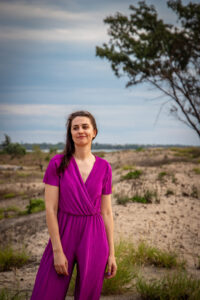
Photo by Corinna Rostan
Raelke Grimmer grew up writing in the hills and foothills of Kaurna Country in South Australia and has lived in Darwin on Larrakia Country since 2016. She writes YA, poetry and creative nonfiction. Raelke’s work has been published in Westerly, Kill Your Darlings, Griffith Review and Meniscus, and she was shortlisted in the Poetry Award in the 2023 Northern Territory Literary Awards. She is a founding editor of Northern Territory literary journal Borderlands, a publication showcasing the very best of Northern Territory and First Nations storytelling. In 2023, Raelke was a participant in Creative Australia’s Digital Fellowship Program and is a 2024 recipient of an online ArtsNT Varuna Fellowship. She holds a PhD in Creative Writing from Flinders University and is a Senior Lecturer in English Language and Linguistics at Charles Darwin University. White Noise is Grimmer’s debut novel and will be published in September by UWA Publishing.

0 Comments