


What fills you with dread when reading a horror novel? For RACHEL DENHAM-WHITE, hands-down, it’s creepy plants. She takes us through her top picks for books where nature is out for blood.
Eco-horror, or environmental horror, uses human fears about the natural world as a springboard to face the terrifying possibilities of nature. Authors of eco-horror have explored killer plant life, unnaturally mutated creatures, cataclysmic natural disasters, and (most frightening of all), the uncanny melding of the human and non-human. As climate change becomes more and more relevant in our daily lives, eco-horror has grown outward to become a fascinating sub-genre of horror.
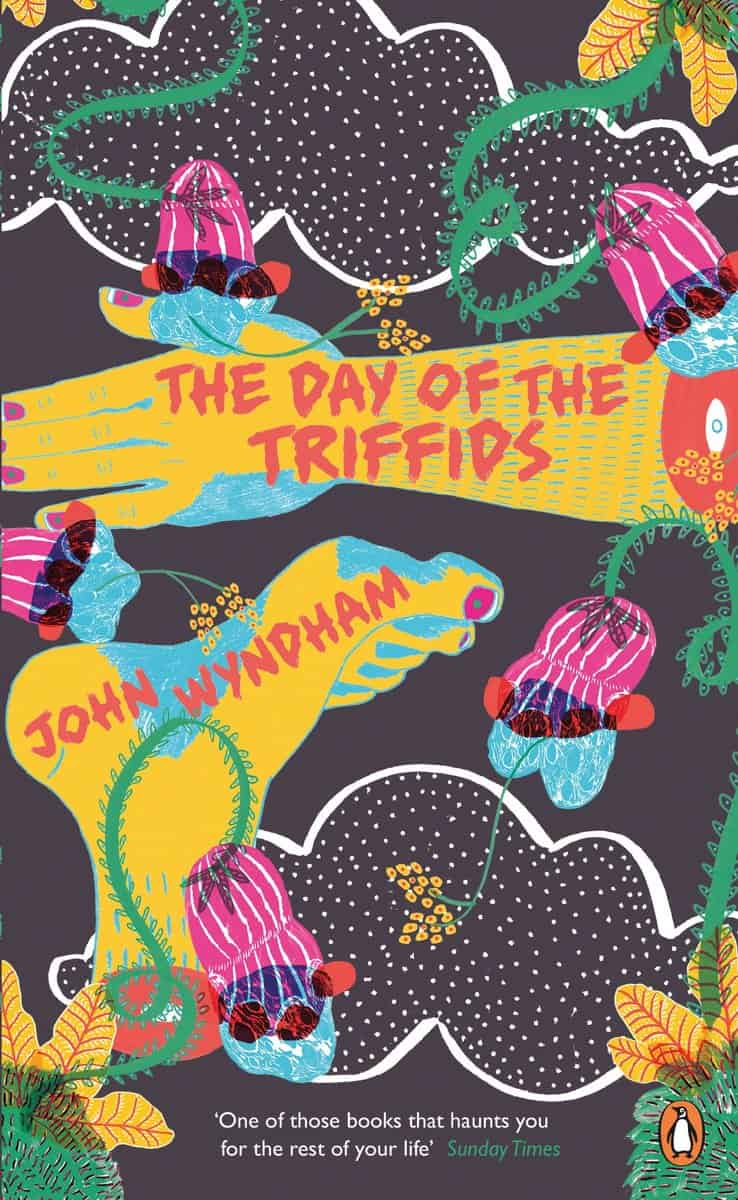
 Starting with an absolute classic: John Wyndham’s The Day of the Triffids follows a biologist trying to survive meteor showers and the deadly Triffids: bipedal, human sized plants with venomous stingers and a taste for human flesh. This iconic horror novel is a great entry to the genre and an engaging snapshot of history; reading it gives you a sense of the ever-present fear of nuclear power and Cold War bio-warfare that defined the ’50s and ’60s. You can follow it up with his next novel The Kraken Wakes, where a giant sea creature rises from the deep to attack humanity.
If you prefer short fiction, look no further than  Stephen King, as this prolific horror author has tackled the idea of unnatural nature multiple times. Similar to the Triffids, The Weeds is a chilling short story of a meteor cracking open on an isolated farm to release deadly plant life. Or you could try The Raft, where a strange black substance drifting on top of a lake suddenly shows bloodthirsty tendencies of eldritch proportions.
 For young adult readers in search of a good creep-out, Rory Power’s Wilder Girls is the story of an island community of girls infected with the Tox virus, which changes their bodies with hideous, animalistic mutations. Or take Krystal Sutherland’s House of Hollow, which isn’t strictly eco-horror, but definitely fits within the realms of uncanny nature. As the protagonist, Iris Hollow, navigates her way through a liminal, overgrown realm between worlds, the book displays its intense overlay of dark cottage-core or cottage-gore aesthetic
  (inspired by an old-fashioned, rural lifestyle, characterised by rustic décor and fashion but with a focus entirely on Gothic or dark nature elements – deep misty forest, ground covered with moss and mushrooms, forest spirits, witchcraft, animal bones, moths and beetles, pagan forest entities, owls and ravens). Moss and white corpse flowers are blooming on every surface in this story, even under human skin!
 The ‘humans just HAD to go poking their noses into nature’s mysteries’ plot is a classic part of eco-horror, with a host of chilling books to choose from. The Ruins, by Scott Smith, takes place in Mexico, where a group of American tourists disturb an abandoned Mayan temple. The site fights back with a horde of terrifying natural defences, including venomous, fast-growing vines. Mira Grant’s Into the Drowning Deep focuses on a group of scientists looking for mermaids in the Mariana Trench, and what they eventually find does not look like your standard Disney mermaid.
 In our modern world, stories of climate change and oncoming climate disasters sometimes feel all too real to be fictional. But if you’re a fan of well-constructed fantasy universes, then you will absolutely love N K Jemison’s ‘Broken Earth’ trilogy, which takes place on a supercontinent called The Stillness. Every few centuries its inhabitants face the ‘Fifth Season’ of catastrophic climate change, such as volcanic ash clouds, acid rain, fungal pandemics, and earthquakes. Of course, I have to also include the
  grand dame of science fiction, Octavia E Butler, and her speculative work Parable of the Sower. Butler’s novel is scarily prophetic in its 1993 portrayal of America in 2024, a world destabilised by urban warfare, corporate greed, poverty, and critical droughts and water shortages. Parable is so much more than a story of Nature’s harshness, it is a mainstay of school and university reading lists and spreads a universal message of empathy, acceptance and the need for change.
 For fans of the hit videogame and TV adaptation The Last of Us, the so-called ‘Zombie fungus’ Ophiocordyceps has found a home in horror books. David Koepp’s Cold Storage is a great example, as this tense sci-fi thriller covers a newly awakened fungal plague in a small town in Australia. But if you’re looking for a more poignant take, M R Carey’s The Girl with all the Gifts introduces a world already overtaken by the cordyceps infection and populated with zombie-like ‘hungries’. The unique story follows a second-
 generation hungry named Melanie in her struggle for self-identification and acceptance of her latent humanity in an uncaring, post-apocalyptic world.
If you’re still not freaked out by cordyceps, then what about stories where humans interact with sentient forms of fungus? Alia Whitley’s novella The Beauty explores a devastated world where every woman was killed by a fungal pathogen. If that’s not weird enough, they’ve been replaced by colonies of conscious humanoid mushrooms trying to  reproduce with the remaining men. For a more Gothic and atmospheric tale, why not try Silvia Moreno Garcia’s historical horror novel Mexican Gothic, or T Kingfisher’s What Moves The Dead, a gender-swapped reimagining of The Fall of the House of Usher. My personal highlight is Jeff Vandermeer’s speculative novel Finch, where the protagonist John Finch must solve a double homicide in an underground city populated by
  surprisingly bureaucratic fungi.
Jeff Vandermeer is undoubtedly one of the biggest names in the eco-horror genre, with a bibliography filled with the creepy, the surreal and the terrifying. His most iconic work is the ‘Southern Reach’ trilogy, and in the first book, Annihilation, five scientists explore an abandoned biosphere called ‘The Shimmer’. All genetic life in this zone has been  dismantled and remade into new combinations of human, plant, animal and alien. The most terrifying part of the narrative: How do you come to terms with the fact that your humanity is being rewritten? His novel Bourne is a surprisingly sweet story of a bio-engineered life form, and its interactions with the survivors of an apocalyptic cityscape overrun with mutated biotech. And once you’ve read that, the spin-offs Strange Bird and Dead Astronauts
  are pretty intriguing too.
To finish off, I’d really recommend his short piece This World Is Full of Monsters. This fever dream of insanity shows an alien parasite fusing with Earth and evolving over centuries, while we witness the narrator’s consciousness being slowly overtaken by plant life. If you’re looking for a new type of creepy story and want to explore this sub-genre, then this  short fiction is a true distillation of everything eco-horror: Nature’s potential for destruction, our relationship to the world we inhabit, the limits of our own bodies, and most importantly, our human capacity for change and growth (no pun intended).
0 Comments