



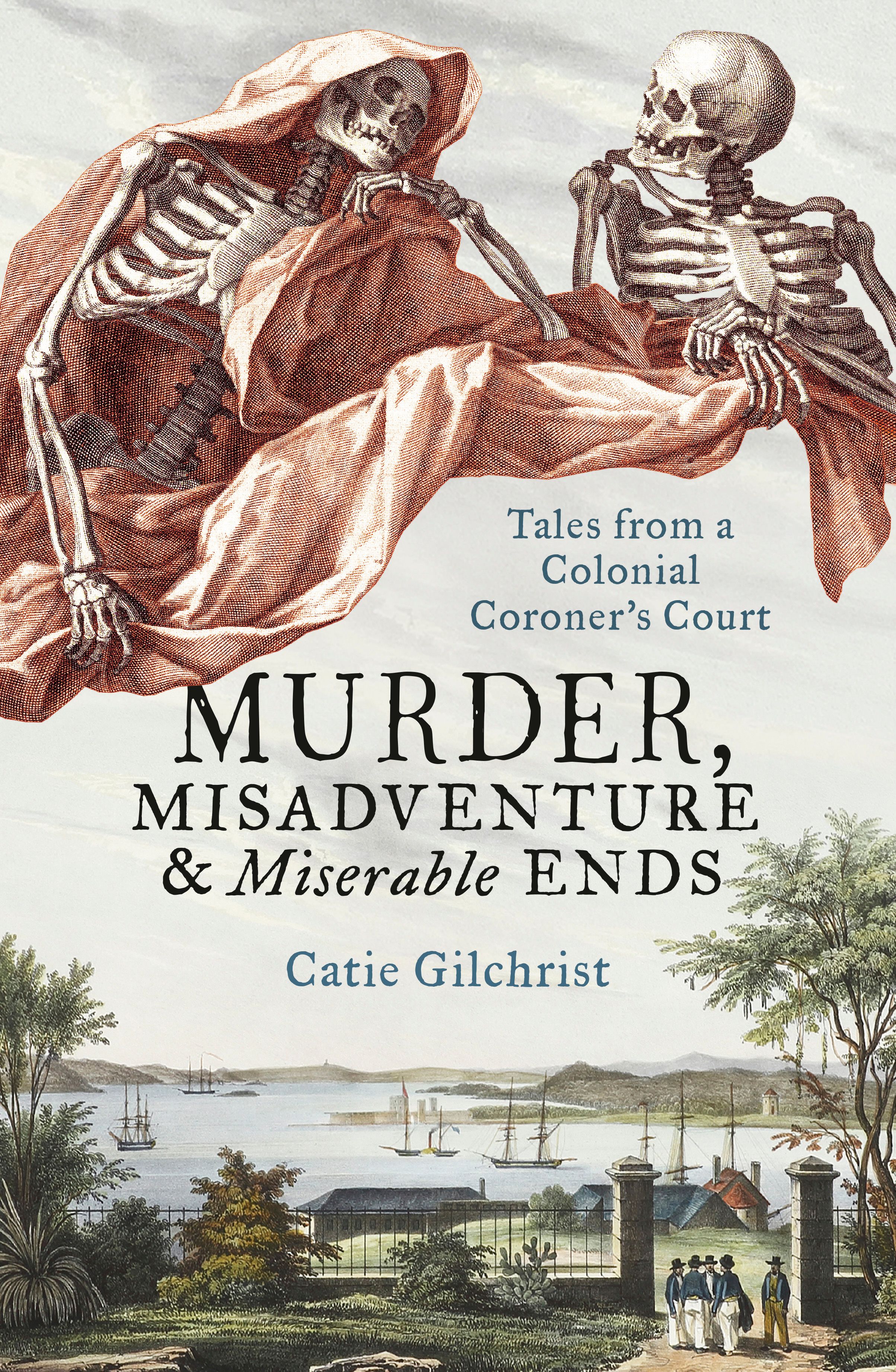
Did you know that in colonial Sydney all taverns, alehouses, inns, hotels and public houses were legislated to keep a lamp burning during the night from sunset to sunset in order to provide street lighting? How about that our current Workers Compensation Act was implemented from workplace deaths during the building of the St Marys Cathedral?
The book centres around Henry Shiell, who was the Sydney City Coroner from 1866 to 1889. In his unusually long career, he held many inquests at the nearest tavern, delving into the lives of Sydneyites and being pivotable in making changes in society to make life safer.
Murder, Misadventure and Miserable Ends could have been a series of obituaries and inquests. Instead, it reveals many of the harsh facts of Sydney’s colonial community, some residing in poverty; their alcohol and drug abuse, the misuse of natural therapies and charlatan chemists; the plight of women involving domestic violence and unwanted pregnancies.
Gilchrist explains the links of how our coronial and criminal jurisdictions have evolved and how our laws, stemming from coronial recommendations, have developed into what we have legislated today.
The book is extremely well researched, even down to the geographical, with addresses of public house, taverns and hotels from a time long gone and includes a 1875 map of Sydney. I learned so much from this book. It even comes complete with a 1875 map of Sydney.
Through death we can better understand life – which is exactly what I took away from this book.
Reviewed by Michelle Harrison
ABOUT THE AUTHOR
 Dr Catie Gilchrist is an Honorary Associate in the history department at the University of Sydney. She has an MA in History, The University of Glasgow, an MA in Women’s History, Royal Holloway and Bedford New College, The University of London, and received her doctorate from the University of Sydney in 2004 for her PhD thesis, Male Convict Sexuality in the Penal Colonies of Australia, 1820–1850.
The thesis explored ‘the moral and sexual anxieties produced by the transportation of male convicts’. It argued that ‘male sexuality lay at the heart of penal and colonial political discourse’ and that “the moral and sexual anxieties of colonial society … were both real and imagined. They informed a variety of discourses that linked the colonial periphery with the metropolitan centre in a relationship that was reciprocal but also antagonistic.’



0 Comments