



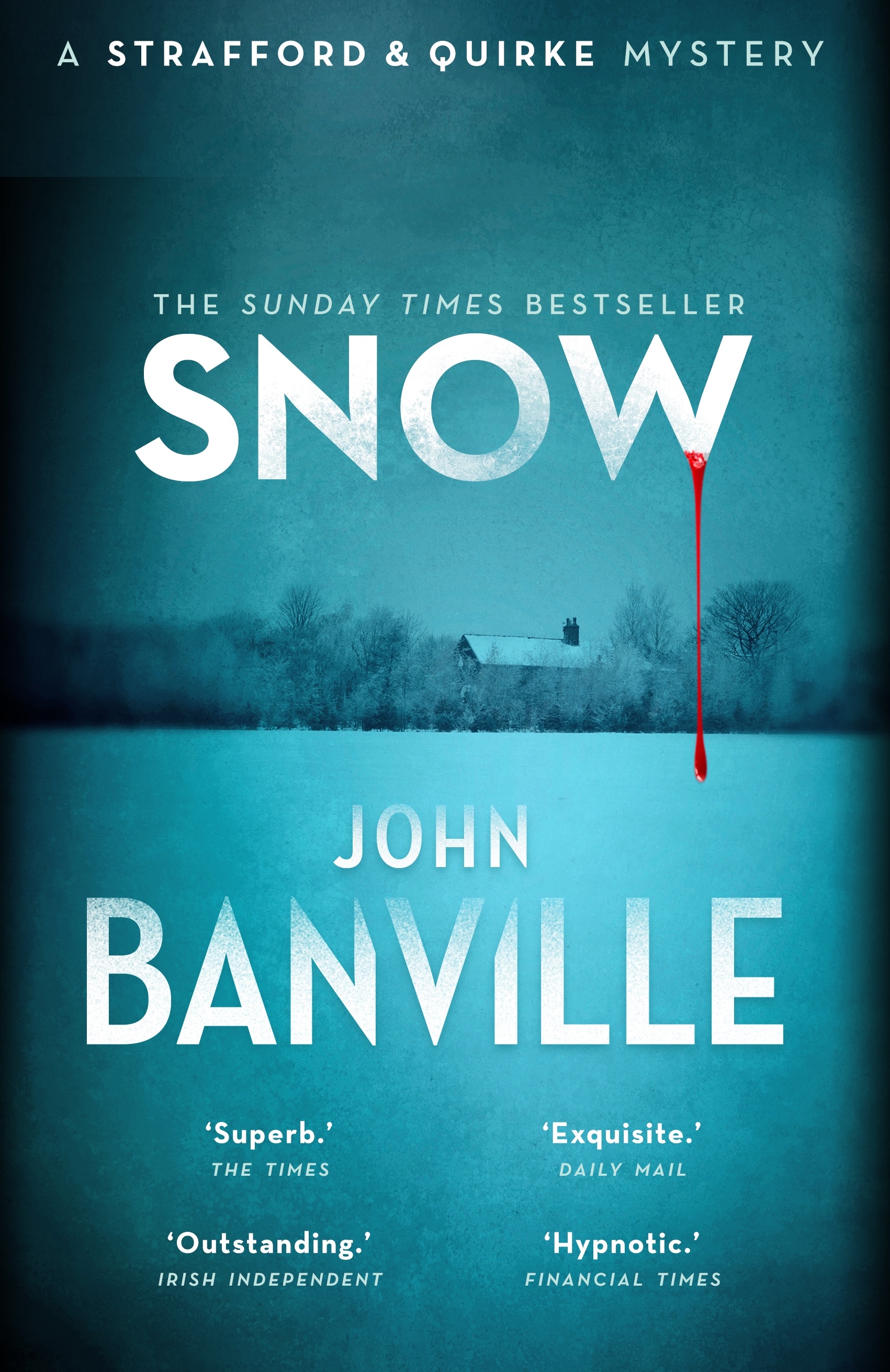
Snow … layered with meaning. The whiteness of it and its purity and innocence; its ability to blanket the environment so that things are hidden; so cold as to be cruel; and so stark that something bright like blood stands out on it.
John Banville often hides his crime writing under the snow of a pseudonym, Benjamin Black, with the series of novels following Quirke, a Dublin pathologist. Quirke makes a tangential appearance here, but Benjamin Black has been relegated to the sidelines as Detective Inspector Strafford (you’ll be reminded about the ‘r’) investigates the death of a Catholic priest at Ballyglass House.
With ‘Bally’ being an Irish word for ‘place of ’, this house of glass epitomises all that the metaphor suggests, particularly fragility and (supposed) transparency. Banville also cleverly uses a missing whiskey glass as an important clue.
Ballyglass House is the ancestral pile of the Osbournes, a Protestant family still clinging to their influential position, if not their wealth. Father Tom Lawless was a frequent visitor to the house and is found early one morning dead on the carpet of the library. (Yes, it’s a body in the library, and yes, Banville is very aware of that stylistic convention. In other textual references, Cluedo gets a nod, as does the higher brow literature of Chaucer, Shakespeare and Joyce.)
This is a closed-room mystery in the Agatha Christie style because, due to the snowfall, the inhabitants of the house – all singular and wonderfully drawn – are the only plausible suspects. The snow also evokes Christie’s play, The Mousetrap, with even the lady of the house dubbed ‘the White Mouse’ by her stepdaughter. Indeed, Strafford feels he’s watching a play, with performances by different characters and no-one showing their true selves.
The Catholic-Protestant divide is central to the narrative, as is the power and obfuscation of the church hierarchy. Could – should – a crime of this magnitude be hushed up?
Despite its subject matter, the book is not without its humour and, in time-honoured tradition, the denouement has several twists. Agatha Christie-like it may be, but this is pure John Banville mastery.
Reviewed by Bob Moore
ABOUT THE AUTHOR
John Banville was born in Wexford, Ireland in 1945. His first book, Long Lankin, was published in 1970. His other books are Nightspawn; Birchwood; Doctor Copernicus, which won the James Tait Black Memorial Prize in 1976; Kepler, which was awarded the Guardian Fiction Prize in 1981; The Newton Letter, which was filmed for Channel 4; Mefisto and The Book of Evidence, which was shortlisted for the 1989 Booker Prize and won the 1989 Guinness Peat Aviation Award. John Banville is literary editor of the Irish Times and lives in London with his wife and two sons.



0 Comments