



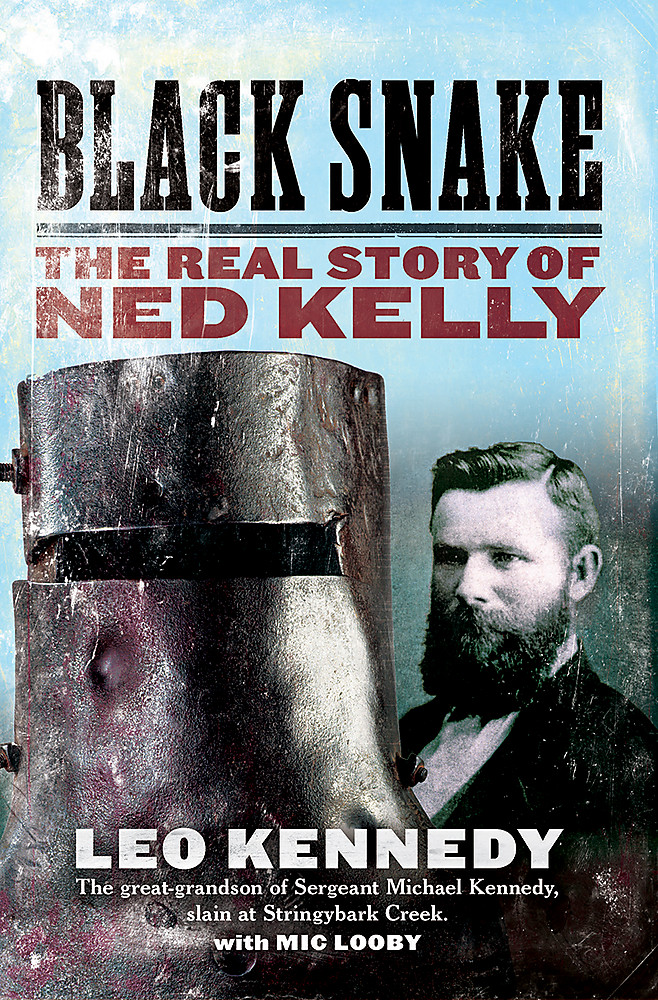
It is indeed a little baffling that a career criminal, cold-blooded killer and self-pitying narcissist such as Ned Kelly could become arguably the best known Australian of the 19th century. Black Snake does not shed much light on this mystery. What it does do is take a careful look at Ned’s criminal antecedents and reveal him as he would have seemed to the authorities of the day. Like a lot of career criminals, Ned was also an informer with close relationships with some police – hence the reference to black snake – and his demise only became inevitable when he turned his considerable reserves of violence on the police themselves.
The limitation of this work, well written and readable as it is, is that the interpretation of the Kelly gang as just one more lot of grubs does not explain much at all. Attempts to depict the Kelly gang as some kind of proto-revolutionaries are undoubtedly misconceived, but what has to be explained is their poisonous hatred of the appointed authorities. The ambush and murder of three police officers at Stringybark Creek was a calculated and callous crime. The denouement at Glenrowan was extraordinary. Career criminals do not, as a rule, try to get into fire fights with the police.
The author of the Jerilderie letter may have had a problem with reality but he also had a sense of grievance and produced an astonishing 8000-word diatribe that inspired, inter alia, Peter Carey’s True History of the Kelly Gang.
Much of the last third of the book is an attempt to debunk what the authors see as the pernicious Kelly legend. The problem is, if you ignore the social context of crime, you are left with no explanation at all for its occurence, except, perhaps, the devil himself. It is the very uniqueness of the crimes of the Kelly gang that calls for a more powerful explanation than that Ned Kelly was just another pyschopath.
Reviewed by Grant Hansen



0 Comments