



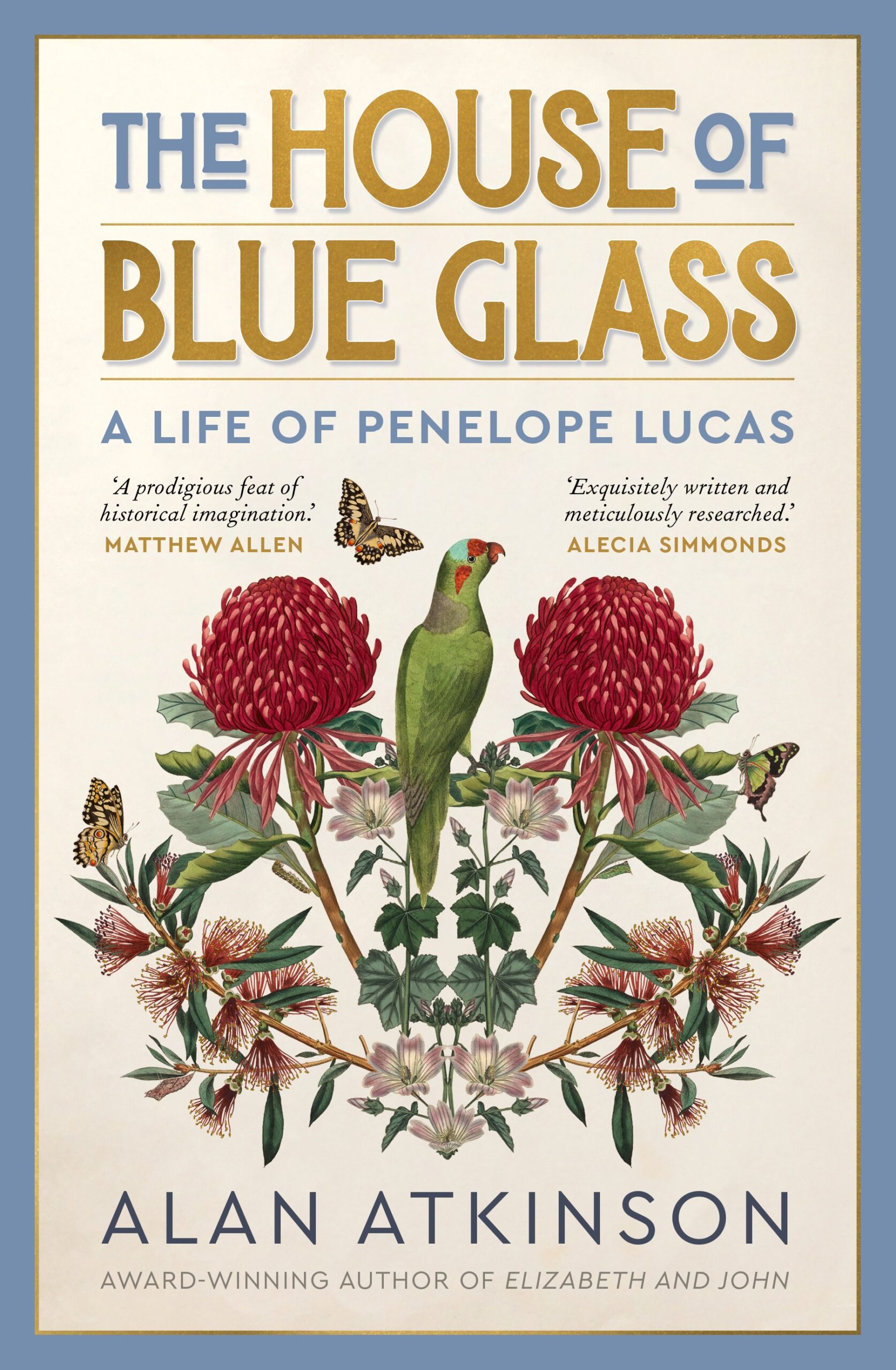
ALAN ATKINSON pieces together the untold story of Penelope Lucas and her contribution to the history in his latest book The House of Blue Glass.
Read on for an extract.
ABOUT THE BOOK
 Acclaimed historian Alan Atkinson – author of the award-winning Elizabeth and John: The Macarthurs of Elizabeth Farm – pieces together the life of Penelope Lucas and the pivotal role she played in building the Macarthur empire. While she is known as the family governess, Atkinson reveals that Penelope was primarily an accountant whose bookkeeping work made an important difference to the Macarthurs’ success.
Penelope Lucas came to Australia in 1805, in her thirties, unmarried – she was the first well-educated woman to travel independently from Europe to Australia – and looking forward to living on inherited income. While Elizabeth Macarthur was unsurprisingly upset when her husband, John, arrived back from three years in England with a woman she had never heard of, Penelope went on to live with the Macarthurs for over thirty years and became close friends with Elizabeth.
In this revelatory work, Atkinson brings together fifty years of scholarship as he explores the gender dynamics of the Macarthur household and the life of a single woman of means in Georgian England and early colonial Sydney.
**********
EXTRACT
Time changes the quality of affection, if – if not necessarily the strength. The French writer André Gide talks about the gradual, reciprocal ‘decrystallisaton’ of married love. Fifteen years married, Elizabeth and John Macarthur were still deeply attached and yet she found herself open to more varied emotional support. In their time as a married couple she had lived both with him and without him. News of the death of her best friend, the friend of her childhood, Bridget Kingdon, had reached her while he was gone, and she had borne that loss on her own, together with the loss of those of her children who had gone to England – gone for years and maybe for life.
And on the other hand, from time to time she had had other men she could rely on. The naval officer Matthew Flinders visited Elizabeth Farm while he was ashore, anxious, as he said, about ‘the oppressive weight’ she had to carry, and there were one or two sympathetic friends in the NSW Corps. ‘God grant me health and patience,’ she told one of them, ‘for indeed… I have much need of both.’
During most of 1804 there was a dearth of ships leaving England for Sydney and when John Macarthur’s ship the Argo sailed from Portsmouth in November it was the first one to take the direct route since early January. As a result, Elizabeth Macarthur could have had no letters from her husband during his final eight months in England. Until he arrived himself, therefore, she knew nothing about his later plans or about the people he was bringing with him. She had heard of his decision that the family should stay in Australia and breed fine wool for the British market because that had been settled during the second half of 1803.
But she could not have heard of his scheme for oceanic trade and she had no reason to expect the arrival of Penelope Lucas.
The sudden appearance of so many strangers, and at night-time in winter, needing beds, stretched the logistical arrangements of Elizabeth Farm. Most of the new arrivals – Hannibal Macarthur, Walter Davidson and Edward Wood – were young men who could be bedded down anywhere, but there was also, as Mrs Macarthur put it, ‘[a] lady of the name of Lucas’ who had arrived ‘with Elizabeth’. Unmarried, she was apparently ‘a very respectable person, tho’ a little ancient for a Miss’.
The jab is telling. This was the first time Elizabeth Macarthur and her husband had been away from each other for any length of time – he had been gone for three and a half years – and now he arrived back in the company of a woman she knew nothing about, who was supposed to have skills she lacked and who was to live with them in their own house. What did that say about them both, herself and John, as they started this new phase of their life together?
As for John himself, sure of his own perfect integrity, he might have failed to foresee the problem, but he must have noticed his wife’s surprise.
And as for Penelope Lucas, she had already lived at close quarters with John Macarthur for seven months on board the Argo. Now, in the confined space of an unfamiliar house – she shared a bed with five-year-old William – she was in much the same position with them both. Now she saw John as a husband, occupied with the intricacies and accountabilities of married life, and now she learnt a little of the way marriage worked for them – when she could make herself part of their work and part of their chat, and when she could not. It was a compact house, filled with bustle, and even whispers might be heard from room to room. For the time being she needed all the tact available to her.
At some point she and Elizabeth Macarthur started to make headway together. At roughly the same age, both were giving themselves new direction, a type of emancipation, and they found ways of guiding each other. Penelope Lucas, at first almost a rival, became a confidante and ally, which says something about the good temper of them both, about the long evolution of the Macarthurs’ relationship – Elizabeth and John – and about Penelope’s single-minded efforts to fit in.
ABOUT THE AUTHOR
 Alan Atkinson has been writing Australian history since the 1970s, and he has a lifelong interest in family circumstances and relationships. He has written or edited a dozen books, including The Europeans in Australia, in three volumes, the third of which won the Victorian Prize for Literature, and Elizabeth and John, which won the NSW Premier’s Award for Australian history. He is an honorary professor and Doctor of Letters with the University of Sydney.
Read more about Alan’s book Elizabeth and John: The Macarthurs of Elizabeth Farm.
Read our review of The House of Blue Glass.


0 Comments