




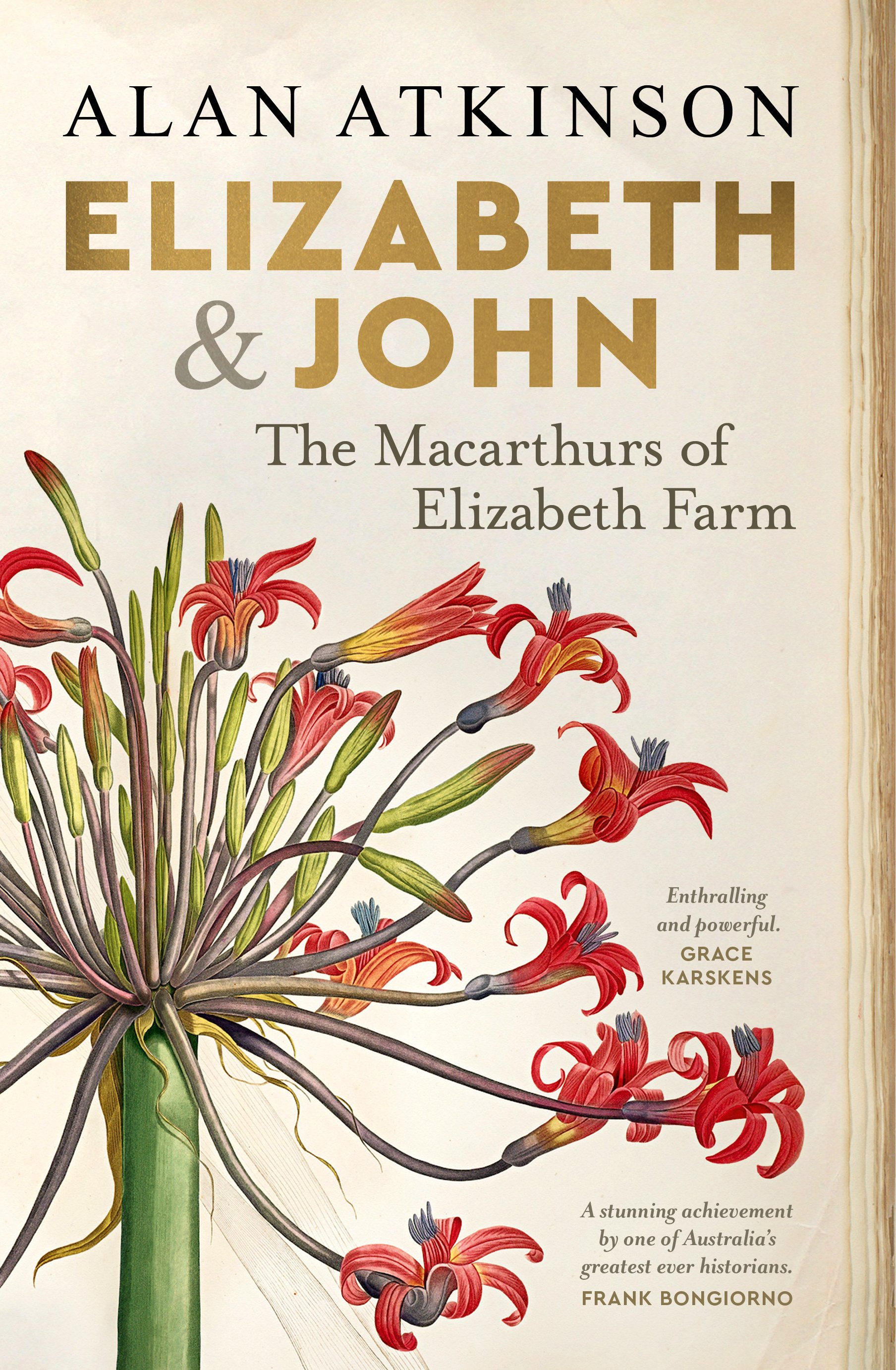
This is a large book, in every sense of the word. Atkinson makes it clear in his introduction to his account of the Macarthurs of Elizabeth Farm that it will be more than just dry history. Readers must be prepared for much tangential and scene-setting material.
Atkinson, an eminent Australian historian, has been researching the family for 50 years, writing two theses and an earlier book about it.
Throughout this well-written book that quietly reappraises some historical accounts. He refers to the ‘invasion’ of this continent by the first settlers, convicts and soldiers. Politely scathing of some of the earlier accounts of Elizabeth and John Macarthur, he writes that he could not always agree with the way their reputations were refashioned from the 1960s.
John, known as the father of the Australian fleece, has been referred to as one of the most difficult men on the planet, a colonial monster, and an extortionate rum-trader. Atkinson writes that that latter description lives on, even though there has never been any evidence of that.
So back to the beginning Atkinson went, setting the scene for the area in which Elizabeth and John grew up around the River Tamar in England’s West Country.
Their youthful activities, marriage, and subsequent voyage to Australia are set against copious information about the European Enlightenment.
Among the ephemera Atkinson uses in this historical account is the evolution of pen nibs from quills to steel. All part of a picture of Australia’s early colonial past, with the Macarthurs playing a prominent role.
Reviewed by Jennifer Somerville
ABOUT ALAN ATKINSON
 Alan Atkinson is an Australian historian who first graduated in 1970. He has written a number of books, including The Europeans in Australia, in three volumes. The third volume won the Victorian Prize for Literature and Elizabeth and John. He is an honorary professor and Doctor of Letters with The University of Sydney, and an honorary senior research fellow with The University of Western Australia.


0 Comments