



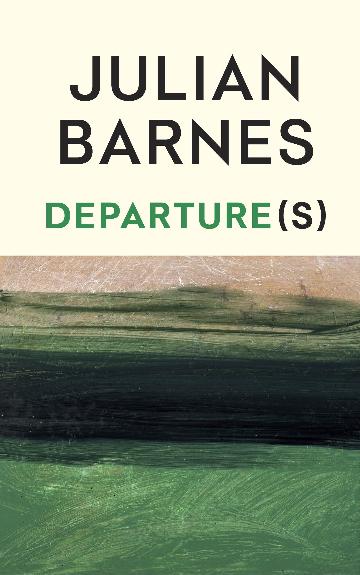
If you’re not aware of Julian Barnes’ work, just look at the list of accolades on his Wikipedia page, from a 2011 Man Booker Prize win on down. He starts his latest book Departure(s) with an assurance that it will be his last – like he details in the book, he has a manageable but incurable cancer in his blood he supposes will be the end of him.
Described as a ‘metafictional novella’, Departure(s) is about his own life, with the (perhaps fictional) account of two friends who ended up in a relationship while they were all young, broke up, and rekindled their romance decades later after Barnes engineered them to meet again.
He talks several times about his promise not to write about them, one he’s obviously broken (if they exist), but his friends aren’t really the point of the book. He’s writing about memory – including a repeated motif about Marcel Proust’s own writing about being transported to another time and place through memory thanks to the taste of a biscuit in tea – ageing and illness, and how inchoate and messy they can be, but how beautiful a thing life is because of that.
There are very few scenes of action or activity per se, most of it is simply Barnes musing to himself and the reader about how things in the author’s life (including his perhaps-fictional friends) have turned out.
But if none of that interests you, you can simply enjoy it for its clipped, straightforward, informal and brilliantly constructed prose. If Departure(s) really is Barnes’ last book, he’s going out on a high.
Book review by Drew Turney
 ABOUT THE AUTHOR
Julian Barnes was born in Leicester, England on January 19, 1946. He was educated at the City of London School from 1957 to 1964 and at Magdalen College, Oxford, from which he graduated in modern languages (with honours) in 1968.
After graduation, he worked as a lexicographer for the Oxford English Dictionary supplement for three years. In 1977, Barnes began working as a reviewer and literary editor for the New Statesman and the New Review. From 1979 to 1986 he worked as a television critic, first for the New Statesman and then for the Observer.
Barnes has received several awards and honours for his writing, including the 2011 Man Booker Prize for The Sense of an Ending. Three additional novels were shortlisted for the Man Booker Prize (Flaubert’s Parrot 1984, England, England 1998, and Arthur & George 2005).
He has written numerous novels, short stories, and essays. He has also translated a book by French author Alphonse Daudet and a collection of German cartoons by Volker Kriegel. His writing has earned him considerable respect as an author who deals with the themes of history, reality, truth and love.
Julian Barnes lives in London.



0 Comments