


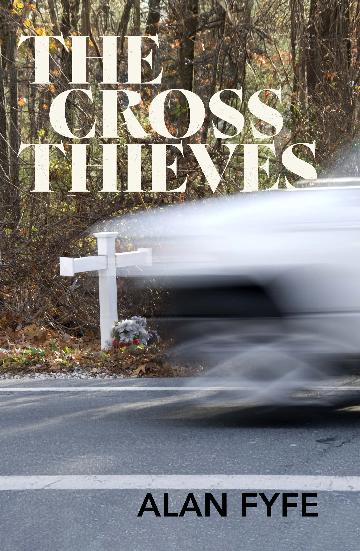
‘Razor sharp and startlingly original, The Cross Thieves crackles with street spirit. A big-hearted, unholy riot!’ Bram Presser, author of the award-winning Book of Dirt.
Two hungry boys set out from their squat by a slow river on a not quite mythic quest for revenge. At the same time, a local pastor drives from his beachside home to visit a dying parishioner. What each means to the other will be revealed as brothers, Gark and Pell, run for their lives over one desperate night, across a coastal town haunted by its past.
The Cross Thieves is bold, mature and compassionate. And sprinkled with humour, 80s pop, carny lore, and the mysteries of philately. Fyfe’s knowing eye for place, poverty and powerlessness and his empathy for the underdog is captured in an unforgettable story of profound emotional power.



(2/5)
Having just finished The Cross Thieves by Alan Fyfe, I’m still sitting here trying to work out how I feel about it. The Gark and Pell storyline was great — raw, messy, emotional, and full of tension. I loved the Australianness of it. Every time the book cut away from them, I just wanted to get back to their chapters and to what happened next. I was also desperate to know more about Ellie and what happened to her, who Moll really was, and more details about Lilly and Cyrus. That part of the book definitely had me hooked.
But then there’s the pastor storyline… it just didn’t land for me. Every time we switched to him, it felt like the whole book slowed down. At times it felt like I was reading a different book. And the random narrator voice that pops in now and then — I honestly had no idea what to do with that.
Apparently, the whole thing is written in “ring composition” (I read the acknowledgements), which basically means (I Googled it) the story loops back on itself and mirrors its own structure; it also explains those odd chapter titles. It might be clever, but for me, someone who just wants to get immersed and carried along by a story, it made the book feel a bit disjointed. I don’t want to have to stop and figure out what the author is really trying to say or dig for deeper meaning.
In the end, I’m just glad I finished it. The way it’s put together stopped me from enjoying it. It’s not a book I’d recommend, and the blurb made it sound far better than it actually is.
(4/5)
This is the sequel of “T” by Alan Fyfe, an Australian author, but I have not read that one. I don’t think you need to read the first one to get the gist of the story, as it refers back at times.
Gark and Pell are two brothers who are down on their luck. They don’t even have any money and can’t ‘sign onto’ anything as they have no fixed address either, only a squat. It’s down and out to the extreme, like not even having shoes. This novel is set in Western Australia.
There are some kind people around who do help them occasionally with money or a free meal, but they are wary of any type of kindness due to being let down so often.
They’ve been brought up with Christian values and know how to play the recorder, so in their early lives with their mother, it could not have been all bad, but she’s not around anymore. I’m guessing that would be in the first book. This is the second of a trilogy.
The author certainly knows how to write this type of raw scenario, so I’m sure he must have perhaps lived with or thoroughly researched homeless young people, or he has a huge imagination. I didn’t enjoy the book in the beginning, but then I had to keep reading to see what happened to these two boys when they stole a cross from a bit of a hard man’s garden after a death in the house. Why they did it … well, you need to find out. But it sets off a wild chase all over the town. It’s very sad at times, but it has a bit of humour too. All in all, a typical Aussie yarn, likened to Shuggie Bain with the huge problem of poverty.
If you don’t like swearing or violence, this isn’t for you.
(1/5)
This book is negative and depressing, and its narrative does not inspire the reader to continue reading. The language is poor and full of slang and expletives, with little metaphorical use of English to entice the reader to linger. The only endearing feature is the loyalty between the two brothers. I would not be surprised if AI was used in the production of this book.
(4/5)
If you’re looking for a light read that barely touches you, then this is not the book for you. It is definitely not a light read; it is quite aggressive and edgy with lots of sub-stories to concentrate on and follow. It challenges the reader – or at least it did me.
The story is about two brothers, Gark and Pell, who are currently living in a dilapidated shack with no running water and no power. Their mother is dead, and they haven’t eaten anything for 48 hours. Through the book, you learn more of their story and those associated with them – be prepared that you may not like all you discover.
A range of social issues are in play throughout the novel – homelessness, roles of women, mental health, anger management, senseless violence, fight for survival, drugs and dealers, abuse within religion, and vengeance. The stories within are gritty, and some parts are quite hard to read, but they certainly touch you.
This is definitely a different book to read, even the chapters A to F, X, F to A leave you wondering why, and going back over what happened in those chapters to create that sequence.
I can’t honestly say I enjoyed this book, but I’m not sure the author wanted me to. If he aimed to make me uncomfortable and to question myself and my actions, then he has succeeded. Definitely worth a read, but be prepared.
(3/5)
My first impression was of grit – not just the feeling of the surroundings but the grit shown by the two young men who are the main protagonists. Pell and Gerk display so much resilience throughout the novel during some really grim times. The underlying emotion is revealed beautifully by the author as the plot progresses.
The novel opens with the boys intent on revenge; however, they are both very hungry, and there can be distractions during the course of the half day in which the story is set. As part of their revenge and due to one of their main acts of revenge, they are constantly on the run through their small Western Australian town. A town that also has its own struggles due to unemployment and illegal drugs. The plot is fast-moving and full of angst as it entwines with regular people in the town living their lives as they are able.
There seems to have been a lot of struggle in the relatively short lives of the brothers, especially since the death of their mother. Their idea for revenge is a result of the death of one of the few people who genuinely showed kindness to the boys.
The novel is interspersed with letters between the mother of the boys and her sister. At the time of writing, their aunt and mother discuss many things, such as the church that their aunt, Molly, is establishing and the unsavouriness of the minister of religion with whom they had both been in connection in earlier years.
Joshua Chord, the minister mentioned, is still active in the town of Mandurah, and despite his ability to recall many bible verses, he is less than reputable. The letters give away some of his actions, as do those of his wife. Due to various circumstances, he meets an untimely end that may be considered to be Karma.
Although this book is the second in a trilogy, it doesn’t matter if the first one has not been read; it is a fine standalone book. The only assistance would have been the background of various characters mentioned.
This novel is recommended for all readers who appreciate the hardships of young people in 21st century Australia.
(4/5)
The Cross Thieves has quite a complicated plot. Fyfe indicates in his Acknowledgements that he has used a very old style of structure known as ring composition (p199). This is quite complicated for the writer as Fyfe admits. Apparently it is a structure like the books of the Christian Bible from Exodus to Leviticus.
I must admit that at first, I battled a bit, however going through it briefly a second time I found I could understand it much better. I didn’t have to read it completely but scanning it that second time the narrative was clearer as I had a picture of the whole story.
Basically, the book has three storylines and a series of letters, and as a reader you might wonder whether will come together at the end. To tell you whether this happens or not would be a spoiler. Let me just say this. If you find yourself wondering where this book is going and whether-or-not you want to finish it, please persist. This is a very interesting book that takes some effort. Give it the effort and it will be worthwhile.
(5/5)
The Cross Thieves is an absolute gut-punch of a read. Told over the course of single night it examines the themes of race, religion, revenge, and what happens when people take justice into their own hands.
Central to the story are two teenagers, Gark and Pell, struggling to survive with no family and mourning the loss of a friend. The book opens as Gark’s grief overflows and my heart broke for these boys as I was compelled to keep reading with the hope the situation could change for them at the conclusion.
The cast of characters around them, whether in direct contact or not, is diverse and on the whole many are very unlikeable. I had trouble with the coarse language but it was needed to keep the book true to the story being told.
An interesting and confusing element of this book is that it is written in a ring composition, something I wasn’t familiar with and often struggled with.
This book isn’t for everyone but it is a powerful read that will keep you glued to the pages. Five well deserved stars.
(1/5)
Raw, violent, confronting, uncomfortable! This is not a light read, be prepared for considerable explicit language (appropriate for the characters) and one especially gruesome scene.
Fyfe can undoubtedly write. He has the credentials to prove it. However I could not engage with his characters. I wanted to feel empathy for brothers Pell and Gark, living rough in a squat – no water, electricity and without the resources to change their circumstances.
A second storyline of Joshua, pastor of an evangelical Church, with some questionable behaviours, living comfortably in his seaside home, intersects that of the brothers.
As a result of some poor decisions by the brothers we embark on a wild night across town encountering the underbelly of society. Simultaneously Joshua is visiting a dying parishioner on the pretext of providing religious solace.
The three cross paths nearing the end of the night with disturbingly violent results, and some revelations for the reader.
Fyfe vividly describes the harshness, cruelty and powerlessness of the brothers, and the baseness of Joshua but for all that the book didn’t engage me. A DNF if not for reviewing.
(3/5)
The Cross Thieves is a book I think will hit differently depending on the reader. For me, it was hard to get into and keep track of all the different characters and what/who was connected. I think it may be helpful for others before reading to know that the book is written in ‘ring composition’ (look it up).
I did find it drew me in and made me want to keep reading – and it is a compelling book which is fast paced at times, slow the other and touches on a lot of social issues like homelessness, drugs and violence.
Overall – an interesting read with plenty of different characters to keep you entertained.
(4/5)
This book has quite a complicated plot. Fyfe indicates in his Acknowledgements that he has used a very old style of structure known as ring composition (p199). This is quite complicated for the writer, as Fyfe admits. Apparently, it is a structure like the books of the Christian Bible from Exodus to Leviticus.
I must admit that at first, I battled a bit, however going through it briefly a second time, I found I could understand it much better. I didn’t have to read it completely, but scanning it that second time, the narrative was clearer as I had a picture of the whole story.
Basically, the book has three storylines. A series of letters between Molly and Ellie comes before each chapter, although chapters may be the wrong word as each is headed up with a letter rather than a number. This seems to relate to the ring composition structure.
Gark (Garcon) and Pell (Peloton) seem to be the main characters, becoming a second storyline, while Joshua Chord and Bella, together with the Rev. Michael and the Noble Shepherd Ministry, make a third storyline.
Gark and Pell are two young boys battling life on their own resources, often without food for lengthy times, thus making the theme of food insecurity one of the main themes. In seeking revenge against one of the Stanley brothers, they find themselves in real trouble after stealing a cross from a memorial to the brother they find has died. For most of the book, they find themselves to be the ones who are sought by the remaining avenging Stanley brothers
Rev Joshua Chord, the Rev Michael, and Bella make another storyline as their roles in the Noble Shepherd Ministry, to which they add very little nobility. Fyfe makes an interesting use of biblical quotes, often being used by Joshua Cord to justify his activities. Chord and his Noble Shepherd Ministry exhibit some rather disrespectful activities that most mainstream churches of today would despise.
The letters between Molly and Ellie tell another story, but you gradually find connections.
As a reader, you might wonder whether they will come together at the end. To tell you whether this happens or not would be a spoiler. Let me just say this. If you find yourself wondering where this book is going and whether or not you want to finish it, please persist. This is a very interesting book that takes some effort. Give it the effort, and it will be worthwhile.
(4/5)
This book is a sad tale of loyalty and circumstance. It explores how we are rarely able to change the circumstances we inherit and/or experience in childhood.
Alan Fyfe is masterful in allowing us to see behind the actions of brothers Gark and Pell, to their emotions, which slavishly drive them. Homeless and alone, the boys allow their automated emotional responses to drive them as they pursue power in their world, the seedy side of rural Australian society.
However, I found Alan Fyfe’s depiction of the Christian church collectively stereotyped and derogatory despite his notable Biblical awareness.
I rated this book 4 stars; it left me with questions and empathy for those with no means of emotional or practical support in our country.
From the very first page, The Cross Thieves captivated me. It follows brothers Gark and Pell as they navigate a town shaped by poverty and unresolved traumas. What starts out as a mission motivated by revenge eventually transforms into something more contemplative that addresses loss, brotherhood, and a system that does not adequately protect everyone.
One of the best parts is the dialogue. It’s rough, but in a raw and realistic way. It adds to the tension as the fear and rage feel palpable, especially as the confrontation loomed nearer. The emotions land because they feel honest, like fear concealed by bravado and loyalty, causing them to push others further away. I could tell that even though the brothers found it difficult to express, their actions show how much they care for one another.
The way the book explores the factors influencing these young men is just as memorable as the events that take place in it. They are not reduced to heroes or villains. Pell and Gark are impulsive, weak, and obviously influenced by their surroundings. Despite their imperfections, the book shows them a great deal of compassion. Long after I finished the novel, I continued to contemplate who they might have been if life had dealt them a better hand.
The Cross Thieves isn’t a light read. But it’s thoughtful, layered, and deeply human. Fyfe has written a novel that’s sharp in its social awareness and generous in its empathy. This has left me thinking how easily circumstances can shape a life. I can’t wait to read more from Fyfe.
(4/5)
The Cross Thieves is a quirky, quick read. Alan Fyfe is an extraordinary writer who has the ability to write descriptive passages with great detail, and this book takes you on a descriptive journey. The characters have been well created, showing different emotions, which makes them lovable larikans! A good read for a lazy Sunday morning!
(4/5)
What a great read. The feelings and comradeship of the two brothers were admirable. Gark takes it upon himself that if no one will avenge Lilly’s death, then he will. This takes the brothers into some dangerous but funny at times disastrous circumstances, which change their course completely. From the “accidental ” removal of the killers’ cross, to running and hiding from their enemies throughout the night, just getting away by the skin of their teeth. One of the great features of this book was the author taking you back throughout this book to events in the brothers’ past lives, and how they intertwined with the late-night adventure that they were going through.
(3/5)
I have not read or heard of this author before. It had very descriptive information about the places the brothers travelled, and very relatable as I live near the areas that were described in the book.
(4/5)
The Cross Thieves is a raw yet powerful look at homelessness, hunger, religion, violence, drugs, to name a few, and how decisions made can have unforeseen consequences.
Gark and Pell are somewhat likable characters who live a life of desperation. They are constantly working to find the next meal, living without water or electricity. Their mother has died. They find themselves in trouble after a rash decision. Meanwhile, a local pastor pays a visit to a dying parishioner. The story slowly evolves to show what each means to the other over the course of one night.
The boy’s devotion to each other is admirable, but I found I wanted to hear more of the other stories hidden in the background of the Gark and Pell story. The ending was not what I expected, but I would have loved to hear more of the epilogue.
This book is not a long read, but it is a confronting one. It shows society at its rawest.
It has a little bit of everything – humour, a little bit of rock and roll, and talk of a cult.
This book will stay with you long after you have read the final page.
(3/5)
The author’s deep insight into children living in poverty, surviving, and the struggles they endured each day was moving. However, I just couldn’t delve deep enough into the characters and storyline to say I really enjoyed this book as much as I hoped I might.
(4/5)
This was a most unusual story that revolves around two protagonists (brothers), squatting in an abandoned house on the outskirts of town. They are caught in a cycle of poverty, food insecurity, homelessness, and prejudice. Other themes of the book include violence, religious fanaticism, and powerlessness.
In the first pages, we are reminded of the punitive unemployment benefits system, which keeps people on the edge of society. An example of not having a permanent address prevents one from library membership with its free internet access to meet job-seeking obligations.
The story unfolds over one night, where the boys steal a homemade cross in an act of revenge, and local drug dealers chase the boys as they continue through the night. The connections of other town members fill the background. It is not all bleak – there is some joy, some humour, some kindness. We also learn a little about the lesser-known subjects of philatelics and circus life.
It’s a story that is unlikely to leave you satisfied but will surely leave you thinking about those who may be trapped in the cycle of poverty and those caught up in a religious fanatical group.
(4/5)
The Cross Thieves is set over the course of a night where brothers Gark and Pell are seeking revenge. Tearing down a cross sends a powerful message, and Gark and Pell make that clear: “This cunt doesn’t deserve remembrance.” Raised in poverty and shaped by an unstable upbringing, the brothers lean on each other to survive. It’s clear that when side characters have opinions about their family life, they are fiercely protective of what remains and what once was. Nobody can come between their bond, not even their dire situation. Meanwhile, on the same night, a local pastor drives to visit a dying parishioner. His significance isn’t immediately clear, but as the story unfolds, his role gradually comes into focus.
Fyfe has written some incredibly strong characters that feel realistic. Their personalities shine through and were the driving force behind this book. With heavy themes spread throughout, The Cross Thieves is not a light read; it’s confronting and needed.
The use of the ring composition structure made it difficult to understand at times, but once I was clued in, I was absorbed.
A compelling read for anyone who appreciates character-driven books rich in emotion.
(4/5)
From the very first page, The Cross Thieves captivated me. It follows brothers Gark and Pell as they navigate a town shaped by poverty and unresolved traumas. What starts out as a mission motivated by revenge eventually transforms into something more contemplative that addresses loss, brotherhood, and a system that does not adequately protect everyone.
One of the best parts is the dialogue. It’s rough, but in a raw and realistic way. It adds to the tension as the fear and rage feel palpable, especially as the confrontation loomed nearer. The emotions land because they feel honest, like fear concealed by bravado and loyalty, causing them to push others further away. I could tell that even though the brothers found it difficult to express, their actions show how much they care for one another.
The way the book explores the factors influencing these young men is just as memorable as the events that take place in it. They are not reduced to heroes or villains. Pell and Gark are impulsive, weak, and obviously influenced by their surroundings. Despite their imperfections, the book shows them a great deal of compassion. Long after I finished the novel, I continued to contemplate who they might have been if life had dealt them a better hand.
The Cross Thieves isn’t a light read. But it’s thoughtful, layered, and deeply human. Fyfe has written a novel that’s sharp in its social awareness and generous in its empathy. This has left me thinking how easily circumstance can shape a life. I can’t wait to read more from Fyfe.
(4/5)
Homeless brothers Gark and Pell are distraught after the funeral of Lilly, who’d helped them out on occasion with kindness and food. Convinced the Stanleys, a meth cooking family, had something to do with her demise, the lads go looking for some kind of retribution. A newly erected curbside tubular steel cross memorialising Cyrus Stanley sets them on their path as the cross thieves.
And what a path it takes them on: explosive action, menace, and treachery. A house-wrecking party with under-employed carnys, famous circus performer May Wirth stamps, car chases, an unholy pastor, imminent death, and letters between their dead mother and aunt. Not a conversation or missive is meaningless. It’s a tale of loyalty, revenge, and just desserts – Shakespeare in Mandurah, WA.
I was intrigued by the chapter titles; were they the notes of a primary school plastic recorder musical piece? All was revealed by a mention in the acknowledgements, the specific order of the composition, like the cross, returning to its starting point. This is a book that the more you think about it, the more you think of it.