


READ OUR BOOK REVIEW
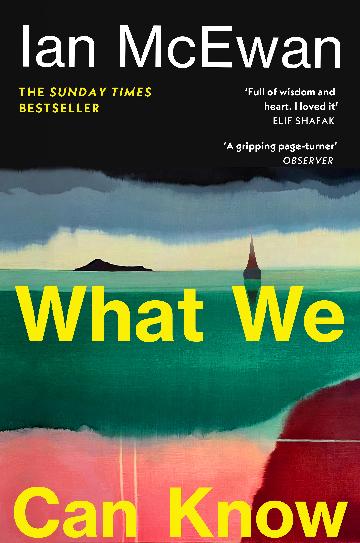
A century from now an archivist, Tom Metcalfe, will search for physical evidence of a poem written in 2014. The poet, Francis Blundy, had written a 15-sonnet corona for his wife, Vivien, to celebrate her birthday. After reading it to assembled dinner guests, Blundy handed the sole copy to Vivien. It was never seen again. Its disappearance has given the corona mythical status. According to legend, and several online conspiracies, it speaks of enduring love and is a beacon for preserving the natural world. Metcalfe’s research suggests the latter was anathema to Blundy.
The narrative in What We Can Know is Janus-like: both looking forward and, from there, looking back to now. The 22nd century is defined by a ravaged climate. The UK was flooded and is now dotted islands in an archipelago. The future is tech-heavy but lacking in basics. Communities are isolated and travel is difficult and risky. Data from the present day should be an archivist’s dream but it’s polluted with quotidian minutiae: it has extraordinary breadth and precious little depth. (How vacuous we seem.) Writing from the future gives the appearance of critical distance and allows McEwan to view the stupidity inherent in the 2020s with impunity.
In Part I, Tom teams with his colleague and wife, Rose, to dissect the Blundys’ lives and hopefully trace the poem’s hiding place. Part II is Vivien’s narrative, where Tom’s research is upended. Important, intensely private parts of her life weren’t documented, so secret relationships, a tragic history, and love and loss are revealed. This second narrative is instructive. As much as we can’t possibly know the future, we also cannot fully know the past.
Reviewed by Bob Moore



0 Comments