


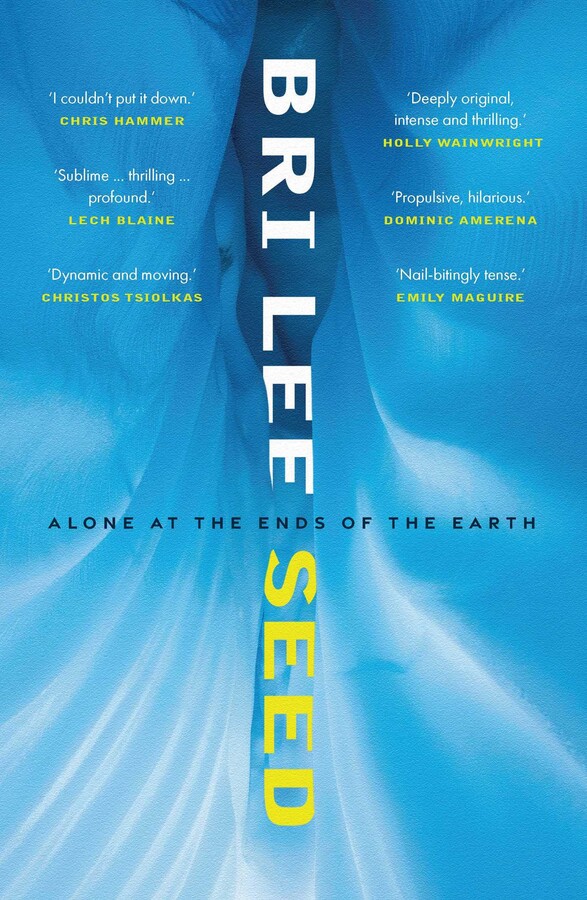
The premise of this novel is extremely intriguing, and I was eager to delve into the bleak, cold world of Antarctica.
Mitchell is a brilliant biologist and a prominent figure in the growing antinatalist movement. For one month each year he and his colleague Frances live in a childfree utopia of radical equality and science in Antarctica.
They are working on the Anarctos Project: a seed vault in a secret location, an insurance policy against a failing planet. When their helicopter misses its exit rendezvous and strange things begin to happen, they lose a grip on logic and science, and their fallible human emotions take over.
Initially, Mitchell is an unlikeable character – rude and obnoxious, seeing everything through the lens of his stringent beliefs. His heart is steeled against Kate, his ex-wife, a woman he still loves vey deeply but she dared defy him and is now pregnant by another man. Mitchell behaves abhorrently towards her as she flies them out to the vault but once his scientific world is tested, his emotional struggle is very raw and I softened towards him as his complexities were exposed.
I found the concept of the Anarctos Project to be a fascinating one. I enjoyed the shifts in thought processes in both Frances and Mitchell.
This is a complex novel best described as a literary thriller. The first part of the book is slow paced mirroring the life in Antarctica but as things start to unravel the pace picks up and the tension tightens. The exact cause could have been more developed but that is a minor point.
A different but enjoyable read.
Reviewed by Nicola Skinstad
Read a book review of The Work by Bri Lee
Read a book review of Eggshell Skull by Bri Lee
Listen to a podcast with Bri Lee about her memoir, Eggshell Skull

(4/5)
Seed is set in Antarctica at a seed storage facility, a biodiversity insurance policy against a heating earth. Mitchell and Frances are colleagues who have worked together in this remote location before and think they have come to know each other well. However, when the helicopter that is supposed to pick them up after one month fails to arrive, their relationship begins to change, as secrets they had not shared with each other previously are revealed. The novel concludes with a hair-raising race to safety and a shocking result when they arrive. A bundle of hope for the future is all that remains.
Bri Lee’s descriptions of the glaciers, ice, penguins, seals, birds, bitter cold, clear air, and strong winds are realistic and immerse the reader in this unique environment. She also creates a real sense of isolation, and freedom from a corporate world where time begins to dissolve.
Told from Mitchell’s point of view, I found him quite unpleasant at first with his demeaning comments about a pregnant woman, but as the novel unfolds his character becomes more likeable as we begin to understand his motivations. I think this book is perfect for readers who love thrillers set in remote locations.
(3/5)
Written in first person format, I was drawn in to Seed, and became a willing confidant of Mitch, a cynical Antartic biologist. In daily diary entries, the story focuses on the symbiotic relationship of two characters working in an Artic seed vault.
Vivid descriptions of the extreme environment suggest there is menace lurking, and as the characters develop, hidden agendas and tensions rise. The story races to an exhilarating climax, and challenged me to resolve an unexpected tragedy.
I enjoyed this well-written, thought-provoking story about climate change, personal resilience and treachery.
(4/5)
Bri Lee’s Seed is an atmospheric, well-paced novel which engages the reader with mystery, adventure and human connection.
The protagonist, Mitch, demonstrates vulnerability and emotion which I appreciated being conveyed in a male protagonist. Mitch was complemented by Frances, a strong woman of colour with her own inner demons to wrestle. There is a small amount of spice, which is relevant to the circumstances in the story.
Once I picked the book up, I very much struggled to put it down, eventually accepting my fate and flying through the pages. As this book covers multiple themes (adventure, love, science, sex and responsibility) and has main characters with diverse personality traits, I believe it would appeal to a wide range of readers. I thoroughly enjoyed Seed and I will now endeavour to read Bri Lee’s previously published works.
(4/5)
Mitchell and Frances are both biologists who get dropped off on a remote secret seed vault facility in Antarctica, called the Anarchos Project. They have been there before so know what to expect and quickly get into their daily routine.
It was a slow burn for me but one where I felt the isolation, claustrophobia and freezing temperatures. The book delves into their complex relationship as colleagues and lovers, as their relationship intensifies when the helicopter doesn’t arrive to fetch them.
They have different views on how to move forward. Do they wait out the Winter months or take the hazardous 60km trek on snowmobiles to the McMurdo base. The decision is made even harder when strange things start happening around them. I became as scared as them and it kept me turning pages.
They both have personal secrets which come out when they face an uncertain future. They need to learn to trust each other. However, the ending left me with so many unanswered questions, so I have to give it four stars.
(5/5)
I’ll say this upfront: Seed is the best novel I’ve read this year. It’s thoughtful, tense, provocative and emotionally devastating. It has everything you could possibly want in a thrilling story.
As a lifelong reader of Antarctic stories, I was keen to read another. Under the author’s deft skills, Antarctica became not merely a setting but a major character in Seed. Despite the place being wide and open, I felt it was claustrophobic and always unpredictable.
From the first page, the story was compelling. Was my initial sense of doom going to play out? What was going to happen next? Would the human characters resolve their challenges, or would the landscape ignore them and behave in unpredictable ways?
The fact that many of my (and other) questions were unanswered by the end of story added to the suspense. I loved this because plotlines weren’t tied neatly but left open for the reader to imagine. I’ll be reading this book again but more deeply this time to follow many of the themes that were woven throughout it. It’s a beautifully written and thought-provoking story.
(3/5)
Set in a research station and seed vault in Antarctica, the main protagonist is a biologist named Mitchell. His favourite part of the year is when he gets to spend 4 secluded weeks in the station far away from the rest of the world. As the project may be winding down due to funding issues, only Mitchell and Frances are at the station for this – perhaps final – session, but odd things start to happen.
While not my usual genre, I found this book very suspenseful. The bleak landscape was matched by two fairly bleak main characters, scientists who bring their lives from home into the clinical setting of the research station. The time period and such extreme isolation gave both of the characters a lot of time to ruminate on their lives back home, along with worries for the future of the project.
As I despise the snow and cold weather in general, Lee’s descriptions of the physical landscape sometimes made me feel such despair, although I could appreciate the beauty she also described. I found myself feeling as agitated as Mitchell & Frances as the book progressed. The headlong run in the final chapters had me up reading WAY past my bedtime, but it was worth it!
(4/5)
Bri Lee’s new novel Seed is a slow burn, and definitely worth putting on your TBR pile. Set in a remote Antarctic seed vault, the icy, isolated setting creates a quiet suspense that builds as the story unfolds. I’ve loved Lee’s previous books, and even though this one is different in tone it still really worked for me.
At first, I wasn’t sure where it was heading, but the tension creeps in gradually, and by the end, I was completely hooked. The psychological dynamics between the characters are fascinating, and the themes around climate, control, and ethics give it real depth. Lee’s writing is sharp and thoughtful, and the final chapters pack a punch.
I love the kind of story that stays with you long after you have read it.
(3/5)
Seed is set in Antarctica and follows colleagues Frances and Mitchell as they work on a secret project. The author does a fantastic job of bringing the harsh and icy environment to life. While the characters developed throughout the book, I struggled to feel invested in their journey as a whole. The story was quite unique and different, however the pacing was a little slow for my liking.
(3/5)
If you enjoy a book that leaves you with more questions than answers, then Seed is a book for you.
It is mainly set in a seed vault in Antarctica sometime in the future. The descriptions of the landscape are the highlight of the book, invoking both its beauty and its danger.
The story is related by Mitchell, who I found quite unlikeable. His views and opinions are unshakeable. He and another biologist, Frances, are working in isolation in the vault.
Seed drops hints about the why, how and when for the need of a seed vault in Antarctica, always leaving you wondering are we getting all the reasons for its development.
(5/5)
I was thrilled with the premise of this book as I have a fascination with Antarctica and people who go there to work. I was also really interested in Mitch, and his anti-natalist ideas which were thought provoking.
I did wonder about the relationship between him and Frances, and whether some of their characterisation was realistic and necessary.
But Seed’s story kept me enthralled all the way and I could almost hear and smell the penguins and feel the ice cracking. I will definitely look for Bree’s books again.
(4/5)
My favourite part of Bri Lee’s Seed is the great setting. The action takes place at the Anarctos Project: A Seed Vault located in a secret area of Antarctica. The climate is a constant menace, the cold is a danger, and the isolation add to the drama.
I would have liked to have more of an explanation of the seed vault early in the book. It would have increased the importance of the work that was being done in such a harsh environment and why people were so committed to be working in such an inhospitable location.
The two main characters are Mitchell and Frances. Mitchell’s character was intriguing, and I found him more believable than Frances. There are a few surprises along the way, which sends the story in a slightly different unexpected direction.
Seed is a quick, enjoyable read that packs so much suspense throughout the story, and the suspense only intensifies as you read.
(3/5)
Seed takes you into the future, giving the reader an insight into a secret life in Antartica. Full of drama, suspense and a lot of self-reflection, Bri Lee makes you question decisions already made that have consequences for the future.
I found the ending suspenseful and unexpected, which could easily lead in to a sequel. Seed is absolutely a book to add to your reading list.
(5/5)
Seed is a powerful, thought-provoking, intelligently crafted novel exploring the emerging controversial anti-natalism movement, the increasing threat of global warming caused by man’s selfishness, greed and apathy, and man’s freedom when cut loose from the comforts of normal life. Mitchell, a brilliant biologist, and his sole companion scientist, Frances, have a month to complete the Anarctos Project which involves preserving seeds for future generations in a secret vault buried in the depths of Antarctica.
They face individual fears, doubts about their belief systems, their relationships and lives, and despair at the universal human trait that prefers “to pass the buck” than to take responsibility for the ruination of the planet. Meanwhile, they’re fighting for their own existence against Antarctica’s beautiful, stark, unyielding backdrop of ice, wind, and endless snow. They face their own avalanche of loneliness connecting in their work, but struggling to connect fully with each other. Deeply-rooted philosophies are sensitively held up to the microscope.
Seed is a riveting, nail-biting race against the elements and serves as a chilling indictment of where man is heading, delivered through the characters sympathetically, gently, insidiously. Its message and intent will affect me for a long time.
(3/5)
I’ve been an admirer of Bri Lee’s work since Eggshell Skull and I was eager to dive into Seed.
Set in a remote part of Antarctica, the story follows two biologists – Mitchell and Frances – working in a seed vault.
Lee’s writing is as strong as ever and I was swept along by her vivid imagery. Her descriptions of the Antarctic landscape and the living/working quarters are so evocative, it’s clear she spent time immersed in the environment she portrays.
The novel explores themes of climate, reproduction, trust, and survival, while also raising questions about how humans adapt to extreme isolation. At times I found myself considering how I would fare in such conditions with only one colleague for company. I particularly enjoyed the depth of the characters and how more layers were revealed as the story unfolded. Still, the book left me wanting more. I was left with many unanswered questions about the research facility, the project, and the ending.
Overall, Seed is a beautifully written, thought-provoking novel that lingers after the last page, though I wished it had given just a little more.
(4/5)
Having recently read a novel about a seed bank in Antarctica, I was curious to read another author’s take on this subject. I was pleasantly surprised as the books were so different.
Seed is set in a secret location known to very few and now, almost ten years after being set up, is only manned by two people for one month a year. We meet Mitchell and Francis on their way to the base in a helicopter piloted by Kate, Mitchell’s heavily pregnant ex-wife, and the only person to know they are there. This story addresses many issues. Personal ones such the characters’ relationships with each other and loved ones, climate issues, population growth and human destruction of the environment.
I disliked Mitchell’s angst about his relationship with Kate, and Frances wasn’t a likeable character either, but soon became engaged with both. Bri built the tension well with surprising and subtle twists, and an interesting and unexpected ending. The characters were well rounded, the feeling of isolation throughout the book kept me slightly on edge, and the pace of the book was very good. I would highly recommend Seed.
(4/5)
I found this a little hard to get into at first as there were so many names in the first few pages that I thought I needed to know and recall. Once the main characters arrived at the destination, I started to be drawn into the story and enjoy the two characters.
The writing is really evocative and lets me imagine the locations with the detailed writing. This was a strong point of the book, the way it invited me along for the story. As I don’t dwell on the environment in my day-to-day life, this was an achievement. It took me a while to understand what Mitch’s standpoint was, as he tended to waffle a bit, but I eventually got it.
The ending seemed almost rushed. I am not sure if the writer was trying to make the book a particular length, but I would have liked to read more, building up to the ending with the same level of detail the rest of the book demonstrated.
Overall, Seed was an entertaining read in a genre that I don’t usually read, so it was a pleasant surprise.
(3/5)
Seed is a propulsive, well-researched novel. Covering antinatalism, rapidly accelerating climate change, the nuances of relationships undergone in isolation, and the differences between faith in science vs emotion, this is a deftly told story about our responsibility to care for each other and the earth.
I found Mitchell – the intelligent, emotionally stunted biologist protagonist – both intellectually fascinating and incredibly frustrating; strange, potentially deadly things start happening from the moment he and his fellow scientist arrive in Antarctica, but he consistently dismisses her mounting panic. Despite this frustration, I loved the daily drudgery of endlessly cataloguing seeds, going on ice runs, and the exhausting business of staying alive in such extreme conditions. It contrasted brilliantly with the increasing sense of threat and menace that hums constantly beneath the surface of this novel.
While I flew through the body of the text, the ending left me with unanswered questions and generated some new ones. Rushed and rather unsatisfying, the conclusion brought the book down from 4 stars to a solid 3.5 (rounded down to 3 here). Fans of suspenseful thrillers threaded with complex philosophical issues will find a lot to love in Seed.
(4/5)
“It didn’t matter how much or what your brain knew. If someone had sown the wrong seed in you when you were a child – a seed of shame, of guilt – no amount of adult intellect could till it out.”
On one level, Seed is an aptly named story of two scientists working on what may be the final phase of a seed vault project in Antarctica, given the vagaries of research funding. Less literally, the eponymous seeds of the novel are symbols in the narrative arcs of Mitchell, an anti-natalist still hung up on his (now pregnant) ex-wife and Frances, a lapsed Catholic with festering familial wounds.
Lee deftly explores the corrosiveness of climate guilt and the regret that lingers in the wake of a failed relationship against the backdrop of the Antarctic landscape, which is evocatively and sometimes brutally captured. Seed becomes an increasingly compulsive read after the helicopter prearranged to collect Mitchell and Frances fails to materialise and they grapple with the question of whether their predicament is the result of natural forces or something more sinister.
While some aspects of the plot stretched credulity, Seed remains a thoughtful and gripping work of fiction.
(3/5)
Mitchell and Frances are scientists, dropped off in Antarctica for a month to continue research. They need to be supportive of each other in this brutal environment, being the only two there. Strange things start to happen around their base, then no-one arrives to collect them at the specified time. There is much speculation as to what may have happened.
Seed is mostly a slow-paced story that takes a few pages to get into, but keeps the reader intrigued, wanting to find out more. It becomes fast-paced and exciting towards the end. However, the ending itself is disappointing, creating more questions as to what is going to happen now. Not all the strange occurrences are explained either.
I found it difficult to consistently visualise the characters, because extra details arose part-way through the story. E.g. a third of the way through, we find out that Frances is Filipino. Plus, a glossary of scientific terms would be useful.
A fun read, so I give it 3 stars.
(3/5)
Mitchell is devastated by a past betrayal that he doesn’t accept, but that isn’t really explained. He is not coping with almost everything he does and it gets worse as unusual events occur in their isolated environment.
This book left me with more questions than answers. A heavily pregnant pilot flying in an extreme environment isn’t believable!! The continuity is not very good, the story jumps around too much for me. Plus, the relationship between Mitchell and Frances is narcissistic and destructive.
I think the author missed the target with Seed, but that’s just my opinion.
(5/5)
This is my first Bri Lee book, and it won’t be my last. Bri is definitely a rising star in Aussie Literature.
For a thriller the behaviour of the characters of Seed feel very real to me. Whilst the central character Mitchell is not exactly likeable, I found myself understanding his world view more and more as the book went on. I found the initial moments of tension subtle enough to be believable and his relationship with Frances realistic.
The real star of the show is the location – Antarctica – and it is made evident in Bri’s evocative descriptions of the isolated landscape. It’s clear they put that trip to the continent to good use! Trying to keep this review as spoiler-free as possible, but it’s worth your time – especially if you enjoy well written Australian fiction.
(3/5)
Seed is a slow burn book that makes you question the ethics of life, the climate, and the future.
Two researchers banking seeds for the event of restarting nature in the future become stuck in a secretive scientific base when their pickup doesn’t arrive. Odd happenings that plague them from the beginning make them question their surroundings and their survival.
The complexities and ethics of humanity in the future as told by the characters makes arguments grey, not as black & white as we think, and will probe the readers into thinking about the future.
(4/5)
Seed, written by Bri Lee, has the reader travel to a secret and remote location in Antarctica – a group of scientists fly into the wilderness with a plan to rescue humankind from self-inflicted destruction.
The first mystery is the biodiversity project they are working on, but as the chapters progress day-by-day, it becomes apparent that there is another bigger mystery at play around them. Isolated and living inside a locked vault, the characters develop a relationship that we hope will help them survive, and the story becomes a thriller as they race to find a safe way home.
The characters are well-developed and the atmosphere is oppressive – although the mood is lightened by a friendly kitten, strange dinners from vacuum-sealed food packs, and some local inquisitive penguins. However, we are never far from the unknown dangers all around them in the snow.
The book encourages us to think about the impacts of climate change, reproduction, waste, and overconsumption but also provides us with a philosophical and personal slant on the issues, as Mitchell and Frances race to solve these planetary problems.
(4/5)
Seed by Bri Lee is a thoughtful and engaging novel that feels quite different from her earlier non-fiction works like Eggshell Skull. Instead of focusing on law or justice, she takes us deep into Antarctica, where biologists Mitchell and Frances are working on the secretive Anarctos Project. This is a seed vault hidden away in an isolated location. Through their story, she explores relationships, isolation, survival, and the urgent reality of climate change.
The writing is clear with emotional depth, making it easy to read while still layered with meaning. The icy, remote setting is vivid and memorable. I’ve never read another novel set in Antarctica and that uniqueness really stood out. There are a few unexpected turns and the relationship between Mitchell and Frances feels complex yet still authentic.
What makes Seed especially strong is the way it balances the stark, frozen backdrop with human warmth and connection. The climate change theme runs through the story in a subtle but powerful way. By the end, many questions remain unanswered, leaving me curious and even considering a second read to take it all in fully.
Overall, Seed is an original, thought-provoking, and enjoyable novel.
(4/5)
Seed by Bri Lee is out at the end of the month and as far as speculative fiction goes, I found it genuinely satisfying.
Mitch is a scientist, very much of the black and white variety, and driven by a strong sense of moralism for our planet’s future. He is dispatched to a secret seed storage facility somewhere in the Antarctic alongside another colleague Frances.
Seed is drawn taut with a sense of foreboding. Strange coincidences occur that fail all logic. Much of Mitch’s backstory is untangled, with the plot pausing to consider how far one is willing to forego in the name of love and companionship.
The novel questions what it means to live ethically and equally, and how often this can contradict with human desire. Mitch is reasonable, even logical to a flaw, and yet his personal circumstances demonstrate how fallible the human condition can be.
Seed felt like the beginnings of a series that’s yet to come to fruition, a taster for something much larger at play. While it did unravel a little towards the end with crucial questions left unanswered, its premise of morality when faced against an inevitable climate crisis was packaged nicely as a fascinating character study.