


In 2018, Australian conservation scientists developed the Threatened Bird Index, a tool that brings together data from 400 000 bird population surveys across 17 000 locations to create a broad picture of the state of the nation’s birdlife. For those of us who relish visits from our feathered friends, the picture the data painted was bleak. On average, populations of threatened bird species had plummeted by almost 60 per cent since 1985.
The most gut-wrenching downward skew appears when you view the graph about migratory shorebird populations. They’ve declined by 72 per cent nationally (and by a staggering 88 per cent in NSW and 82 per cent in South Australia). The good news is that data is the lifeblood of conservation, and the Index has generated a new sense of urgency towards protecting native species.
While the Index creates a broad view of the state of Australian birdlife, Andrew Darby in Flight Lines takes us to the other extreme of data collection: the dogged birders commando-crawling through mud who are responsible for the painstaking groundwork of counting and tagging each bird.
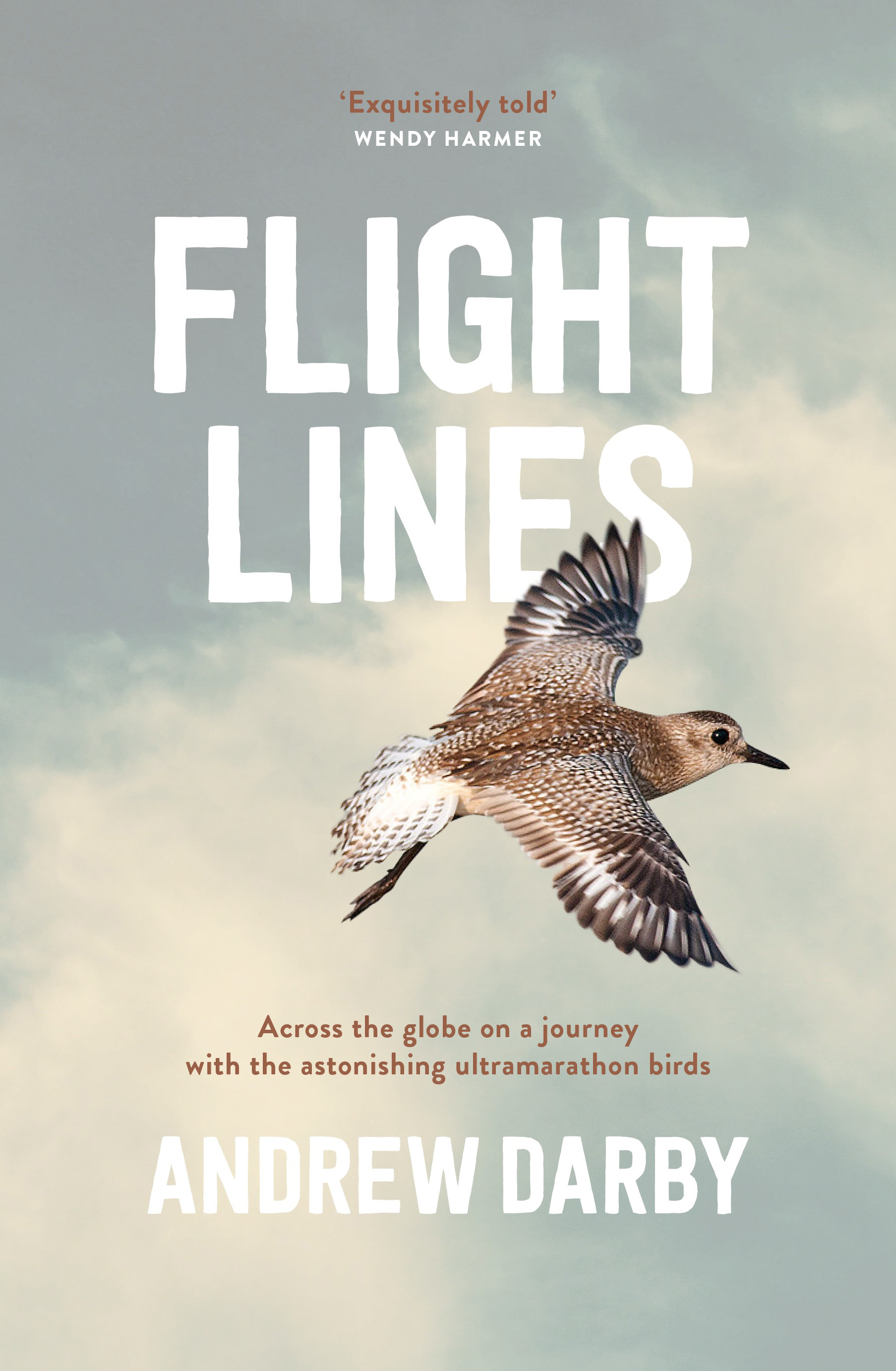
Darby, a former Hobart correspondent for The Sydney Morning Herald and The Age, focuses on the Grey Plover in this book. They’re a relatively innocuous, medium-sized mudflat and shore-dweller with fine grey plumage that melds perfectly with the overcast landscapes they inhabit. Unless you’re an avid twitcher, you probably wouldn’t have ever cared to notice one, which is exactly why Darby chooses the Grey Plover as his subject: ‘In life there are many surprises to be found among the overlooked,’ he writes.
Grey Plovers are extraordinary voyagers, travelling 7000 kilometres between Australia, China and the Arctic each year along the East Asian-Australiasian Flyway, one of the great ‘bird highways’ arching across the globe. It’s mostly female Grey Plovers that travel as far south as Tasmania and South Australia – the males, for reasons unclear, are less ambitious in their odysseys from Arctic breeding grounds.
Darby touches on the history of bird leg banding (pioneered by an eccentric Danishman who took to glitzing his eyelids with yellow eyeshadow because he believed it helped him see better) and how new technology helps us track migratory shorebirds’ mammoth and mysterious journeys. He also acknowledges the uncomfortable similarities between those who hunt birds for data and those who hunt for their flesh. Indeed, bird conservation involves far more gunpowder than I ever expected; one of the methods for catching skittish shorebirds for banding and satellite tagging involves using cannons to fire a huge, gossamer net over flocks resting on the beach.
One of the best parts of Flight Lines is meeting the people who have dedicated their lives to the Grey Plover. They are, in general, not scientists. There’s the retired bookkeeper who has perfected the art of the net-cannon blast, the bizarre ring of British expat metallurgists who all became volunteer bird-trackers, the nimble woman who comes to Australia from Taiwan to help catch birds for banding because she loves that the Plovers are ‘tiny, and so strong’. These stories of citizen science are heartening at a time when it’s clear we need all hands on deck to help save pockets of critical ecosystems, collect data and preserve biodiversity.
As Darby takes us from Australia to the Yellow Sea to the Arctic, he reveals a terrifying diagnosis. And so the little Grey Plover, with its pearly mottled feathers and dark, intelligent eyes, becomes for Darby and the reader a soaring symbol of hope, science and survival.
Reviewed by Angus Dalton



0 Comments