




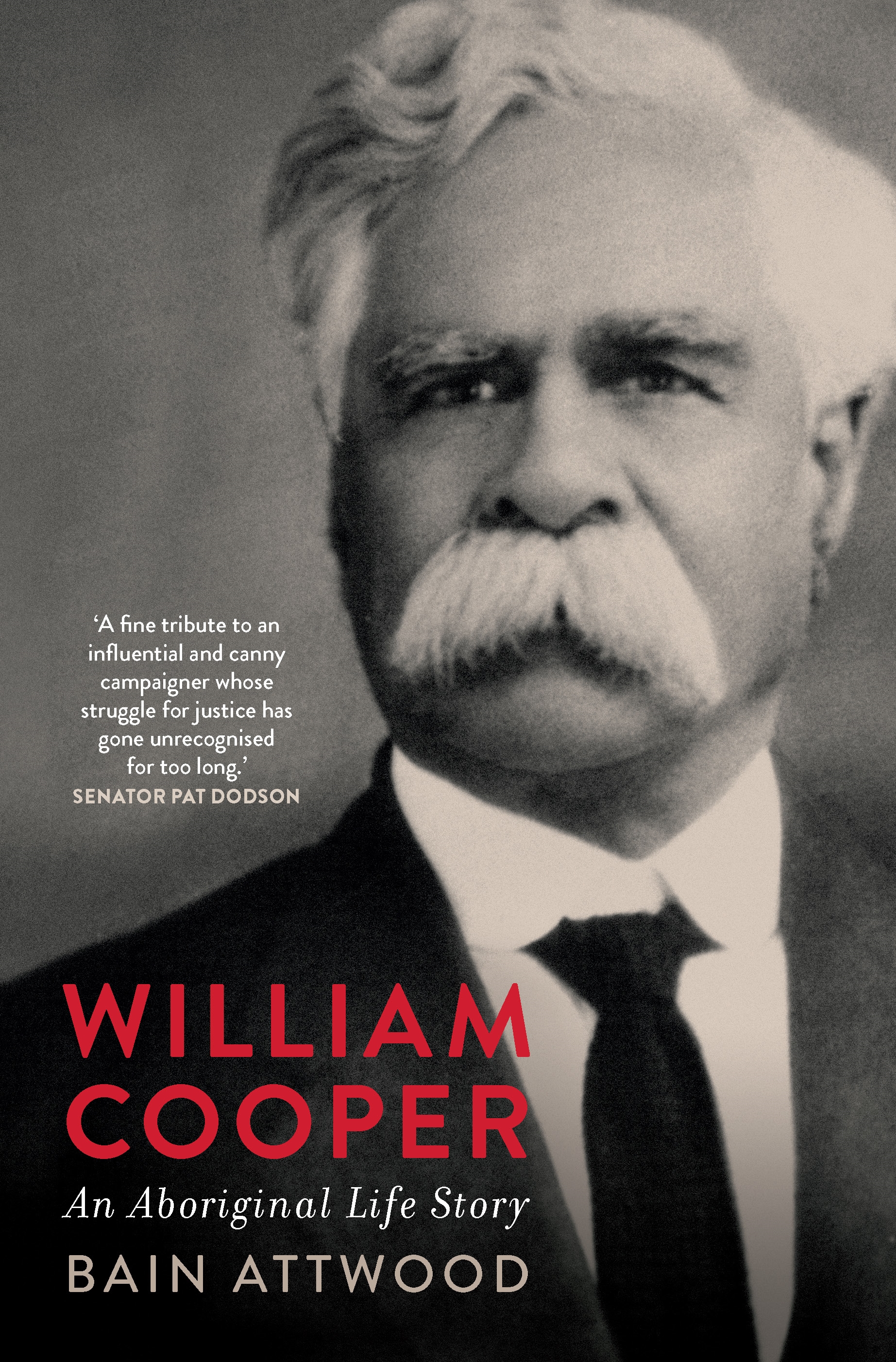
William Cooper became a leading advocate for Aboriginal rights in the 1930s. Through his activism, notably his petition for an Aboriginal representative in Federal Parliament and his organisation of a Day of Mourning on the 150th anniversary of white settlement, he managed to raise awareness of the conditions of the Aboriginal peoples of Australia during the ‘Protectiont’ era.
In William Cooper Bain Attwood gives us a thoroughly researched account of a man who achieved much against incredible odds.
Cooper was born in about 1860 at Lake Mira near the confluence of the Murray and Goulburn Rivers to a Yorta Yorta mother and a local white settler. He had seven siblings and was raised by his mother and her family. At the age of seven he was sent to the Melbourne home of a local businessman for about three years and then returned to his own country where he learnt the skills necessary to make a living as an agricultural worker.
This bald account conceals a wealth of fascinating detail. For a start, he was born into a functioning Indigenous society – one which had been decimated by introduced disease and frontier violence, but which was still functioning as a self-sustaining community a generation after first settlement while adapting to the occupation of their land. Throughout his life, Cooper, like most of his Indigenous peers, was able to make a living as an agricultural worker and fisherman.
In the 1870s and 1880s the Indigenous population were increasingly confined to Missions where they supported themselves by farming and fishing supplemented by traditional foods. Far from wishing to be dependent they actively sought to be given title to what they saw as their own land. Cooper was active in these petitions for land and by the mid-1890s some 20 Aboriginal men had been granted leases at Cumeroogunga on the Murray.
By 1908 there were 60 buildings in the village and some 1400 acres had been cleared. Cooper lived at Cumeroogunga but also worked as a shearer and was a union representative. He married a Muthi Muthi woman from Balranald and had seven children.
None of this fitted the then prevailing narrative that the Aboriginal race was congenitally backward and in fact doomed to extinction, let alone the principle of a White Australia.
Ultimately the NSW Protection Board took possession of the leased blocks and sought to utilise the residents as unpaid labour. Cooper was evidently politicised by this experience. He left the mission with his family and worked as a fisherman and labourer before moving to Melbourne in 1933 where he began his career as a political activist.
Cooper did far more than survive. His political work in the 1930s was important but the story of how he got there affords a fascinating insight into the complexity of Indigenous experience in Australian history.
Reviewed by Grant Hansen
ABOUT THE AUTHOR
 Bain Attwood is Professor of History at Monash University and has held fellowships at the University of Cambridge and Harvard University. In 2010 his book Possession: Batman’s Treaty and the Matter of History won the Ernest Scott Prize for the most distinguished contribution to the history of Australia or New Zealand or colonial history.
He has written many books, including the acclaimed biography William Cooper: An Aboriginal Life Story, about the inspirational Aboriginal leader William Cooper, and co-edited Telling Stories: Indigenous History and Memory in Australia and New Zealand and Protection and Empire: A Global History.
Photo credit: James Braund.



0 Comments