



As I’ve recently experienced, conversations about our intriguingly divided human brain – with its two halves – are tricky. Such notions of the neuroscience of our right hemisphere are too often dismissed and ‘debunked’ in logical, over-simplistic conceptions.
The problem possibly lies with the essentially subjective nature, or ‘felt sense’ and individual meaning associated with our ‘right half’. A wonderfully immediate illustration is how we have two entirely different ways of using language: prose and poetry. (‘Winds varying from 25-40 kilometres per hour’ in contrast to ‘The moon was a ghostly galleon tossed upon the cloudy seas’.)
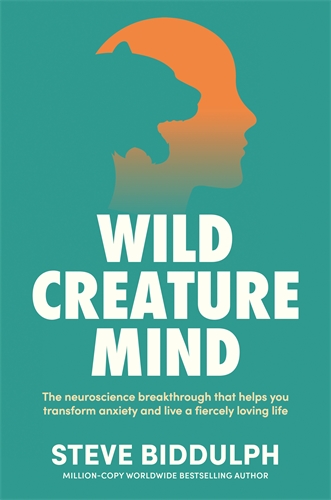
The ideas and practical exercises explored in Wild Creature Mind sit somewhere between neuroscience, therapy, and self-help. After introducing the vagus nerve, a fundamental part of our parasympathetic nervous system, the book explores the central idea that our body’s a thinking creature with an opinion, and we can talk to it. This ‘wild creature mind’ is the deeper part of ourselves. Having a conversation with it is the key to good mental health.
This book is easy to read, with the author speaking directly to the reader. The epigraph, an excerpt from a poem by Mary Oliver, encapsulates the essence:
You only have to let the soft animal of your body love what it loves.
If you pay close attention, you might have a ‘felt sense’ right now, as you’re reading this review – ‘That feels right’, or ‘That feels wrong’. Pay attention. Something here is important.
Reviewed by Mark Parry
ABOUT THE AUTHOR
 Steve was born in the UK, and attended John E Batty primary school in Redcar, Yorkshire. He emigrated with his parents to Australia in 1963. He graduated from Melbourne University with a science degree in 1974. In 1975 he completed an honours degree in psychology at the University of Tasmania.
Steve was a participant in the Village Scheme exchange program in Papua-New Guinea, learning about village and family life in Silanga, West New Britain. He supported himself through university by working in many agricultural jobs, and for a year operating a remedial reading unit in a Melbourne high school.
His first job as a psychologist was as a Guidance Officer with the Education Department of Tasmania in 1976. In 1977 he headed a study of the effects of unemployment on young people, for the Department of Employment, which formed the basis of the Community Youth Support Scheme; olled out through Australia to counter the effects of 20% unemployment among young people at the time. He also designed the Leavin’ School simulation game for helping young people and adults understand and navigate the difficult job market. The game won an Advance Australia Award, and was a winner on the ABC Inventors program. His first book “Teaching About Youth Unemployment” was published by Longmans in 1978.
Steve and his partner Shaaron founded Youthline, a phone counselling service run by young people, for young people. In 1978 Steve was recruited for a position at the Wellington Street Clinic, by Dr. Murdoch McKenzie, a paediatrician who was pioneering the use of family therapy for childhood problems in Launceston, Northern Tasmania. Steve worked at the clinic for five years, seeing hundreds of families with mild to severe difficulties. In 1980 he won a Churchill Fellowship to study group and family therapy, and the non-drug treatment of young people with schizophrenia, in the United States. Steve and Shaaron initiated ‘InterACT’, (Inter-Agency Counsellor Training), bringing interstate experts to teach Tasmanian counsellors. They also pioneered Preventive Behaviours training in that state.
In 1985 Steve and Shaaron founded the Collinsvale Centre, training public servants, police, health professionals and counsellors and therapists. The centre trained several thousand people until 1995. During this time they co-wrote “The Making of Love”, a book about marriage, and “Manhood”, which was widely acclaimed for creating a change in how men saw themselves, and especially for prompting many men to reconcile with estranged fathers.
Steve and his family moved to live in Bellingen, northern NSW in 1996. He also began speaking around Australia on Raising Boys. In 1997 he wrote the Raising Boys book and began to speak worldwide, consulting to many of the world’s leading schools about boys education, and their need for warm, clear teaching focussed on their unique development timetable, and increasingly speaking directly to parents. Steve continued doing this work for over a decade, reaching a total of 130,000 people. Raising Boys became a bestseller in the UK, Brazil, Japan and Germany, and was published in 32 languages.
In 2001, deeply concerned at his country’s treatment of refugee families, Steve lead and funded a five year human rights project- the SIEVX Memorial in Canberra (www.sievxmemorial.com). The SIEVX was a refugee vessel that sank under suspicious circumstances with the death of 353 people. Student artists from 300 schools and communities built the 400 metre long memorial which today attracts thousands of visitors each year on the Canberra lakeshore.



0 Comments