



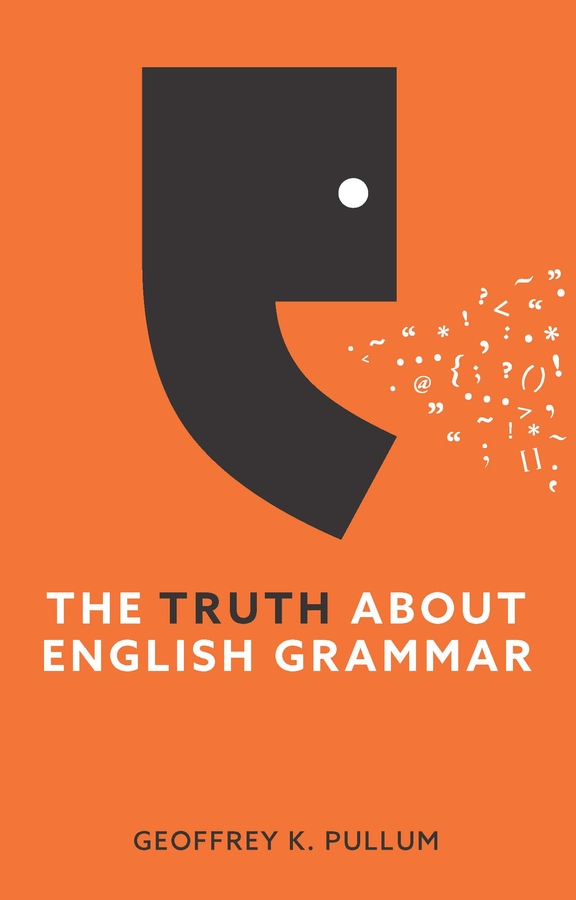
Few writers could achieve such a lively and authoritative ‘true confessions’ of the English language as linguist and humorist Geoffrey Pullum has done in The Truth About English Grammar. It is written not just for word nerds, or (heaven forbid) word snobs, but for all those who have grieved over the inadequacies of their grammatical education, and these days that’s just about all of us.
It is not always an easy read – skimmers don’t bother – so be prepared to re-read on occasion and keep a marker in the Glossary.
From the wide-ranging introductory chapter which defines grammar as the system governing the way in which sentences are put together, Pullum reassures readers that they already instinctively know grammar because they have been using it ever since they learnt to speak. Yet, an understanding of grammar is fundamental to stylistic questions. This book is practical while carrying the reassurance that, since language is ever-changing, your ‘error’ may become accepted practice in the future. The ‘rules’ from the past are sometimes just one purist’s obsession with keeping language under control, going contrarily against what was widespread practice at the time and succeeding in imposing an unwarranted restraint on the usage of later generations.
I appreciated Pullum’s lack of moral outrage – that letters-to-the-editor kind of revulsion over a wrong pronoun. Rather he sees bad writing as a failure of courtesy. Writers should be caring of their readers, and consider carefully what they are attempting to communicate. However (trigger warning) from now on I intend to, happily, not guiltily, split my infinitives whenever I feel like it. Not bad writing, just my style.
Reviewed by Judith Crabb

ABOUT THE AUTHOR
Geoffrey K Pullum is a theoretical linguist with broad interests in the study of language, including the mathematical and philosophical underpinnings of formal linguistics. He also works on the description of the grammar of English; his joint book with Rodney D Huddleston, The Cambridge Grammar of the English Language, won the 2004 Leonard Bloomfield Book Award from the Linguistic Society of America.

0 Comments