


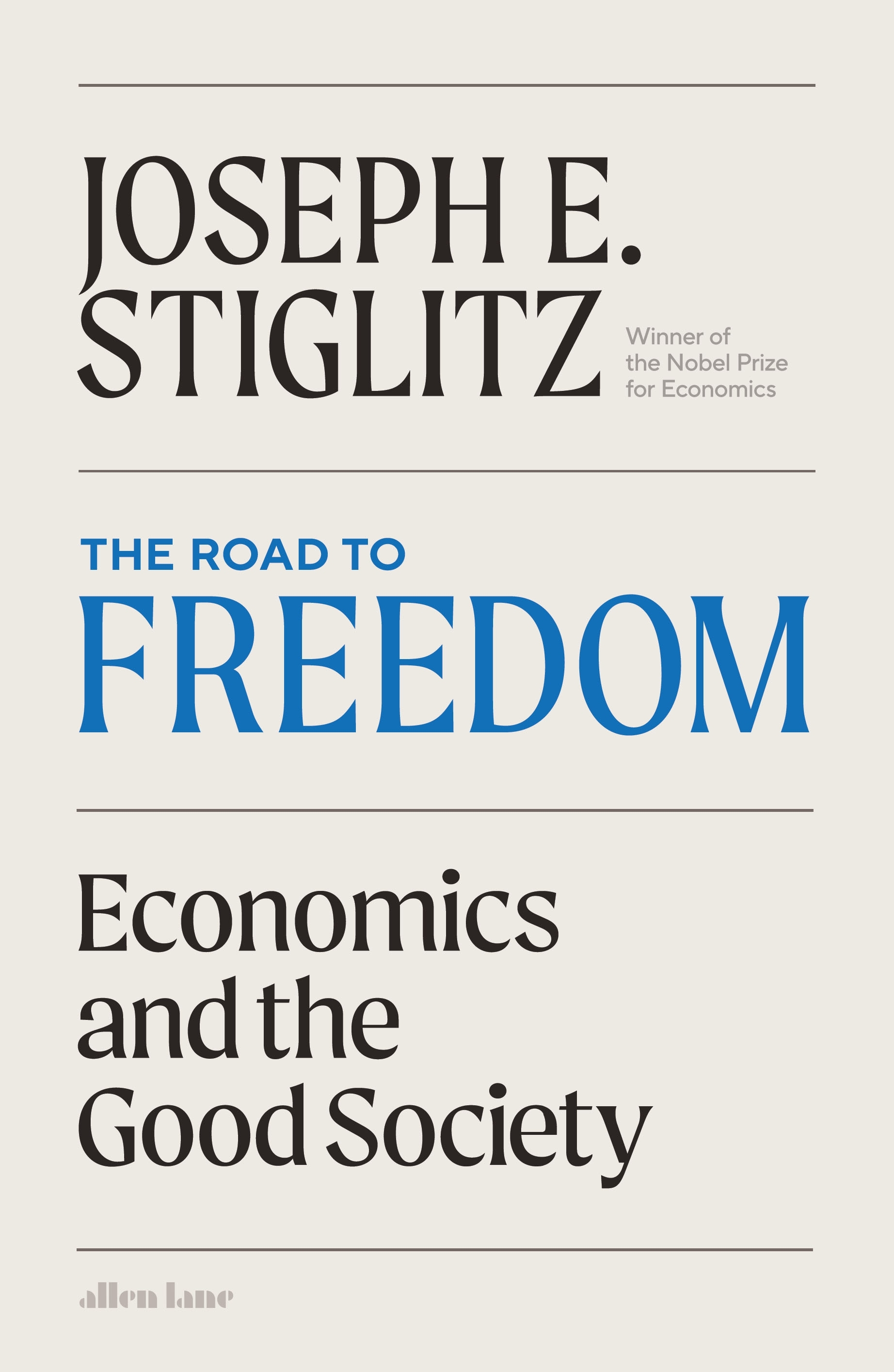
As the former chief economist of the World Bank and Clinton’s chief economic advisor, Stiglitz knows what he’s talking about. The Road to Freedom is an impassioned cry to remake the economy to improve the lives of many instead of just a few, highlighting how it corrupts democracy and causes the catastrophic economic inequality we see today.
His contention is that while we all strive for freedom, it’s an inescapable fact that freedom for one often means constraint for another, and that an equitable society can only work when we accept restrictions on certain freedoms (like the freedom to run a red light or kill someone who sleights you).
As you might expect from a career bureaucrat, the language is far less impassioned than the sentiment, the tone officious, even when it’s talking about very human tragedies of poverty and unfairness that underpin the capitalist system. It’s a good thing overall because, as they’re supported by facts, research and expertise, Stiglitz’s arguments have authority and credibility.
It’s divided into topics like the economy, democracy and tolerance, but by the nature of his views, Stiglitz repeats himself often. You get the feeling the book could have been about a third shorter if it’d been structured differently.
But his assertion that neo-liberalism has failed us and how we might correct its influence are valid and provide hope. The only thing that it leaves you wondering, is why (like Al Gore and An Inconvenient Truth) so many public officials shoot their barbs at the system after they’re out of it and it’s too late for them to effect change.
Reviewed by Drew Turney

ABOUT THE AUTHOR
Professor Joseph E Stiglitz is an economist and a professor at Columbia University Business School, as well as co-chair of the High-Level Expert Group on the Measurement of Economic Performance and Social Progress at the OECD, and the Chief Economist of the Roosevelt Institute. Professor Stiglitz was awarded the Nobel Memorial Prize in Economic Sciences in 2001, the John Bates Clark Medal in 1979 and the Sydney Peace Prize in 2018. Known for his pioneering work on asymmetric information, Professor Stiglitz’s research focuses on income and wealth distribution, climate change, corporate governance, public policy, public finance, macroeconomics and globalization. He is a former senior vice president and chief economist of the World Bank and a former chair of the U.S. Council of Economic Advisers. He is also the author of numerous bestselling books.



0 Comments