



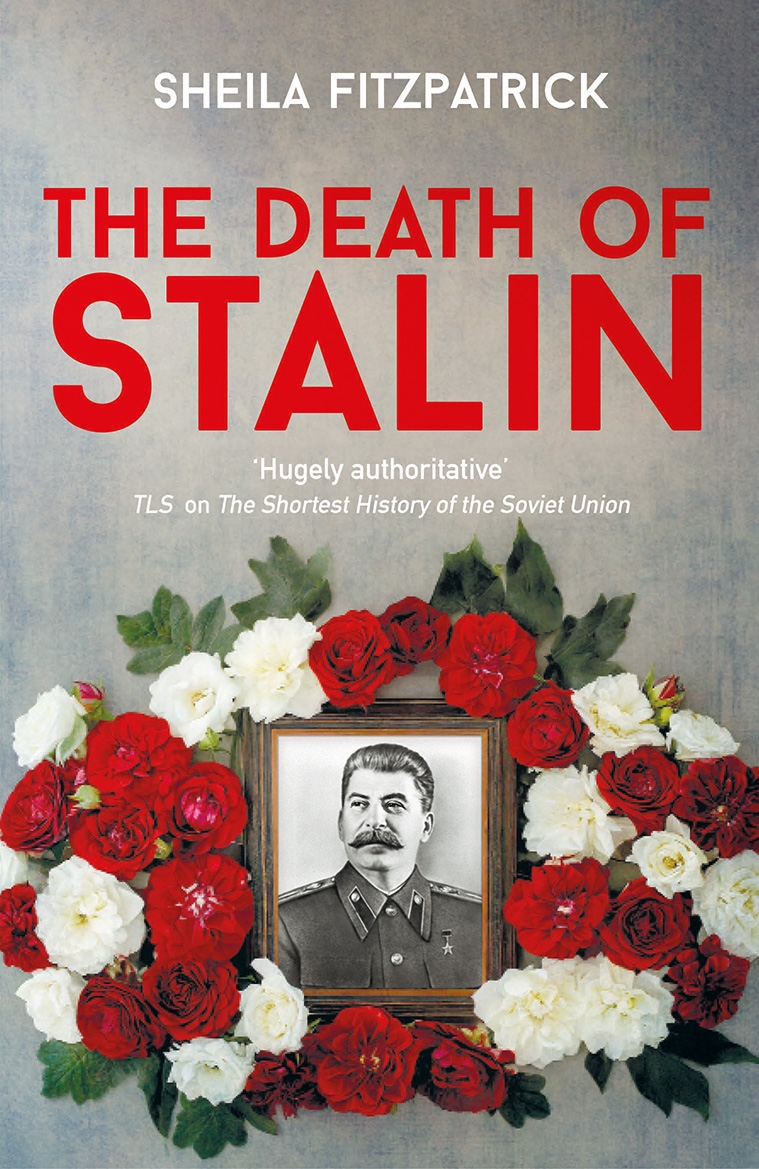
Australia’s own Sheila Fitzpatrick is a leading historian of the Soviet Union and a genuine expert on Stalin. She brings a refreshingly post-Cold War perspective to the subject and makes more sense than the ideologically conditioned Totalitarian analysis of a Cold War warrior like Robert Conquest (Soviets equal Nazis, just less smartly uniformed). Her On Stalin’s Team made the obvious point that no one man could run the Soviet Union and Stalin was enthusiastically assisted by many people who basically agreed with him out of conviction rather than fear.
In The Death of Stalin Fitzpatrick ponders the transition of power in an autocracy where the rule of law was only as valid as the Politburo wanted it to be. (The name of the book is a homage to the great movie of that same name.) While the film is fabulous it is not a documentary. Much as he deserved it, Beria was not dragged out of a conference room and shot in a farmyard. The process was far more structured and the transition of power to a collective leadership group was surprisingly smooth. Molotov for example who had been frozen out of the leadership some time before was able to reemerge as a key player.
Fitzpatrick also deals with Stalin’s extensive after life and his, to Western eyes baffling, popularity in Russia to this day. Putin for one looks to him as a nation builder and successful military leader. Fitzpatrick questions whether his death made much difference to the course of the Cold War but does see it as an opportunity that the West failed to take up – precisely because of the ideological blinkers that conditioned Robert Conquest’s take on the Soviet Union as Nazis in Red.
Reviewed by Grant Hansen

ABOUT THE AUTHOR
Sheila Fitzpatrick is primarily a historian of modern Russia, especially the Stalin period, but in recent years has added a transnational dimension with her research on Russian migration to Australia. She received a Mellon Foundation Distinguished Achievement Award in 2002 and the American Historical Association’s Award for Scholarly Distinction in 2012. She is past President of the Association for Slavic, East European and Eurasian Studies (formerly AAASS) and a member of the Australian Academy of the Humanities and the American Academy of Arts and Sciences.
Having worked for most of her career in the United States, she moved back to Australia in 2012.



0 Comments