




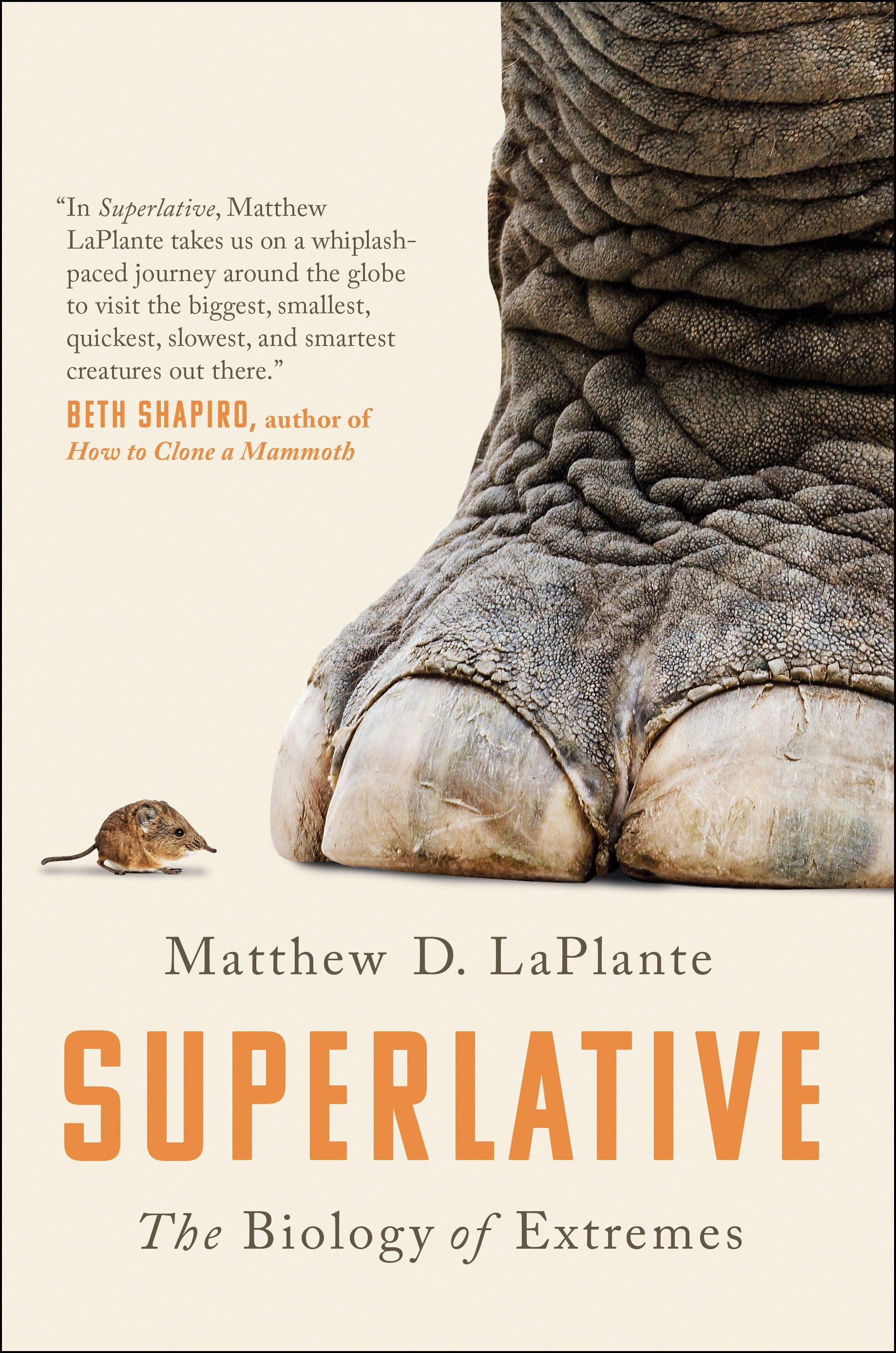
This book is full of extremes. The biggest, longest, oldest, fastest slowest, most painful, strongest, smartest.
Superlative starts a sad tale of a war against poachers in Mago National Park, southwest Ethiopia. The author is tramping through the park with a guide in search of elephants. But the elephants are hiding as they are terrified. The guide shows him a piece of paper where he had recorded the number of elephants in the park in 1997. There were approximately 575. Tears well in the guide’s eyes as he says they now estimate only 15 remain.
About three-quarters of our human and elephant genomes overlap. Pediatric oncologist Josh Schiffman, a survivor of childhood cancer, was fascinated by the fact that the size of an animal doesn’t correlate to an increase risk of cancer. Cancer cells develop in part because cells divide. As they divide they make copies of their DNA and sometimes things go awry. The more cells divide, the more chance there is of something going wrong and that being duplicated, again and again. So for an elephant, whose has masses of cells compared to humans, you would think they should suffer from cancer much more than us, right? Not so. In fact they hardly get cancer at all. Schiffman discovered that they have more of a particular protein than we do. Schiffman now speaks openly about his intention to rid the world of cancer using a synthetic version of that protein modelled on the DNA of elephants. The results he is having are astounding.
I love frogs. I kept them in my pockets as a child and took them to bed. My mother would look at me suspiciously and I would have to hand them over to her before lights out. So I was fascinated to read about the world’s smallest frog. P. amauensis is less than 8 mm from nose to tail. About the size of a corn kernal. They were discovered only in 2009 in Papua New Guinea.
What has no eyes, mouth or flippers, but has a nine-foot silica spicule skeletal leg? It is one of the oldest animals in the world, Monorhaphis, a glass sponge. It is a hexactinellid. Some researchers have speculated that they can live for upwards of 20 000 years.
LaPlante had travelled a great distance to arrive in the jungles of Ecuador. Exhausted, he crawled into his tent and he collapsed into asleep. Suddenly right above him he heard an ear-splitting awe-inpiring howl. So who’s one of the loudest creatures of them all? It is the howler monkey.
Just being the biggest howler on the block did not necessarily mean you can make the loudest noise. Different howlers have different-sized hyoid bones, which work like a megaphone to amplify their screech. The Venezuelan red howler takes the award for the biggest hyoid bone which means it has an exceptionally low, loud resonant roar as it calls to potential mates or sends a pretty scary message to potential competitors.
But LaPlante says that the loudest monkeys were compensating for something. They had smaller testicles. The quietest monkeys were smug as they had the biggest testicles. It’s presumed the smaller testes produce less sperm so the monkeys had to work harder to pass on their genes, hence they got louder. Interesting.
LaPlante is a really great writer. He has that knack of making science so interesting and readable. He not only tells us about the longest and fastest, smallest and all those extremes, but he informs us along the way about how all these animals are actually helping humans too, like the elephants. Humans and all living things are connected.
It is a book of fascinating facts and stories that celebrate the incredible diversity of living things that have evolved on this wondrous planet we all live upon. Let’s hope we can finally learn to share it.
Reviewed by Rowena Morcom



0 Comments