



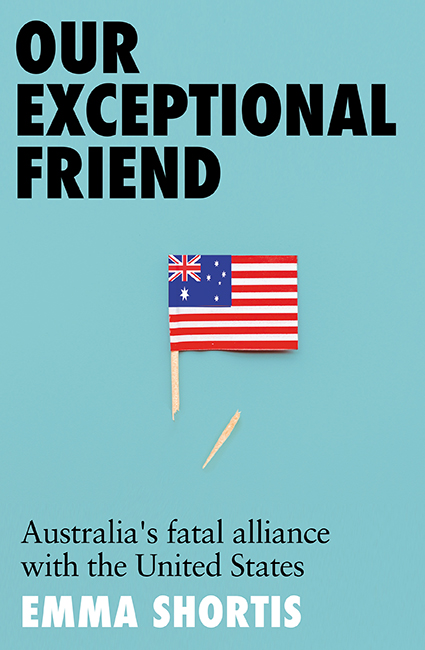
In Our Exceptional Friend Emma Shortis mounts a spirited attack on the wisdom of our alliance with the United States. Like Michael Pembroke in Play by the Rules or David Brophy in China Panic Shortis draws attention to the vast gap between what the US says it believes in and what it actually does. She then argues that ‘ANZUS locks Australian governments into binary choices predicated on the idea of perpetual threat … these are false choices …’
Shortis argues her case by attacking the idea that Australia has little choice but to rely on the US and by arguing that our interests are not identical. She savages the idea that China is an existential threat to Australia and then suggests that, even if it was our policy of alignment with the US, it won’t make us safer.
Compared to Brophy however, her analysis of China is simplistic and minimises the real dilemmas an assertive China raises – even if they are simply seeking to reassert their historical pre-eminence in East Asia. Shortis makes no real attempt, for example, to grapple with what our attitude should be to the annexation of Taiwan, preferring to make the point that China’s ambitions are essentially local. All very true but it doesn’t address whether a democracy such as Australia should acquiesce in the hostile takeover of another country.
She is on firmer ground when she questions the fundamental reliability of the US as a long-term strategic partner and its very patchy track record in foreign adventures in Vietnam, Afghanistan and Iraq. But here, as elsewhere, she overplays her hand. Even the Korean War – a UN approved intervention to defeat an unprovoked North Korean invasion of South Korea was ‘All for everything to go back to the way it was before’. Well, no. There are tens of millions of South Koreans who are very happy they are not living in a worker’s paradise ruled by the third scion of the Kim Dynasty.
There is no doubt that the US richly deserves much of the well-informed criticism it attracts. Shortis does a thorough hatchet job without even getting on to the horrors of US domestic politics. What she doesn’t do is sketch out a concrete alternative.
I can’t imagine that Emma Shortis will be pleased by the recent decision to acquire nuclear submarines from our exceptional friend nor by the clear signal this sends that we are doubling down with Uncle Sam for the long term. Even those of us who would be very cautious about severing ties with the US can still sympathise when Shortis writes, ‘We are allowed to demand better, even if we don’t know exactly what it looks like.’
Reviewed by Grant Hansen

0 Comments