



Salman Rushdie was attacked on 12 August 2022 by a young man with a knife and an ideological fixation that supposedly wasn’t related to the book that prompted the Ayatollah’s fatwa. Rushdie was wounded and almost killed, and spent months in recovery.
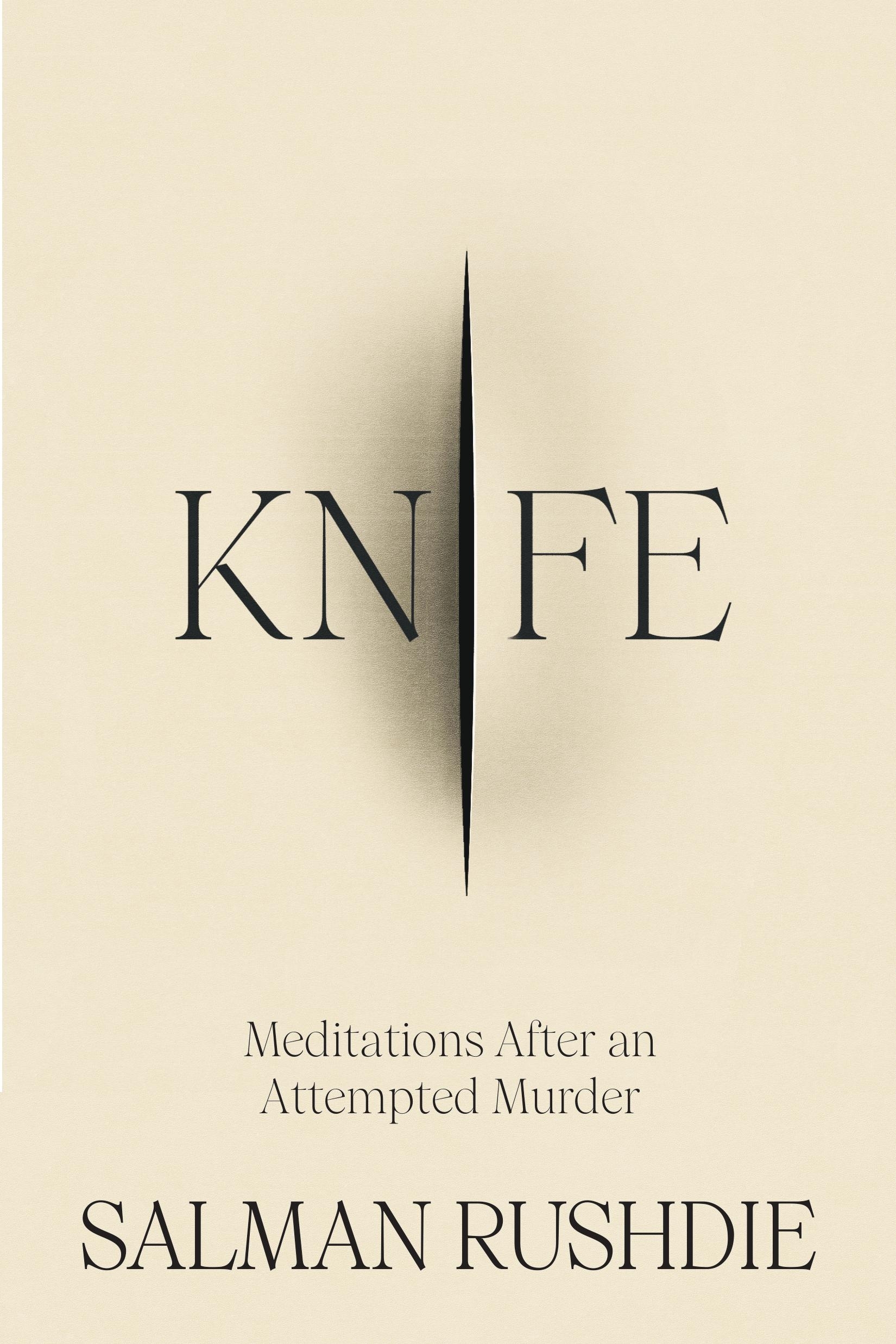
The time of the attack is clustered with numbers. Seventy-five: Rushdie’s age; 33: years since the fatwa was ordered; 24: the age of the attacker; 15: the number of knife wounds Rushdie received; 27: the seconds it took to inflict them. Rushdie didn’t want to write this book – he has a healthy suspicion of writing-as-therapy memoirs – but found that his writing life couldn’t continue until he’d put his experience onto paper. Kudos goes to the art department of the publisher as the cover design is simple yet chillingly evocative.
The events surrounding the attack at the Chautauqua amphitheatre and his subsequent hospital experiences are covered in detail. He refuses to give his attacker his name. Within the book, he’s reduced to ‘the A.’. Rushdie devotes a chapter to the A., imagining a conversation with him, but it’s clunky. The later monologue addressing him is far better.
What Rushdie noticed during the attack surprised him. He found that the essence of himself was distinct from his corporeal body: ‘My body was dying and it was taking me with it.’ It’s almost as if he had a soul, and the lifelong atheist couldn’t adequately explain it. He escaped death, but the optic nerve in his right eye was destroyed.
The kindness of the literary community uplifted him. The greatest impact on his recovery, however, came from his wife, Rachel Eliza Griffiths, and the book is, in some ways, a love letter to her.
Reviewed by Bob Moore
ABOUT THE AUTHOR
 Salman Rushdie’s Midnight’s Children was awarded the Booker Prize in 1981. In addition, Midnight’s Children was named the Best of the Booker – the best winner in the award’s 40-year history – by a public vote. He has adapted the book for the stage which was performed in London and New York by the Royal Shakespeare Company. The film was directed by Deepa Mehta and released in 2012.
The Ground Beneath Her Feet, in which the Orpheus myth winds through a story set in the world of rock music, was turned into a song by U2 with lyrics by Salman Rushdie.
A Fellow of the British Royal Society of Literature, Rushdie is the recipient of an impressive list of honours. These include the Whitbread Prize for Best Novel (twice), the Writers’ Guild Award, the James Tait Black Prize, the European Union’s Aristeion Prize for Literature, Author of the Year Prizes in both Britain and Germany, the French Prix du Meilleur Livre Étranger, the Budapest Grand Prize for Literature, the Premio Grinzane Cavour in Italy, the Crossword Book Award in India, the Austrian State Prize for European Literature, the London International Writers’ Award, the James Joyce award of University College Dublin, the St Louis Literary Prize, the Carl Sandburg Prize of the Chicago Public Library, and a U.S. National Arts Award.



0 Comments