




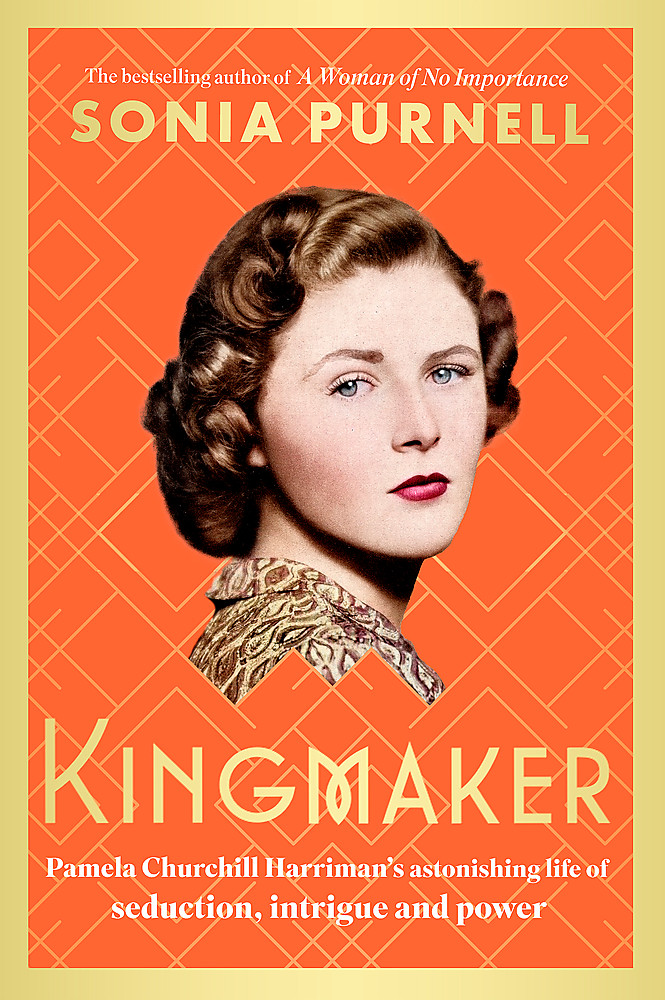
Pamela Churchill Harriman, the United States Ambassador to France, died in Paris on 5 February 1997 at the age of 76. President of France, Jacques Chirac, posthumously awarded her the Grand Croix of the Légion d’Honneur in appreciation of the work she did to stabilise the French-American relationship after many years of distrust. President Clinton sent Air Force One to return her body to the United States.
The two presidents held her in high esteem. Kingmaker, Sonia Purnell’s well-researched biography of Pamela, quotes many opinions that say otherwise. But as Celia Sandys, Winston Churchill’s granddaughter, reminded Pamela in a letter: ‘You can’t make that much of a splash in the world without making enemies.’
Pamela was born in 1920. Her father, Edward Digby, was the eldest son of the 10th Baron Digby; her mother, Constance, was a daughter of the 2nd Baron Aberdare. Soon after her birth, she and her parents moved to Melbourne when her father was appointed military secretary to the Governor-General of Australia.
Constance considered her daughter ‘wilful’ and hoped she would marry within the aristocracy. There was always a warm welcome whenever Pamela tired of her hectic life in London, Paris or Washington DC. There were servants galore at Mintern House, the ancestral home in Dorset. Pamela wanted fewer servants and a larger dress allowance.
Eddie, Pamela’s brother, was sent – at the age of eight – to boarding school in preparation for Eton. Pamela was envious of Eddie’s male privilege. She was educated at home by a series of governesses and later sent to Munich to learn German and Paris to learn French. Her father was concerned that over-educated girls would deter suitors.
Portraits of ancestors were everywhere in Mintern House. One that intrigued Pamela was of Jane Elizabeth Digby (1807-1881) that was on a wall in a dark passage rarely used by family
and visitors. The painting was hidden away, she learned, as Jane was notorious. What she eventually found out, influenced her attitude as to how she would lead her own life.
Jane Elizabeth had four husbands and many lovers: Lord Ellenborough, Governor-General of India; King Ludwig I of Bavaria; King Otto of Greece; Prince Felix zu Schwartzenberg and the Greek General Christodoulos Hatzipetros to name a few. She had six children and died in Damascus, then part of the Ottoman Empire, as the wife
of Arab Sheikh Medjuel el Mezrab, who was 20 years her junior.
In 1938, the upper-class marriage market known as ‘the season’ was still popular. Pamela and a friend, Popsy Winn, were rehearsing their curtseys for when their time came to be presented to the King and Queen at Buckingham Palace. Popsy introduced Pamela to her mother, Olive, Lady Baillie, an Anglo-American heiress, landowner and hostess.
This introduction, according to the author of this biography, was to ‘change Pamela’s life’. Lady Baillie encouraged Pamela’s fascination with wealth, power and powerful men. More importantly, Olive Baillie stressed, wealth and power could and should be used for good.
Kingmaker is revelatory, entertaining and fascinating. It is divided into three major sections: War, Peace and Power. Readers interested in the sensational gossip need only read the first two sections and skim over the third. If you want to know why Pamela is known as a kingmaker, don’t miss the final section: Power.
Reviewed by Clive Hodges
ABOUT THE AUTHOR
 Sonia Purnell is a bestselling and prize-winning author celebrated for her lively writing style and meticulous research with a growing readership across the world. Her work has been optioned by several leading film-makers, won fans from all walks of life from presidents to physicians and been translated into more than twenty languages.
Readers write to her regularly on how they have drawn inspiration from her books, which have sold more than a million copies


0 Comments