



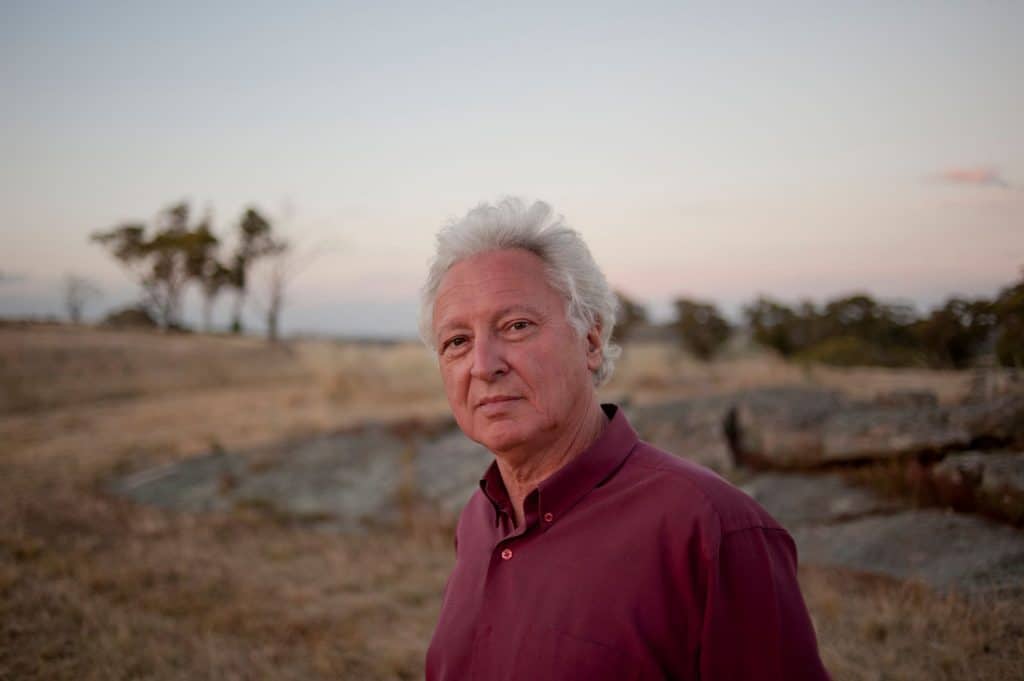
Raymond Gaita is a philosopher best known for his memoir Romulus, My Father. Gaita was born in post-war Germany but emigrated to Australia with his parents soon after the war. Romulus, My Father tells the story of what happened next.
In Justice and Hope we are presented with a selection of his writings on literature, moral philosophy, politics and society. Gaita is that rare thing in contemporary Australia – an academic who is also a public intellectual but not a celebrity. Think Robert Manne, Inga Clendinnen or even Germaine Greer – academics with real substance who publish essays on public events.
The essays in Justice and Hope cover a broad range of issues from the last 20 or so years but always from a philosophical perspective. Thus, Donald Trump becomes the occasion for a contemplation of his attack on the ‘epistemic space that makes conversations between citizens possible’. A discussion of the corrosive effect of ‘spin’ on domestic politics segues into an account of Plato’s Gorgias. An analysis of Howard’s Intervention becomes a discussion of the history of western attitudes to indigenous peoples.
Gaita’s perspective is nuanced and well read. He writes clearly but discursively – these essays are lengthy and sometimes dense but represent a standard of discourse which is simply in a different league to the kind of opinion pieces one is used to consuming on a screen.
Reviewed by Grant Hanse
ABOUT THE AUTHOR
 I‘ve worked in philosophy departments for more than forty years and regard philosophy as my vocation rather than my profession or career. My writings and teaching have ranged over several fields, as the following pages reveal – moral, political and social philosophy, and aspects of the philosophy of law. Universities have changed greatly since I became an undergraduate in 1964; so much so that no institutions, at least in Australia or the UK, think of what they do under an historically deep concept of the university.
For that reason, my relation to academia has been complex, ambivalent, and sometimes tense. Nonetheless, I’m grateful to the universities that employed me. I’ve been fortunate that my life in them has been nourishing, exciting and often inspiring, especially during my undergraduate years at University of Melbourne, and differently, in the early years of my post at King’s College London. For most of my life they enabled me to do what I love doing. Above all I am grateful to have had the opportunity to teach, which has been a joy and a privilege.
I don’t think of myself as writer in the sense in which poets, novelists and playwrights are writers. I think of writers as people who take pleasure in the literary construction of their works and in a finely constructed sentence. A friend and poet described poetry as “the mind in love” He meant in love with language; in loving engagement as one works with it, painful though that sometimes is. I take that to be more generally true of writers.
I’m not that kind of lover, as I explain in a short video. There I also explain why, nonetheless, language matters profoundly to me because I believe that in all writing about how things in life mean to people, one must have an ear for tone, for what rings true or false, for what is sentimental and so on. In such writing style and content, and feeling and thought cannot be separated


0 Comments