




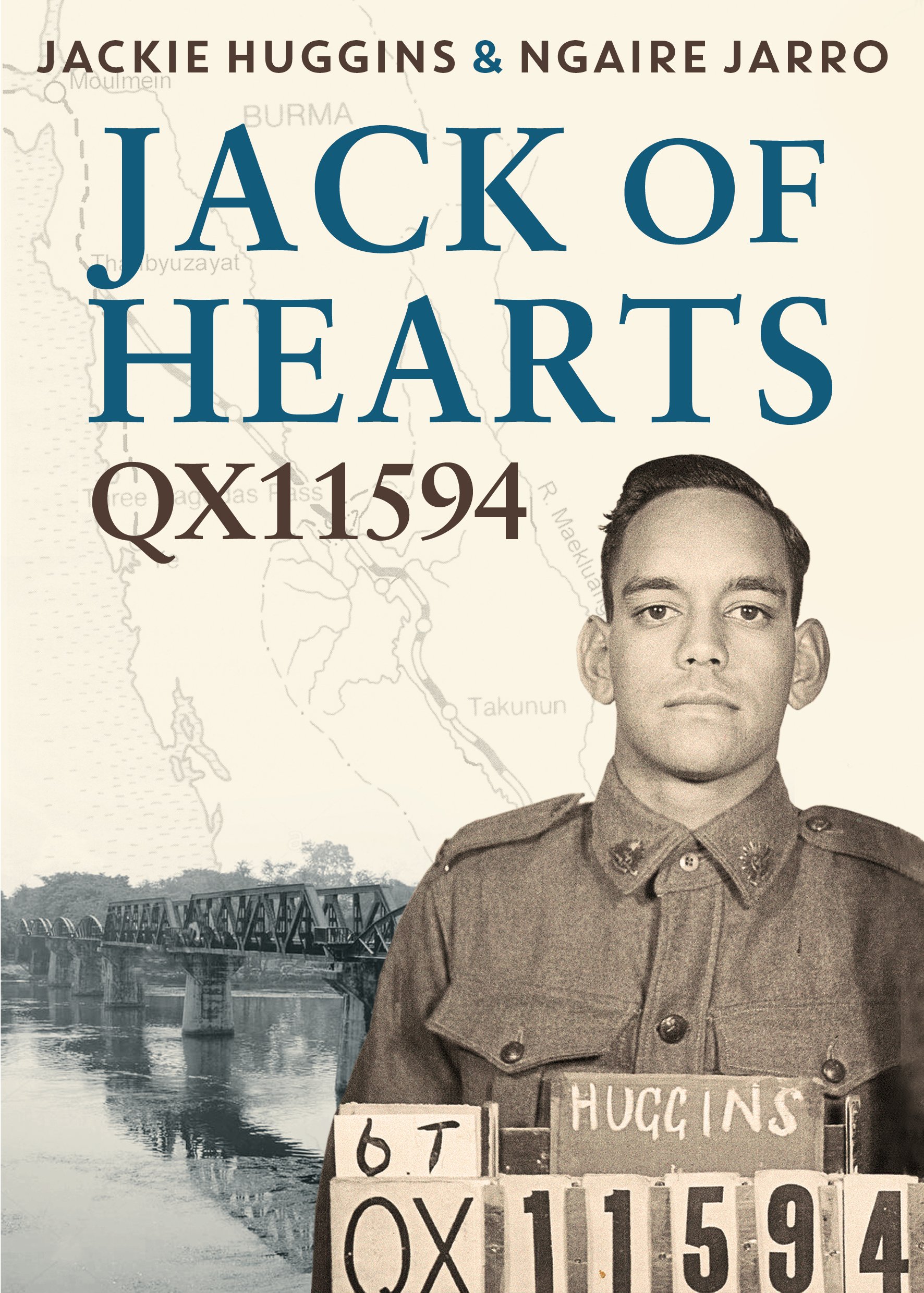
Jackie Huggins and Ngaire Jarro are sisters from the Bidjara and Birri Gubba Juru nations. One hundred years after the birth of their father, John Henry (Jack) Huggins III, and 60 years since his death, the sisters decided to research and write about a man they hardly knew.
Born in Ayr, North Queensland, Jack was not the first Huggins to serve his country. Grandfather Huggins had served in Egypt, France and Belgium in the Great War. Jack enlisted in the AIF as QX11594 in February 1941. He saw action on the Malay Peninsula and from there began one of the most horrific experiences of war – Jack was taken prisoner by the Japanese in February 1942 and was condemned to labour on the infamous Thai-Burma Death Railway.
The question remains, ‘Why did they go to war when they weren’t even citizens of their own country?’ When one considers the treatment of Indigenous people through the years of the so-called Aboriginal Protection Acts, with endemic racism and forced removal of children, Jack’s decision to enlist is remarkable. But then Jack Huggins was a remarkable man.
Jack chose to live outside Aboriginal communities after returning from the Death Camps and settled into his hometown of Ayr with his new wife, Rita, in 1950. A ‘free man’, he was a strong believer in education as the pathway to a better life. But his service to his country was not without consequences and he suffered bouts of depression and poor health until his death in 1958.
One of the most touching sections of this book is when Jackie and Ngaire made the decision to ‘walk in his footsteps’ and in 2019 they undertook a journey to Southeast Asia to do just that.
‘Spiritually [he] has always been with us … Our Aboriginality dictates this.’ Jack of Hearts reaches back in time to renew those physical and spiritual connections. Continuity of family and tradition are the messages embedded in this great story of courage and survival. Common ground, don’t you think?
Reviewed by Gregory Dobbs



0 Comments